
Independently Owned, Locally Grown, Community Loved
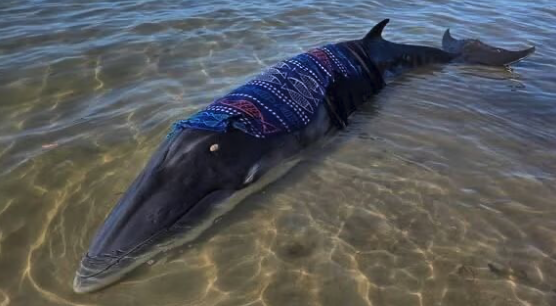
By Zach Houtenville A stranded whale made its way back to sea after hours of care at Sinclair Bay on Sunday 4th October, with local couple Larry and Sue Shieffelbien helping wildlife officers through the lengthy rescue. For Larry, the day began around 6am with a morning coffee at Sinclair Bay Resort. Looking out over the beach, he noticed what appeared to be a large branch washed up on the shore. But as the tide receded, a fin appeared, prompting him and his wife, Sue, to wander down for a closer look. Up close, they realised it was a roughly four metres long whale. “It was still blowing through his blowhole, so I kind of felt that it was still alive and healthy, just stranded,” Larry said. The couple reported the stranding to Queensland Parks and Wildlife Service and got to work while waiting for officers to arrive. For the next hour, Larry and Sue stayed beside the whale, shading it with an umbrella and keeping the towels covering it wet. “They said to put towels over the whale, which is exactly what we did until they turned up,” Larry said. The officers’ arrival marked the start of a long wait for the tide to change, with the team sheltering the whale beneath a gazebo and continuing to keep it wet throughout the day. “They seemed to know what they were doing and just nursed it the whole remaining six or seven hours until the tide was coming back in,” Larry said. Even then, the whale’s path to freedom was far from straightforward. The relief of seeing the whale swim again was short-lived, with Larry recalling how the animal turned back towards shore and became stranded again further along the bay. Officers Tim and Ben kept working to guide it beyond the sandbar, until it finally reached deeper water and swam out to sea at around 3pm. ‘It was a good feeling to see it go and to have helped save an animal, save a life,” Larry said. “Tim and Ben, the two main guys from the wildlife people, they were awesome,” Larry said. Photo captions: Photo 1- Whale Beached in Sinclair Bay. Photo credit: Sue and Larry Shieffelbein Photo 2- QPWS Officers Tim and Ben watching the animal go Photo 3- QPWS Officers attempting to slide the animal back into the sea
Read the full story
OPINION PIECE from the office of Federal Member for Dawson Andrew Willcox There is no question that immigration into Australia is out of control. The government’s numbers are too high, and standards are too low. A sustainable migration program must consider our capacity to provide housing, healthcare, infrastructure and the essential services everyone relies on, and Australians must come first. But Labor’s decision to target Working Holiday Makers Visa holders is not the answer. These people filling vital gaps in our workforce are not the cause of Australia’s housing crisis. In many cases, they are living in accommodation provided by the very businesses that employ them. The National Farmers’ Federation has made the point that Working Holiday Makers generally stay in hostels, caravan parks or purpose-built on-farm accommodation. Resorts usually have on-site staff quarters. They are not the source of Australia’s housing shortage. So why is Labor making it harder for them to come here, when these workers fill genuine jobs that regional Australia holds? Working Holiday Makers fill approximately one in seven farm jobs nationally and are particularly important during peak agricultural periods, which for Dawson, it is right now! Farmers rely on these workers to plant, pick, pack and harvest the produce that ends up on Australian supermarket shelves. Having run one of Australia’s largest tomato farms, at times Working Holiday Makers made up more than 50 per cent of my workforce. Without them, much of our crop simply would not have been picked in time and rotted in the paddock. Some may say, why not employ the Australians who don’t have a job and are on “the dole”? Can I say, this does not work. Most farmers will employ Aussies over travelling backpackers, but many either don’t want to do the work or don’t turn up after the first day. Who picks the fruit or veggies then? Farmers are already warning that visa delays are leaving them without workers. The NFF says approvals that once took days are now facing processing times of up to three months, and this time frame can be the difference between harvesting a crop or losing it. That should concern every Australian already feeling the pressure at the supermarket checkout. The same problem is playing out in tourism. Across Dawson, Working Holiday Makers are an important part of the workforce supporting tourism and hospitality, particularly in the Whitsundays. They help fill shifts, work in hotels and restaurants, support tour operators and keep businesses running through their busiest periods. They also contribute to the local economy. They spend money on food, fuel, attractions and tours, supporting the small businesses that depend on a strong visitor economy. That is why tourism and business leaders across North Queensland are raising the alarm. They understand what happens when a regional business cannot get enough staff: opening hours are reduced, and services are cut, creating a downward spiral. We do need to reduce migration to sustainable levels. We need stronger integrity measures, and we need to crack down on rorts. But responsible migration policy means understanding which parts of the system are creating pressure and which parts are helping Australia function. Working Holiday Makers are not the problem. They are part of the workforce solution for regional. Australia. People have had a gutful of watching their standard of living go backwards. Groceries, fuel, housing and everyday expenses are already putting enormous pressure on families. The last thing Australians need is another reckless policy that makes it harder to produce food, harder to run regional businesses and harder for tourism operators to find the workers they need.
Read the full storySomeone sold a house in Sydney last week for $9 million less than they bought it for four or five years ago. The sellers had bought the property in Sydney’s eastern suburbs for $29 million and sold it for $20 million in a sale forced by their bank. I imagine the sellers are a little disappointed by the government’s decisions on negative gearing and capital gains tax and feeling pretty hurt by the increased interest rates. Australia’s interest rates are on the rise and are now sitting at levels not seen since 2011. Increased cost of living is hurting people around the country and interest rates are playing into that. But the impact of interest rates is not felt evenly around the country. The far-higher property prices mean people in the major cities suffer much more than regional areas with the rates increase. That is certainly not to say people in Mackay are unaffected by the cost of living; it’s just that the impact of interest rates increase on a $400,000 mortgage is much less than the impact on a $1m mortgage. There are other Mackay-specific factors that are in play when discussing the current housing market. The big factor is the role of coal in our economy. Most of the coal extracted and exported from our region is coking coal, which is used to make steel. The price of coking coal is around $280 a tonne, which is about 50 per cent up. Good activity in the coal market translates to good news for the Mackay economy, as it is an economic engine that other cities and regions just don’t have. Good activity in Bowen Basin flows throughout the Mackay economy; Paget workshops, transport, suppliers and related businesses all benefit. But so do other, non-mining-related businesses as they benefit from the general confidence and spending that goes on. The strong mining activity also means mines need to keep their staff levels up and that means more people moving to Mackay. Of course, Mackay is much more than a coal mining town but if the coal sector is going well those other areas definitely benefit. It is a confidence boost for Mackay people looking to get into the housing market and those wanting to upgrade or downsize. It also means continuing strong demand from people wanting to rent a property and it will be interesting to see what sort of activity that creates from investors. Investors have walked away from the big-city markets because they can no longer use negative gearing on established properties that do not have a sufficient yield to be positively geared. Negative gearing has never been a big thing in Mackay because our prices are lower and rental returns continue to be strong so many investors have a positively geared property. Around the country everyone is nervous about the state of play and the probability of more interest rate rises. But strong coal prices and an economy that is performing well mean Mackay might just be presenting an opportunity for buyers and sellers that doesn’t exist in other parts. I remember when national confidence was flying high and Mackay prices were going up significantly that many buyers were saying “I wish we had bought a while ago when the market wasn’t so hot”. I’m not armed with a crystal ball so I’m not here to tell you what is going to happen but I suspect there is a very good buying window right now for those looking for an opportunity.
Read the full story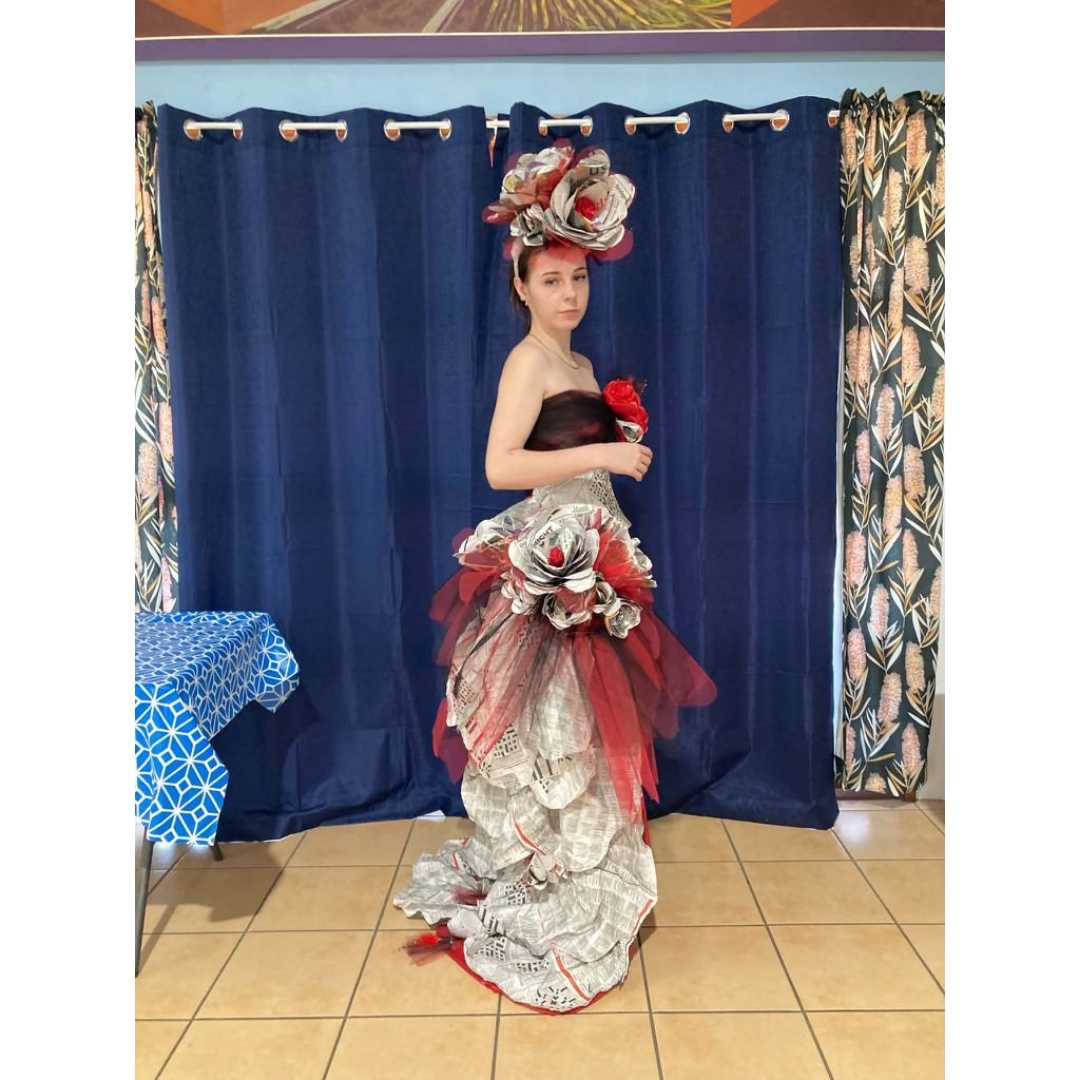
A local Mackay and Sarina based model has created a dress out of newspapers, including Mackay Life, for her upcoming pageant, representing her region and hometown on the runway as she vies for Miss Diamond International in Brisbane. Zoe Place will be competing this weekend in the three-day event, beginning this Friday 2nd October and ending on Sunday 4th October. The young model spent around a month creating her eco-fashion outfit, using old newspapers as the main material and transforming them into a bodice, skirt and flowers. Red elements were also incorporated into the design to give the dress a bold and glamorous pageant feel. Zoe said, “The entire concept was really about taking something that would normally be thrown away and turning it into something beautiful and meaningful.” Her eco-fashion creation will form part of a busy weekend in Brisbane, with the Miss Diamond International event including photo shoots, interviews, an eco-fashion show and the final pageant. Zoe has been preparing for the event by practising her strut and walking, preparing for interviews and getting comfortable in the different outfits she will wear throughout the weekend. Alongside her love of modelling, pageantry has also provided Zoe with a platform to raise awareness about causes close to her heart, including mental health, while fundraising for Beyond Blue. “Pageantry has given me more of a platform to combine my love for modelling with something that is really important to me.” “When I first started, I was more nervous about putting myself out there and worried about what others would think about me – but I’ve changed a lot through my journey in pageantry.” “Pageantry has also taught me that it’s not about how you look on stage. It’s about the person you are when you step off it.” “Every woman has their own unique journey and that journey is something we should all be really proud of.” “To me, it represents confidence, empowerment, kindness, and using your voice to make a difference.” Zoe said she was looking forward to meeting the other contestants, making new connections and creating memories. “I’m definitely looking forward to meeting all the new contestants and making new connections and creating memories that I will carry with me for a lifetime.” While Zoe hopes to eventually move to the city, her sights are set even further afield, with a dream of one day walking in New York Fashion Week. Mackay and Sarina local Zoe Place has created an eco-fashion dress from recycled newspapers, including Mackay Life, ahead of her Miss Diamond International pageant in Brisbane. Photos supplied
Read the full story

The Proserpine Entertainment Centre is planning ahead for next year and they want to hear from you! PEC, with the Whitsunday Regional Council, have released an entertainment questionnaire to find out what the community wants to see most coming to the Whitsundays in 2026.
The survey has options to choose what type of acts and activities you would like to see being brought to the PEC From music concerts to comedy nights, there’s options across the broad spectrum of talented live acts the PEC could provide and host. Theatre, dance, magic, seminars, and interactive experiences, your feedback will help shape the future line-up. And it’s not just about live shows, they want to know what movies you want to see too!
Check out the QR Code, it will take you directly to the survey page or visit the Whitsunday Regional Councils website and tell them exactly what live shows and performances you would love to see at the Proserpine Entertainment Centre. The PEC is all about creating unforgettable entertainment experiences right here in the Whitsundays. The survey closes April 30th, so have your say today!
https://yoursay.whitsundayrc.qld.gov.au/proserpine-entertainment-centre-community-feedback-questionnaire

A group of local children has shown an incredible sense of generosity and community spirit at a young age. With their hearts in the right place, they raised nearly $100 from selling old toys to donate to the Whitsunday Suicide Prevention Network. It’s a beautiful reminder of how even the smallest acts of kindness can make a meaningful difference.
Rather than spending the money on lollies for themselves, these kids chose to donate the $97.05 toward a cause that impacts their community in a powerful way. Their decision to donate the funds demonstrates maturity and compassion beyond their years.
This is just the beginning for these young changemakers with their next project already in the works - A deliciously enticing cupcake stall aimed at raising even more funds. It’s exciting to think about the positive impact they will continue to have as they grow and develop, fuelled by a mindset rooted in giving back.
Locals couldn't help but feel inspired by their initiative, with many just stopping by to drop off a fiver to their stall. It’s a bright future ahead for them who are already making a difference, the young children’s sense of community and responsibility truly shines. Thank you for fundraising for such an important cause!
Local children selling their old toys to raise money for the Whitsunday Suicide Prevention Network. Photo Sourced: Rob Murphy's Facebook Page.

The Whitsunday Regional Council want to inform the community about a recent scam involving a fraudulent QR code on a parking meter in Airlie Beach. The code directs users to enter their credit card details, which is part of a scam. If you've scanned a QR code on a parking meter recently, we strongly encourage you to check your bank statements for any unauthorised transactions.
Please be aware that Airlie Beach uses ticketless parking machines and only accept coin payments or direct card payments at their machines, and do not require the scanning of any QR codes.
To ensure a safe and easy parking experience, the Council recommend using the official EasyPark app, which allows you to manage your parking payments online securely. Simply download the free EasyPark app today via: http://app.easypark.net or through your device’s app store to avoid being caught out by scams like this.
The Council urges everyone to use official payment methods and to be vigilant about potential scams. If you believe you have fallen victim to fraudulent activity or spot another QR code on another parking meter, please report it to Council immediately to help protect the community.
The affected parking meter at the beach-side parking lot, near the Airlie Beach Lagoon.
For the close up image. Photo sourced: Whitsunday Regional Council Facebook page.
For the wide-shot. Photo sourced: Google Maps.

It has been relatively quiet this week for the team of the Whitsunday Volunteer Marine Rescue. But the WVMR team are always ready, waiting for that extra loud, special ringtone that signifies an emergency call, and someone needing their assistance. Shane, President of the WVMR, recounts an incident where even though they weren't initially activated, they were ready to respond.
Shane and his wife were enjoying the view on their patio one late afternoon when a strange incident caused Shane to reach for his binoculars. Out in the Airlie anchorage, a puff of smoke erupted from the stern of a yacht and as he zoomed in, Shane could see someone panicking as orange flames began to spread. As his wife called triple zero, Shane recalled a calming pause before all broke lose.
“While I watched in horror, in the gloom of dusk, an explosion and fire ball erupted.”
With the fire on the horizon, the world seemed to spring into action. The water police’s semirigid vessel suddenly appeared with sirens and lights blazing, powering through the water at top speed through the anchorage. Then the fire engines arrived at the Whitsunday Sailing Club, but they couldn't help being stuck on shore.
Shane grabbed his phone and called WVMR’s controller to ask if they had been activated. “No,” came the reply, but Shane was ready to act - “Ok, get a crew together urgently because we will be, there’s a boat on fire and people in the water.” He was out of the door and arrived at the VMR1 just as another fire engine arrived with portable pumps.
Skipper Ken took the WVMR team and the Firefighters out at emergency speed towards the anchored yacht. When we arrived, it was ablaze stem to stern. Luckily the Police had picked up the people from the water and all witnessed as the fibreglass blazed, they watched the mast collapse into the flames spreading rigging everywhere.
With Ken shouting guidance, Shane backed up the VMR1 as close as they dared, remaining upwind of the burning vessel. The wire rigging in the water was a major hazard because if it were to foul their props, they would be immobilised dangerously close to the fire.
The burning hull of the yacht was sinking and as the fire reached the waterline, it quietly slipped under. There was charred flotsam, but not too much pollution and Shane recounted it was an event of great exhilaration.
If you would like some excitement in your life, while doing a great community service, visit vmrwhitsundays.com.au/volunteer/
Contributed with thanks by Shane Newell, VMRW President.

The Whitsundays’ original and most awarded tour operator, Ocean Rafting, is stoked to take the podium and be recognised amongst Australia’s best tourism operators. Since 1984, the Australian tourism Awards have long been the nation’s premier recognition of excellence in the tourism industry. Ocean Rafting joined the nation’s best in the beautiful Adelaide and is beyond thrilled to be taking home a Bronze in the “Major Tour & Transport Operator” category in the 2024 Qantas Australian Tourism Awards.
Peter and Jan Claxton, the proud owners of Ocean Rafting for 28 years, along with Nathan their Sales & Marketing Captain of 13 years, were overjoyed to represent the family-owned business at the awards ceremony in Adelaide. Their heartfelt gratitude went to their passionate team, dedicated family members, and loyal guests, whose support has been pivotal to their ongoing success.
Peter shared, “A huge thank you to all our team, both past and present, who share our passion for tourism and showcasing natures wonders. We are proud to continue stepping onto the podium and winning awards like this for all those who have made Ocean Rafting what it is today”. Pete added, “Additionally, I would like to thank all our guests who have enjoyed a day out, whether that be on the water or in the air, in the last 28 years of operations” Jan shared the sentiment, “These awards are for our team, as much as they’re for us, so cheers to us, and cheers to the team”.
Three generations of family and almost three decades as one of the Whitsundays’ most loved on-water experiences, Ocean Rafting’s mission is still to treat every day as if it was the one and only day their guests will experience Ocean Rafting and the Whitsundays’; and this has attributed to the company’s long-term success and thriving growth over the years.
The team would also like to thank Australian Tourism Awards for facilitating these awards and their continued support for our industry. Additionally, we would like to raise our glasses to all the fellow operators and local businesses for their much-deserved recognition and awards.
Beyond their remarkable history of providing unforgettable on-water experiences, Ocean Rafting is equally committed to the environmental sector by participating in the Tourism Reef Protection Initiative and starting our very own initiative, “Tins 4 Fins,” to fund beach cleans and additional research, ensuring we protect this beautiful part of the world.
Ocean Rafting’s reputation speaks for itself and is recognised with a perfect score as Best of Queensland Experience under the national quality tourism framework along with a Quality Tourism accreditation. Additionally, Ocean Rafting is the recipient of a TripAdvisor Travellers Choice Award for being in top 10% of attractions worldwide every year since 2012 and a TripAdvisor Travellers’ Choice Best of the Best award winner in the Top 1% of Tourism Businesses around the world and Top 10 Experiences in Australia.
Ocean Rafting is also a coveted Ecotourism Australia Hall of Fame member for being continuously Advanced Ecotourism Australia Certified for 25 years or longer. Ocean Rafting is also a Green Travel Leader, Climate Action Business and is the only company in the Whitsundays with six Master Reef Guides, who are recognised as the world’s leading reef guides, interpreters and story tellers, in addition to a team made up of Marine Biologists and Eye On the Reef trained Eco Hosts.
Ocean Rafting offers two exciting day tour adventures, the Northern Exposure and Southern Lights, with an exhilarating ride to Whitehaven Beach, the ultimate access to Hill Inlet and special snorkelling sites, as well as the Fly Raft package, 60-minute scenic flights, a range of adventure packages, charter options and the Reef Seeker environmental educational program. The fleet of eight semi-rigid inflatable vessels allow guests to experience Ocean Rafting’s signature adrenalin-fuelled ride amongst the beauty of the Whitsundays, while a maximum of 32 passengers allows for a personalised experience in the pleasure of a small group.

Talk to anybody who has spent a bit of time diving or snorkelling the coral reef and you will hear a turtle story. Watch people encounter a turtle for the first time and you hear shouts of delight. It seems that the sea turtle is everyone’s favourite marine animal.
There are 7 species of sea turtles in the world and 6 may be encountered on the Great Barrier Reef, making it a paradise for turtle lovers. Sadly, the future of our sea turtle friends is uncertain.
From the day a sea turtle is hatched, its life is a struggle for survival. For every 1000 sea turtle eggs laid, only about one turtle reaches adulthood due to natural predators and other obstacles. Those that do make it face numerous threats from humans; habitat loss, hunting, marine debris, and pollution.
Today, most species of sea turtles are listed as endangered or critically endangered by the World Conservation Union. And now, climate change is exposing sea turtles to even greater threats.
Sea turtles are unusual as they use both marine and terrestrial habitats during their life cycles. They nest on land but spend their lives in the oceans. Unfortunately, this exposes them to multiple impacts of climate change. The beach sites of a sea turtles’ birth, where they return as adults to lay their eggs, are under threat from rising sea level and erosion of nesting sites.
Sea turtles rely on the temperature of the sand in which the eggs incubate to determine the gender of the hatchling in a nest. An increase in nesting beach temperature is impacting the sex of turtles. Typically, cooler sand produces more males and warmer sand produces more females. With increasing nest temperatures due to global warming, scientists are seeing a significant shift towards more female sea turtles. This is a serious threat to population size and genetic diversity.
Warmer ocean temperatures are also likely to negatively impact food resources. As ocean temperatures increase, healthy seagrass meadows and coral reefs are declining, reducing the sea turtle’s most important feeding grounds.
The future of the sea turtle is in doubt because of human activities on the land, the sea and now the atmosphere. It is sadly ironic that the sea turtle’s continued existence is now entirely dependent on human intervention. Protecting sea turtles and their habitat is a must, but reducing carbon emissions to reign in global warming is the most important step we can take.
Contributed with thanks to Whitsunday Conservation Council.
-1742864632.png)
The annual migration of humpback whales from the Antarctic to warm water of the Great Barrier Reef should be beginning in a couple of weeks. Humpback whales can be seen in many locations along the east coast of Australia. It’s been known for years that Hervey Bay is an important resting site in the whale migration, which has made it qualify as a Whale Heritage Site.
For many years it was never know where humpbacks gave birth, but since 2009 researchers have been putting the pieces together discovering it is right here in the Whitsundays, next to the islands!
The Whitsundays are the perfect location because it has deep troughs close to shallow reef, where whales can give birth and then move their calves to shallow water. In shallow water there is less chance of predator attack from below and the mother can support the calf near the surface so it can breathe.
In the first few week's humpback calves spend 30% of their time suckling their mother's milk and 50% of their time on the surface breathing where they have to breathe every five minutes. It is important that the mother doesn’t have to spend her energy reserves on protecting her calf, so she can spend her reserves on producing 600 litres of milk per day. The mother will not feed until she returns to her feeding ground in the Antarctic.
Calves don’t have any buoyancy control for the first few weeks, so mothers have to assist them with buoyancy until they work it out for themselves. The calves are born with no fat supply, so it is important they build up insulation for when they reach cold water down south. They also need to build up their energy to practice learning life skills.
The Great Barrier Reef Marine Park is the size of Italy or Japan, so to have such a significant area on our doorstep is really special. It is so significant that in March 2024 the Whitsundays became a WHALE HERITAGE SITE, the first ever in a UNESCO WORLD HERITAGE AREA and there is a SPECIAL WHALE PROTECTION AREA zone in the Whitsundays.
In the Whitsundays not only does the 300 metres exclusion zone apply to jet skis but to all vessels to protect the whales in the maternity and nursery area.
Whales of the Whitsundays is the project that collaborated to gain the Whale Heritage Site Whitsundays listing. To find out more about special whale events, whale sightings and information on whales in the Whitsundays, join the WHALES OF THE WHITSUNDAYS Facebook page or go to www.whalesofthewhitsundays.com.au
Contributed with thanks to Kellie Leonard - Whales of the Whitsundays

Lucky was one of the puppies found dumped at Bowen tip but don't be mistaken, this little guy’s spirit animal is 100% sloth as he’s all about naps, cuddles, and soaking up all the love he can get.
Lucky is a relaxed and sweet pup with a loving, easy-going nature that’s hard to resist. He loves a snooze and is happiest curled up next to you. He gets along great with other dogs and is super friendly, making him a wonderful companion. He’s fantastic with young kids and has been tested with plenty, so you can rest assured he’s a great family dog!
Toilet training is going well, and he’s proving to be a smart little learner. Lucky is not a barker or crier – he’s just a calm, settled pup who loves affection. If you’ve got love to give, he’ll take it all with his sweet and easy-going nature.
Lucky is patiently waiting for a family to love him forever. Could that be you?
Interested in adopting Lucky?
Please get in touch with Bowen and Collinsville Pet Rescue:
Phone: 0459 757 455
Facebook: Bowen Collinsville Pet Rescue
Email: bcpri.adoptions@gmail.com
Adoption Fee: $400
Currently Being Fostered in Bowen
Age: Puppy
Sex: Male
Other Dogs: Yes
Cats: Unknown
Kids: Absolutely!

Did you know?
Mosquito borne diseases such as, Dengue Fever, Ross River Virus, and Barmah Forest virus can be transmitted through a single mosquito bite. Applying mosquito repellent when outside, particularly during the wet season, is a simple and effective way to protect yourself and your family. Mosquitoes that transmit Dengue Fever are active at all times of the day, not just dawn and dusk. Repellents containing the active ingredients Deet, Picaridin and Lemon Eucalyptus have been scientifically proven to be the most effective in repelling mosquitos. For more information, please visit Council’s website.
.JPG)
Hi Everyone,
Ruth 2 Reef has been running for a month now, and what an incredible journey it has been! I'm truly grateful for the amazing response to the feature and for the opportunity to hear and share so many inspiring stories.
What has been so eye opening about starting this feature is that I never have a week where I'm struggling to find stories, as there are so many wonderful Whitsunday environmental initiatives going on in the background.
In this week's feature we have new ancient fish species, coral restoration, and more!
I love hearing your environmental stories, so please do continue to send them in to ruth@lifepublishinggroup.com.
Happy reading!
Ruth
“Whatever you are not changing, you are choosing.” —Laurie Buchanan

By Ruth Puddefoot
Queensland has recently come under the spotlight, for its newest discovery... and it’s an exciting one!
The state’s rich fossil record just became even more impressive with the unearthing of what is believed to be the smallest vertebrate fossil ever found in Australia.
Described by Queensland Museum palaeontologists, the discovery of Palaeospondylus australis sheds new light on a similar species found only in Scotland, which has baffled scientists for decades.
The species is believed to be a highly elusive, tiny "fish" from a remote area near the Northern Territory border. It inhabited the shallow edges of a marine environment around 400 million years ago.
While Scottish fossils are abundant, they are typically flattened, making detailed analysis difficult. In contrast, Queensland's fossils, though disarticulated, are remarkably well-preserved in 3D. This exceptional preservation offers fresh insight into this mysterious species and may even reveal a distant evolutionary link to modern sharks.
This fossil discovery not only deepens our understanding of ancient Australian ecosystems but also sheds light on the global connections of early vertebrate life. Ongoing research into Palaeospondylus australis holds the potential to uncover new clues about the evolution of jawed vertebrates.
Queensland can now proudly claim to be home to both Australia’s largest and smallest known ancient species!

By Ruth Puddefoot
The recent severe weather may mean you see some more slithery friends hanging about in unusual places, trying to find shelter.
While snakes have garnered themselves a bit of a reputation, they are actually vital to our ecosystem and play an essential role in controlling rodent and pest populations, and therefore it is important to our environment that we protect and conserve them.
Knowing how to identify what snakes you may come across can help you stay safe and appreciate these fascinating reptiles from a respectful distance.
If you encounter a snake, stay calm and slowly back away, avoiding sudden movements, and observe the snake's direction. If the snake is in your home or property, call a licensed snake catcher for assistance.
Fast Fact: Some snakes can see heat!
.jpg)
The Great Barrier Reef is facing a very uncertain future. Global warming is pushing water temperatures up, causing more intense and more frequent mass coral bleaching events.
Reducing global greenhouse gas emissions is the most important action to minimise the impact of climate change on the Reef. Yet the science is clear; warming ocean temperatures are locked in, with emissions reductions too little and probably too late. The Reef now needs our help to survive
We can help through the process of Reef restoration, which is a broad term for methods used to rebuild damaged coral reefs, so they can maintain healthy, sustainable ecosystems. In other words, it’s all the ways we help the Reef to help itself.
There are several reef restoration techniques currently employed.
Fragments of broken corals are collected and regrown in land-based or underwater nurseries, before being planted onto reefs – much like you would collect and regrow cuttings or seedlings in a pot, before planting them in your garden.
There are numerous coral gardening projects across the Reef, including the Whitsundays.
During mass coral spawning, researchers capture excess coral eggs and sperm from healthy reefs and rear millions of baby corals in specially designed floating pools. These young corals are then placed on damaged reefs, helping to repopulate and restore them. The offspring of these corals will continue to breed, revitalising the damaged reefs.
In the Whitsundays, the Boats4Corals project is helping scale up IVF restoration in the region by harnessing the power of the people. Local tourism operators, Traditional Owners, government agencies, and recreational boaters are being trained in the Coral IVF method; from identification of spawning slicks, to releasing coral larvae from floating nursery pools onto the Reef.
Baby corals need to settle on a clean, stable substrate. Unfortunately, after a bleaching event or cyclone, the substrate is primarily loose rubble, precluding natural recovery.
As such, restoration efforts can also involve stabilisation – using artificial means like mesh netting or carbonate rocks, or replacing damaged or lost reef with new structures, like specially-designed 3D shapes.
Researchers are investigating the genes of heat-tolerant corals which will give us an understanding of how and where corals might be able to resist warming temperatures. In turn, this will inform us about their potential to adapt to climate change.
It is important to note, the only long-term guarantee for future reefs is to quickly reduce our carbon emissions and reign in global warming. But we are running out of time. However, with effective, large-scale coral restoration, we might just buy the Reef a bit more of time.
Contributed by Whitsunday Conservation Council.

Janet Erricker found a life of purpose in helping her community, devoting her time and energy to numerous organisations. When she saw a need, she set about fulfilling it, inspiring others through her generous, happy nature and wonderful example.
Born in Brisbane February 19, 1931 to Stanley Robinson and Edna Betsey Holloway, Janet took on the responsibility of a lot of the household chores at an early age as her older sister suffered chronic health problems and her father was a shift worker. Janet passed scholarship exams in Grade 7 and progressed through to Grade 10. She then attended commercial college and mastered typing, shorthand and bookkeeping.
Janet met husband, Des Erricker. while both were working for the Brisbane City Council. They married in 1955. Des’s position took them to Hughenden where he was Shire Clerk and Janet was a stay-at-home mother.
With three bright young daughters, Janet was inspired to push for a kindergarten in Hughenden. She set about raising funds to build the kindergarten which had operated in temporary premises from 1962. Janet organised a band of women to sell second-hand books and comics, craft and second-hand school uniforms and she hosted ladies’ euchre gatherings to see the kindy come to fruition. And so, in 1965, a permanent kindergarten building was opened.
The Errickers were immersed in the swimming club in both Hughenden and Proserpine where Des took was Shire Clerk from 1966. For over 20 years, Janet, affectionately known as Mrs “E”, and Des were prime movers in the Whitsunday Swimming Club from the time the Proserpine Memorial Swimming Pool opened on April 28 1969. Both gained coaching qualifications and gave countless hours, for free, to ensure children could swim and reach their sporting potential. Janet was president of the club, fulfilling this voluntary role for many years. As fitting acknowledgement of their service, both were awarded life membership.
But Janet did far more than coach swimmers. The Errickers subsidised and supported many children whose families were not in a financial position to afford nominations, swimmers, track suits, gate entry, accommodation, and travel. Their home generously hosted many swim trainees (often around a dozen) for breakfast and afternoon tea, and provided a place to do homework to enable before and after-school training when parents were not able to deliver their children to or from the pool on time, or bus schedules did not fit early and late training.
Around 1985, Janet became involved with the Proserpine Nursing Home, initially as a community visitor then as a member of the nursing home board. She organised fundraising to make craft items for sale, using her skills in sewing, knitting, crochet and gardening, in addition to running trivia nights. Along with a group of lady supporters from the Proserpine Nursing Home, Janet started up a local group of the Red Hatters promoting Fun and Friendship After 50.
In the aftermath of Cyclone Ada (1970), Janet helped to organise accommodation for those left homeless. She ensured children were safely housed with different people (including in her own home) while parents worked on recovery.
As a way for women to boost fitness and get out of the house, Janet also started social aqua-aerobics in 1983/1984. She continued this until she was 81. She also co-owned and ran a gymnasium with daughter, Lynne. Janet was very involved in her children’s school P&C, tuckshop and fetes. She was also an active member of the public speaking club, Forum.
With Janet Erricker’s passing in 2021, our community lost a remarkable lady.
Story courtesy of Proserpine Historical Museum and photo courtesy of Lynne Erricker.

As a local of The Whitsundays, I’m always on the lookout for great places to recommend to visiting friends and family – and Waterview Airlie Beach is one I’m always happy to share. This boutique apartment complex, nestled in the heart of Airlie Beach, offers a perfect blend of comfort and convenience, with stunning views of the Coral Sea and Whitsunday Islands.
Waterview features just six stylish apartments, each with its own private balcony or porch, making it a peaceful and intimate spot for a staycation or to host out-of-town guests. The apartments are designed with comfort in mind, offering a fully equipped kitchenette, air conditioning, flat-screen TV, and high-speed Wi-Fi. The modern décor and spacious layouts provide the ideal setting to relax and unwind after a day exploring the area.
The location is unbeatable – just a short walk from the vibrant main street, filled with restaurants, bars, and shops. The Airlie Beach Lagoon is also nearby, perfect for a swim or a leisurely day out. Plus, with a tour desk on-site, guests can easily book excursions to the Great Barrier Reef and Whitsunday Islands.
Whether you’re planning a staycation or need a place for friends or relatives to stay, Waterview is a great choice. It’s the perfect mix of location, comfort, and relaxation right here in our own backyard.
Contributed by Jade Yvonne, Business Development Executive, Tourism Whitsundays
Publishers Indemnity. Any individual or entity that places advertising, supplies copy material, or submits editorial content to Core Life Publishing agrees and undertakes to ensure that all such material:- Does not infringe upon any copyright, trademark, or other intellectual property rights;- Is free from any content that could be considered defamatory, libelous, or slanderous;- Does not infringe upon any rights related to privacy or breach of confidence;- Contains no obscene, indecent, or otherwise unlawful material;- Complies fully with the Trade Practices Act and all other applicable laws, regulations, or statutes.Furthermore, by submitting or placing such material, these individuals or entities agree to indemnify and hold harmless the publisher, Core Publishing and Events Pty Ltd, and/or its agents from and against any and all investigations, claims, demands, liabilities, damages, costs, or judgments arising out of or in connection with the material provided. All material is believed to be accurate at the time of printing and remains the copyright of Core Publishing and Events Pty Ltd.
© 2026 Mackay and Whitsunday Life Pty Ltd.
