Independently Owned, Locally Grown, Community Loved



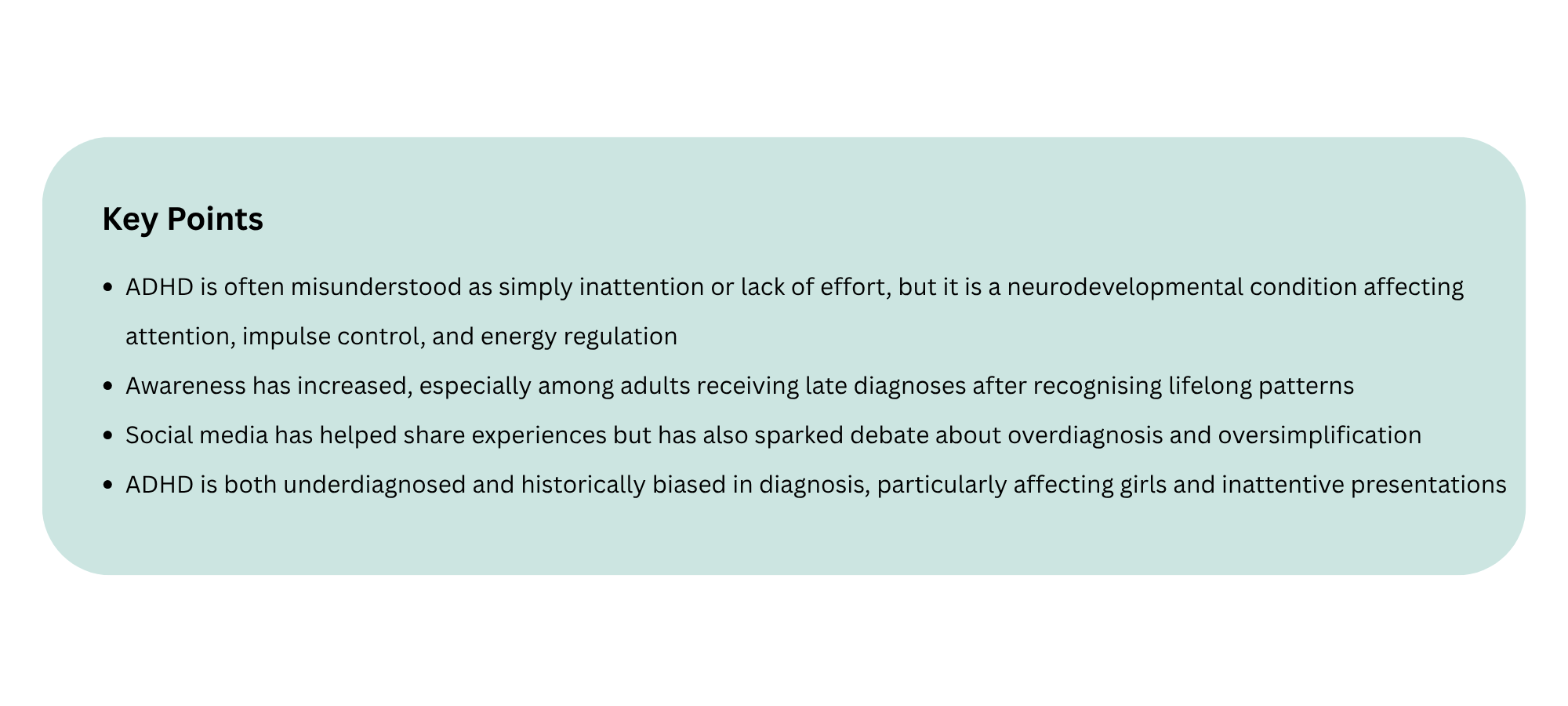
Attention-Deficit/Hyperactivity Disorder (ADHD) has long been boxed into a narrow narrative: restless children, distracted students, and adults who simply need to "try harder." Yet this framing does more to obscure than illuminate. ADHD is not a failure of effort or discipline; it is a neurodevelopmental condition that challenges how individuals regulate attention, impulses, and energy in a world that increasingly demands constant focus, organisation, and restraint.
In recent years, awareness of ADHD has surged, particularly among adults who were never diagnosed in childhood. Many are now recognising lifelong patterns-chronic disorganisation, difficulty sustaining attention, emotional intensity-that were previously misread as personality flaws. This shift has been driven in part by social media, where personal stories have helped demystify the condition. While this visibility has been valuable, it has also sparked debate about overdiagnosis and the risk of trivialising acomplex disorder.
The truth lies somewhere in between. ADHD is both underdiagnosed and misunderstood. For decades, diagnostic criteria were based largely on young boys exhibiting hyperactive behaviours. As a result, girls and individuals with predominantly inattentivesymptoms were frequently overlooked. These individuals often internalised their struggles, leading to anxiety, low self-esteem, and a sense of underachievement that persisted into adulthood.
This stigma not only delays diagnosis but also prevents people from accessing tools that could significantly improve their quality of life.
Workplaces and schools also have a role to play. Flexible structures, clear communication, and recognition of different working styles can make a profound difference. Supporting ADHD is not about lowering standards; it is about creating conditions where people can meet them in ways that align with how their brains function.
Ultimately, reframing ADHD requires a cultural shift. Instead of asking individuals to conform to rigid expectations of attention and productivity, we might ask how systems can better accommodate cognitive diversity.

Publishers Indemnity. Any individual or entity that places advertising, supplies copy material, or submits editorial content to Core Life Publishing agrees and undertakes to ensure that all such material:- Does not infringe upon any copyright, trademark, or other intellectual property rights;- Is free from any content that could be considered defamatory, libelous, or slanderous;- Does not infringe upon any rights related to privacy or breach of confidence;- Contains no obscene, indecent, or otherwise unlawful material;- Complies fully with the Trade Practices Act and all other applicable laws, regulations, or statutes.Furthermore, by submitting or placing such material, these individuals or entities agree to indemnify and hold harmless the publisher, Core Publishing and Events Pty Ltd, and/or its agents from and against any and all investigations, claims, demands, liabilities, damages, costs, or judgments arising out of or in connection with the material provided. All material is believed to be accurate at the time of printing and remains the copyright of Core Publishing and Events Pty Ltd.
© 2026 Mackay and Whitsunday Life Pty Ltd.