Independently Owned, Locally Grown, Community Loved


Aquarium Coral Photo supplied
Flying under the radar is a little-known fishery that operates within one of the world’s most iconic ecosystems: coral harvesting.
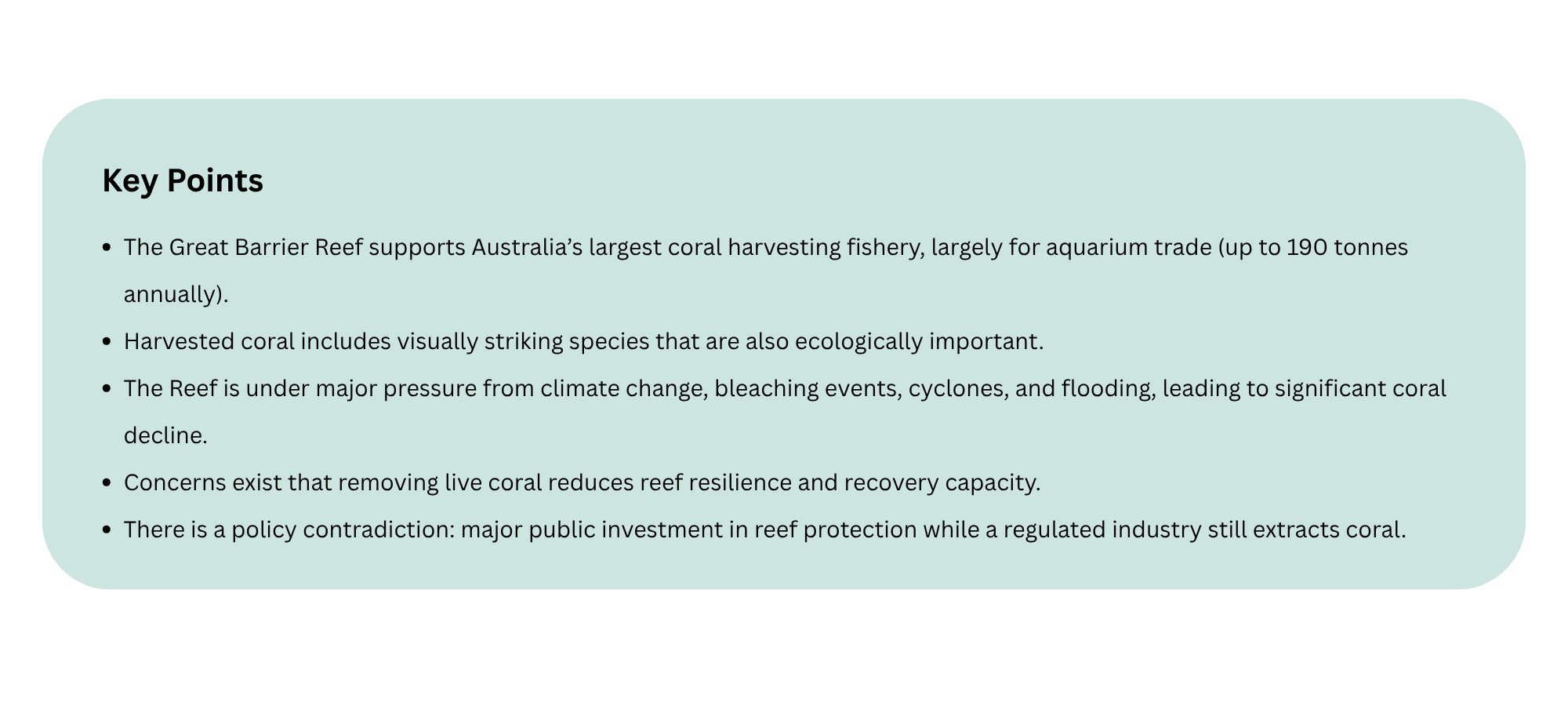
Many Australians would be surprised to learn that the Great Barrier Reef supports the country’s largest coral fishery. Each year, up to 190 tonnes of coral are removed from the Reef, much of it destined for the domestic and international aquarium trade. Among these are some of the Reef’s most unique and visually striking species—highly prized, yet ecologically vital.
The Great Barrier Reef is often celebrated for its beauty and biodiversity, but it is also an ecosystem under immense stress. Climate change has driven increasingly frequent and severe mass bleaching events, while cyclones and flooding have compounded the damage. Together, these disturbances have contributed to some of the most significant declines in coral cover ever recorded.
Against this backdrop, the harvesting of live coral raises difficult questions. Many of the same species targeted by the Queensland Coral Fishery are those already vulnerable to bleaching and mortality. Removing healthy corals from the ecosystem can reduce the Reef’s natural capacity to recover from disturbances, potentially undermining broader conservation and restoration efforts.
This creates an apparent contradiction. Governments have invested heavily in protecting and restoring the Reef, funding initiatives aimed at improving water quality, supporting coral regrowth, and enhancing resilience. Yet, at the same time, a regulated industry continues to extract coral from the wild.
To be clear, the fishery does not operate without oversight. Strict quotas, spatial zoning, and licensing conditions are in place to manage harvesting. Exceeding quotas or collecting coral from protected “green zones” can result in significant penalties.
Enforcement, however, remains an ongoing challenge. In 2016, the first prosecution for illegal coral harvesting since the 2003 rezoning plan occurred in Gladstone, where divers were caught collecting coral in a no-take zone. Since then, there have been more than 20 prosecutions linked to illegal coral collection within the marine park, many involving commercial operators.
Such incidents raise concerns about the industry’s “social licence”—the level of public trust and acceptance it holds. Increasingly, reef tourism operators, scientists, and environmental groups are calling for tighter restrictions, with some advocating for a complete ban on wild coral harvesting.
Despite this, the fishery continues. In 2024, it received federal approval to operate for another three years. Authorities have indicated that a revised ecological risk assessment and updated harvest strategy will be completed by 2026, potentially shaping the industry’s future.
That future may lie beyond the Reef itself. Aquaculture—growing coral in controlled tank environments—has long been promoted as a sustainable alternative. It offers the potential to supply the aquarium trade without removing corals from the wild, easing pressure on an already stressed ecosystem.
As the Great Barrier Reef faces an uncertain future, so does coral harvesting. For many, the answer is clear: the Reef’s corals are far more valuable alive, thriving in their natural habitat, than they are as commodities.
Contributed with thanks to Whitsunday Conservation Council

Publishers Indemnity. Any individual or entity that places advertising, supplies copy material, or submits editorial content to Core Life Publishing agrees and undertakes to ensure that all such material:- Does not infringe upon any copyright, trademark, or other intellectual property rights;- Is free from any content that could be considered defamatory, libelous, or slanderous;- Does not infringe upon any rights related to privacy or breach of confidence;- Contains no obscene, indecent, or otherwise unlawful material;- Complies fully with the Trade Practices Act and all other applicable laws, regulations, or statutes.Furthermore, by submitting or placing such material, these individuals or entities agree to indemnify and hold harmless the publisher, Core Publishing and Events Pty Ltd, and/or its agents from and against any and all investigations, claims, demands, liabilities, damages, costs, or judgments arising out of or in connection with the material provided. All material is believed to be accurate at the time of printing and remains the copyright of Core Publishing and Events Pty Ltd.
© 2026 Mackay and Whitsunday Life Pty Ltd.