Independently Owned, Locally Grown, Community Loved


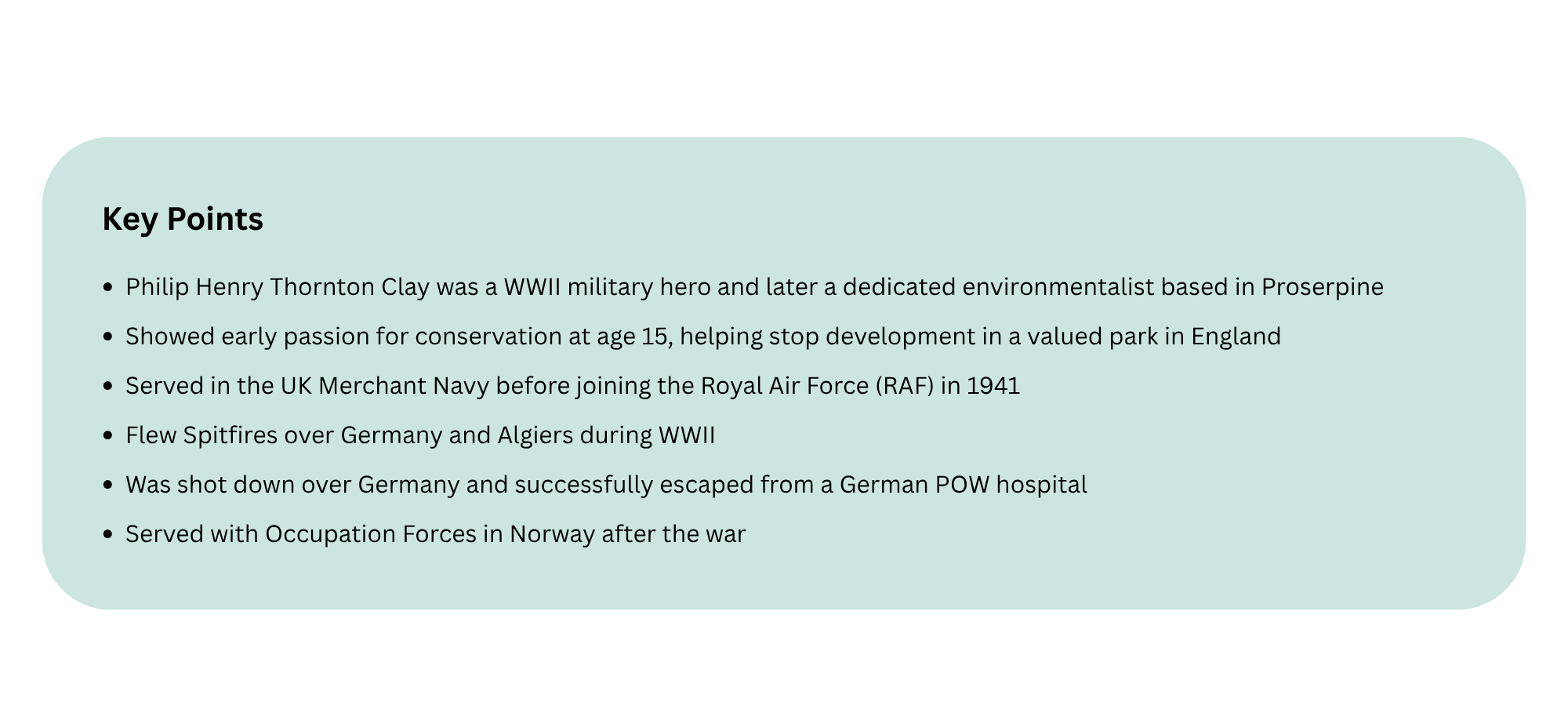
Philip Henry Thornton Clay was a military hero and dedicated environmentalist, who spent the latter part of his life in Proserpine, performing sea rescues and preserving our natural environment.
Philip’s commitment to the environment was very evident as early as age 15 when he helped to raise a petition which eventually pressured government to reject a development in a valued park. All this happened in Surrey and Essex, England, where he spent his childhood, but he retained this avid interest in conservation throughout his life, with he and his wife Joan acting as committed members of the Proserpine Branch of the Wildlife Preservation Society in their retirement.
However, Philip will be mainly remembered for his courageous efforts as a pilot in the World War Two. As a young man he had joined the UK Merchant Navy and in 1941 moved into the Royal Air Force. It was in this capacity that he was recognised. He piloted a spitfire over Germany and Algiers until 1945 when he was shot down over Germany. Subsequently he escaped from a German POW hospital. He joined Occupation Forces in Norway.
Proserpine Guardian 10/04/86 describes his courageous military career:
… Phil was commissioned and awarded, on separate occasions, the British Empire Medal and the Distinguished Flying Cross. Still in the Air Force..he received the Queen’s commendation for Valuable Service for leading the RAF Vampire Aerobatic Team in display stunts over England. Later he was to win a Bar to his DFC for helicopter evacuation work in the Border War in South Yemen.
Philip left the RAF in 1961 and flew helicopters in Canada for three years before emigrating to Australia with his wife and daughter, flying helicopters for Ansett. In 1970 he came to Proserpine to fly Sikorski Helicopters to Hayman and back until his retirement nine years later.
In North Queensland Phil continued to live his life in service to others and, in 1972, was awarded the first Australian Queen’s Gallantry Medal for a helicopter rescue from rough North Queensland waves.
MEDALS: D.F.C. and Bar
Australian Gallantry Medal
B.E.M.
D.F.M.
Commendation [Air]
Contributed with thanks to the Proserpine Museum
Publishers Indemnity. Any individual or entity that places advertising, supplies copy material, or submits editorial content to Core Life Publishing agrees and undertakes to ensure that all such material:- Does not infringe upon any copyright, trademark, or other intellectual property rights;- Is free from any content that could be considered defamatory, libelous, or slanderous;- Does not infringe upon any rights related to privacy or breach of confidence;- Contains no obscene, indecent, or otherwise unlawful material;- Complies fully with the Trade Practices Act and all other applicable laws, regulations, or statutes.Furthermore, by submitting or placing such material, these individuals or entities agree to indemnify and hold harmless the publisher, Core Publishing and Events Pty Ltd, and/or its agents from and against any and all investigations, claims, demands, liabilities, damages, costs, or judgments arising out of or in connection with the material provided. All material is believed to be accurate at the time of printing and remains the copyright of Core Publishing and Events Pty Ltd.
© 2026 Mackay and Whitsunday Life Pty Ltd.