Independently Owned, Locally Grown, Community Loved

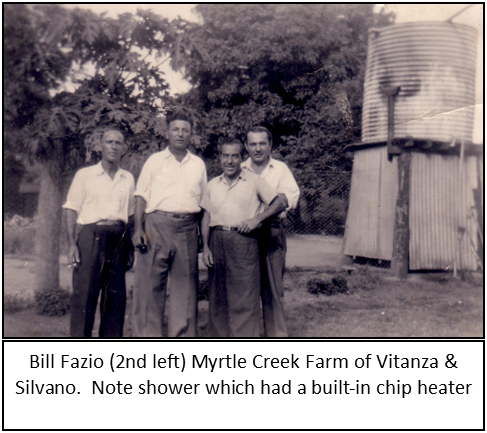
Domenico (Bill) Fazio emigrated from Sicily in 1924 and settled in the North Queensland town of Silkwood where he had a blacksmith’s shop, before working for some time at the Ipswich Railway Department. When Bill came to Proserpine, he farmed in the Preston district for three years before taking over Perry and Co's blacksmithing business.
Bill and his first wife, Minnie, rented a house in Blair Street. Initially, he leased and later bought a block in Main Street from Mrs Daisy Biggs (near the present-day location of Fraser Ford). Working with Bill was his father, Mr Fazio Snr, a wheelwright by trade and possibly the only one in town at the time. Old Mr Fazio would make or repair wheels for cane truck carriers. Chiselled wooden spokes were placed onto curved wooden blocks and then a steel rim, heated in an open wood fire, was placed over the perimeter and burnt onto the wooden wheel. It was cooled with water as quickly as possible to shrink the steel and fix it tightly.
It was in the late 1940s/50s that Bill Fazio made a big impact in his trade in Proserpine. “The Difficult we do immediately The Impossible we take a little longer” said his advertisement but local farmers remember his humble comment when he finished a welding job ... "He no looka too good, but he plenty strong." Apparently, Bill wasn't the neatest welder in the business, but his welds always held!
His business went from strength to strength as reported by the “Guardian”: "Mr Fazio has made rapid advancement in his sphere of industry. Apart from the usual repair jobs associated with blacksmithing, he has branched out into the production of farm implements of his own design which secured a ready market among the farming community of Proserpine and throughout a wide area of North Queensland."
Bill won first prize at the Mackay show for both his wheel grubber and a double mouldboard plough with attached rake. He took the Fazio Grubber and Cultivator as far north as Ingham for demonstration purposes. Orders rolled in the only holdup being the shortage of steel at the time.
The “Proserpine Guardian” June 18, 1948 cited this letter –
"Dear Sir, The grubber which you made for me has given me entire satisfaction, having been in use for some time now. It is very strongly made and has stood all the tests that I have given it. 1 can strongly recommend it to anyone desirous of securing a good grubber. Yours faithfully, J Biggs, Lethebrook, Proserpine.
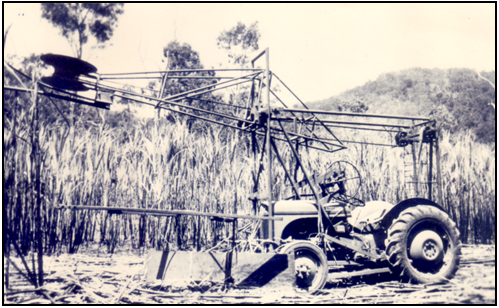
In the early stages of development of mechanical cane harvesters, Bill was involved with the manufacture of the Rolleston harvester which he exhibited at the Proserpine Show in 1951. The Rolleston was invented by Mackay cane farming brothers. A demonstration of Bill’s model was held on EO Dray's Waterson farm and generated a lot of interest but advancing technology soon surpassed it and expectations were left unfulfilled.
Bill’s wife Minnie had died in 1954 aged 55. He married a second time and had three children Mario, Cristina and Agata. The Fazios would often visit the Vitanza family at their Myrtle Creek farm and when Vitanzas moved to town in 1952, their daughter, Lucy Zamparutti (Marano) would do the book-keeping for Bill. Such was their friendship that Antonio Vitanza and Bill bought a cane and dairy farm at Maryborough in the early sixties.
After many years in Proserpine, the Fazios left the area and settled on the farm in Maryborough. Their eldest child, Mario, still resides in the district. The Vitanza family remained in the district, farming in the Conway area though Antonio and son, Joe, often visited.
Story and photo courtesy Proserpine Historical Museum. Thanks also to Tony Vitanza for his recollections.
Captions
Publishers Indemnity. Any individual or entity that places advertising, supplies copy material, or submits editorial content to Core Life Publishing agrees and undertakes to ensure that all such material:- Does not infringe upon any copyright, trademark, or other intellectual property rights;- Is free from any content that could be considered defamatory, libelous, or slanderous;- Does not infringe upon any rights related to privacy or breach of confidence;- Contains no obscene, indecent, or otherwise unlawful material;- Complies fully with the Trade Practices Act and all other applicable laws, regulations, or statutes.Furthermore, by submitting or placing such material, these individuals or entities agree to indemnify and hold harmless the publisher, Core Publishing and Events Pty Ltd, and/or its agents from and against any and all investigations, claims, demands, liabilities, damages, costs, or judgments arising out of or in connection with the material provided. All material is believed to be accurate at the time of printing and remains the copyright of Core Publishing and Events Pty Ltd.
© 2026 Mackay and Whitsunday Life Pty Ltd.