
Independently Owned, Locally Grown, Community Loved

Member for Whitsunday Amanda Camm has stepped down from her role as Minister for Child Safety and the Prevention of Domestic and Family Violence, in an effort to prioritise her health and wellbeing. The announcement comes a fortnight after Ms Camm returned from six weeks of medical leave following major surgery, with the Whitsunday MP recognising she needed more time to recover. “This has been a considered and deeply personal decision,” Ms Camm said. “Having returned from six weeks of medical leave following major surgery I have come to recognise that my recovery still has some way to go and I need to prioritise my health and wellbeing.” “I sincerely thank the Premier for the opportunity to serve in his Government and for his support of my decision.” Ms Camm added in a presser outside of Parliament house in Brisbane, that the pressures of ministerial work had contributed to her decision to step down. This follows months of intense scrutiny over conditions for children in care and domestic violence prevention funding cuts had reinforced the importance of personal safety, especially in light of the recent attack on Victorian MP Helen Haines. “Public scrutiny and accountability are essential to democracy and to our institutions,” she said. “Harassment, threats, bullying and personal vilification are not and for the past year this has been my experience.” But during her time in the role, Ms Camm oversaw reforms to strengthen child protection, support foster and kinship carers and improve responses to domestic and family violence. Central to her child safety work was the Government’s response to the Child Safety Commission of Inquiry, which delivered 52 recommendations for improving the system. “The landmark Child Safety Commission of Inquiry was the turning point for the Child Safety system,” Ms Camm said. “There is much more work to be done, while early positive signs show we have stabilised numbers in the Residential Care system for the first time.” Her work in domestic and family violence included introducing laws for electronic monitoring of perpetrators to strengthen accountability, alongside her reporting a doubling of calls answered by DVConnect to help more people access support when they needed it. “After sitting with victims of domestic and family violence over many years through opposition and then in the ministry, I’m proud to have been part of delivering change that can help save lives,” Ms Camm said. In a statement following her decision, Premier David Crisafulli praised her work across both portfolios, describing the child safety inquiry’s reform roadmap as her greatest legacy and highlighting improved access to the domestic violence helpline. “I thank Amanda for her service to Queensland firstly as a Shadow Minister and then as a Minister,” Mr Crisafulli said. “Amanda took on an enormous task with a Child Safety system in crisis and a state in need of domestic violence reform. “With her dedication, passion and commitment, she has put Queensland on the road to repair both. “I speak on behalf of the Government, the LNP and all Queenslanders in wishing her the best in her recovery.” Ms Camm will continue serving as the Member for Whitsunday, reaffirming her commitment to the local community. “I remain committed to the people of Whitsunday as their Member of Parliament, and to supporting the Premier and the Government in delivering a fresh start for Queensland,” she said.
Read the full story
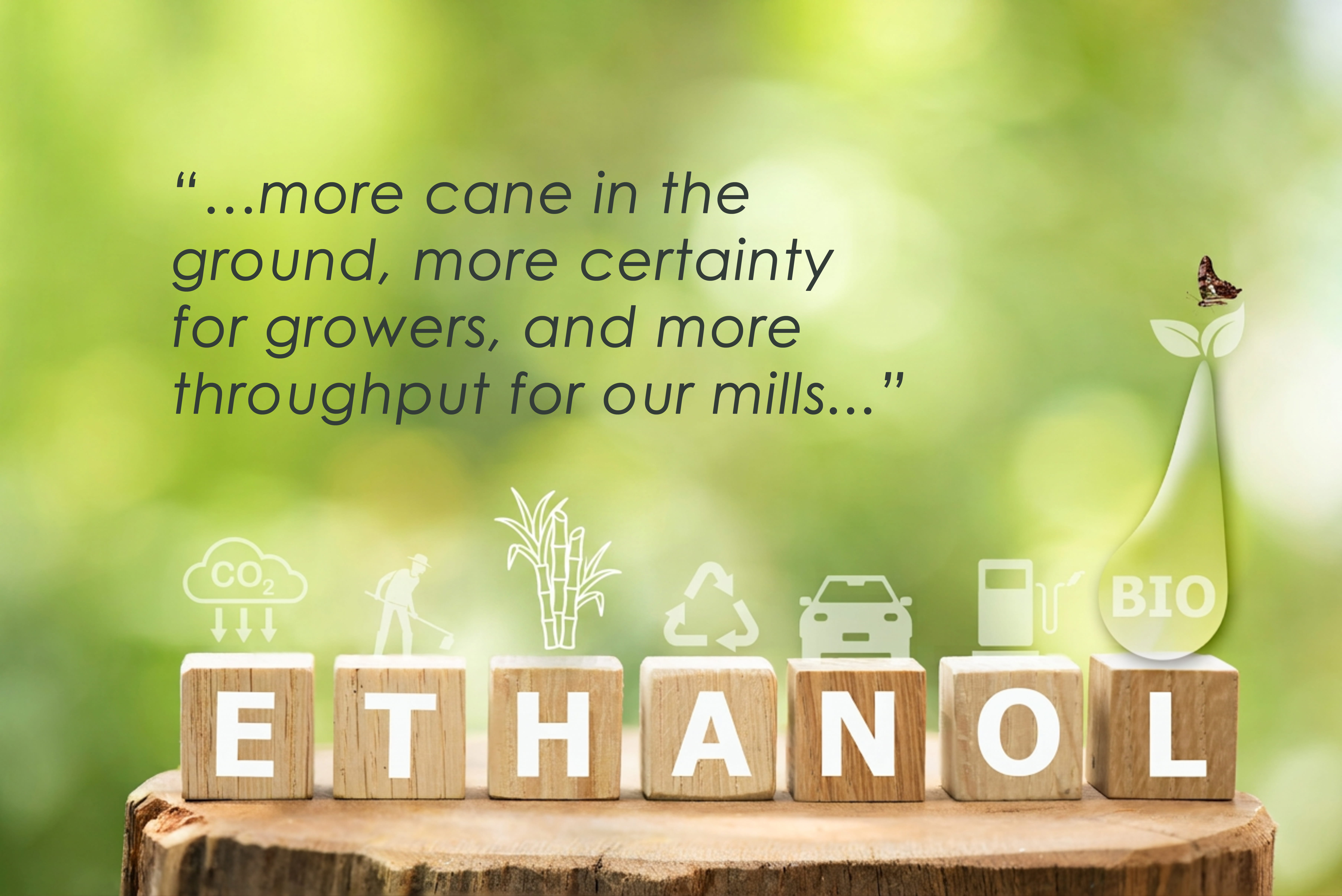
By Joseph Borg, Chairman, CANEGROWERS Mackay A firmly enforced bioethanol mandate, backed by increased local sugarcane production, is essential to strengthening Queensland’s industry resilience, regional jobs, and Australia’s long‑term fuel security. Our region holds enormous potential: not only for producing sugar, but for renewable fuel, energy diversification, and national economic security. Queensland’s sugarcane industry has always been a cornerstone of regional prosperity, but today it stands at a crossroads. Global markets are volatile and input costs are rising, and at the same time, Australia faces increasing pressure to reduce emissions, strengthen domestic fuel supplies, and build more resilient regional economies. A properly enforced bioethanol mandate is one of the most effective tools we have to meet these challenges head on. Queensland already has a mandate in place, but compliance remains inconsistent. When fuel retailers fail to meet their obligations, growers, mills, and regional communities lose out on opportunities that should rightfully be flowing into our local economy. Bioethanol is not a theoretical solution: it is a proven, practical, and immediate pathway to cleaner fuel and stronger regional industries and economies. Countries like Brazil and the United States have shown that bioethanol can reduce emissions, stabilise fuel markets, and create thousands of rural jobs. In these countries, and across the world, bioethanol forms a substantially higher portion of retail fuel sales than this country has embraced. Queensland has the same potential, but only if the mandate is taken seriously and enforced with the consistency it deserves. For Mackay, the benefits are clear. Our region is one of Australia’s most productive sugarcane hubs, with the land, infrastructure, climate, and expertise to support a thriving biofuels sector. Increased demand for bioethanol directly translates into increased demand for sugarcane. That means more cane in the ground, more certainty for growers, and more throughput for our mills, and we all know that milling is a volume game. This in turn supports jobs from the paddock to the processing line. But the opportunity extends far beyond economics. A stronger bioethanol industry enhances national fuel security, reducing Australia’s reliance on imported fuels. At a time when global supply chains are increasingly unstable, producing more of our own fuel is not just smart policy, it is essential. Every litre of bioethanol produced in Queensland is a litre of fuel Australia does not have to import. To seize this opportunity, we must also focus on increasing local sugarcane production. The industry cannot diversify, innovate, or expand into new markets without a reliable and growing supply of cane. More cane means more flexibility for mills, more investment in advanced manufacturing, and greater capacity to produce not only sugar and ethanol, but also bioplastics, green electricity, and other high value products. Growers are ready to meet this challenge. With the right policy settings from all levels of government, including a robust and enforced bioethanol mandate, we can plant more cane, improve productivity, and strengthen the long‑term viability of our region. But growers cannot do it alone. We need government to ensure the mandate is upheld, fuel retailers to meet their obligations, and industry partners to continue investing in innovation and infrastructure. Mackay has the land, the people, and the expertise to lead Queensland’s next era of renewable energy and agricultural diversification. What we need now is the policy certainty that comes from a mandate that is not only written into law but actively enforced. A stronger bioethanol mandate is not just good for growers it is good for Queensland, good for regional jobs, and good for Australia’s fuel future. The time to act is now. Bioethanol can use sugarcane by-products including molasses, bagasse, mill mud as well as plant material. Image: AdobeStock
Read the full story
Marketing strategy boils down to answering four questions: What does your business want? > The goal. Who can help you achieve your goal? > The audience. What do you need to tell your audience so that they can help you achieve your goal? > The message. Where do you need to put your message so that your audience sees it? > The delivery. But how do you actually go about answering those Q’s? Like anything, the broad strokes are more complicated in practice but it’s a good framework to come back to when you’re planning your next marketing activity. Start by drilling down + identifying a measurable goal that you can work towards. Vague + lofty goals are okay, but without a clear way to track your progress, achieving them will be pretty tough. For example, tracking how many enquiries you get + the quote conversion rate can be useful info to have as a baseline. That way, if you do a targeted campaign to attract more work, you can see if it meaningfully pushed the needle in the right direction! Next, really empathise with who can help you achieve those goals. Try to build up a target customer in your head. How old are they? What do they want from your business? What are they interested in? The more specific you are, the easier it’ll be to craft messaging that will actually appeal to that person. Once you’ve defined your goal + who can help you achieve it, you’ve got to tell them how to help you do it. Your messaging should be the key information that your audience needs to know about your business. This is where you focus on not only what your customers want to know about you, but how your business is different to all the others out there. Your messaging should change based on the people you’re targeting. Lastly, the delivery. Where does your target market frequent? Do they use socials? Are they constantly listening to the radio? Do they frequent the pub on a Friday arvo? Once you know where they go, you can start figuring out how to get your message there. While socials are a great option, they’re not the only one. Billboards, coasters, or a flyer that sits on a wall somewhere are all effective options. But if that all sounds like too much effort, you can always reach out + talk to us. We’ll help you figure it out 😉 Taren McAuley
Read the full story

The highly controversial 47.7-metre high-rise development planned for the Airlie Beach Foreshore has been approved for a second time following a lengthy battle at the Environment and Planning Court.
The planning application was initially approved by Whitsunday Regional Council last year but local action group, Save Our Foreshore (SOF) challenged the decision and took the matter to court.
The group disputed the approval, stating that the land was only zoned for a five-storey building, not a 12-storey high-rise and claimed the decision went against the Airlie Beach Town Plan.
They also believe it contradicts the ‘small town feel’ that attracts most tourists to Airlie Beach.
Suzette Pelt, spokesperson for SOF, said that the development will “torpedo the future of the Whitsundays” and that 1,700 letters of opposition were “ignored by the councillors in their decision making”.
"We see this decision as one that will, in reality, hold the Whitsundays back,” she said.
“This decision could also set off a string of future applications along the length of Airlie Beach, resulting in what’s known as the ‘canyon effect’”.
Meanwhile, others in the community believe the development could expand the overall tourism offering as the new hotel must be of five-star standard.
It is also set to include a 500-seater function room which would attract corporate clients and enable large-scale events to be held in the region.
Once again, SOF flag this as a concern because developers, Meridien Holdings, are currently in receivership and the nature of the future development uncertain.
“The development site is problematic, the development must obtain and maintain a 5-star luxury rating, and as stated in the judgement (paragraph 123), to date no potential operator has committed to the development,” Ms Pelt said.
Whitsunday Regional Council Director of Development Services Neil McGaffin said they are still waiting to hear more about the conditions of the approval.
“The judge has ruled in Meridien/Council’s favour and the approval has been allowed, albeit adjourned for parties to provide advice to the Court on appropriate conditions of approval,” he said.
“This should be resolved within the next two – three weeks.”
Save Our Foreshore have been campaigning against a high-rise on the Airlie Beach Foreshore for many years. Photo supplied

Whitsunday Islands have become a hot commodity, with investors spending big to own their own piece of paradise.
Recently, Adelaide real estate tycoon, Mike Dobbin has purchased Poole Island, a 20-hectare island one kilometre off the Whitsunday coast.
Poole Island cost just $1 million and according to Adelaide Now, Mr Dobbin has plans to clean up the island, renovate the two homes, and offer the island as short term accommodation for families facing hardships.
This recent sale marks only one in a stream of other acquisitions.
The leasehold for Hook Island was snapped by Sydney-based Glenn Piper two years ago for $12 million and has shared plans to establish a luxury resort.
Earlier this year a Singaporean family purchased Lindeman Island for $10 million.
Currently, South Molle Island is listed for sale, with the asking price being $30 million, considering the extensive renovations needed to bring the resort back up to luxury standard.
This is only emphasised with the rumours of Hamilton Island’s upcoming sale.
This recent slurry of activity could point to rising confidence in local resort islands, many of which have either been abandoned or neglected, left to disrepair over the past decade.
1: Poole Island – Sold For $1M
2: South Molle – For Sale $30M
3: Lindeman – Sold For $10M
4: Hook Island – Sold $12M

By Bronte Hodge
A less than fruitful mango season could impact the supermarket shelves this summer, with customers paying higher than usual prices for mangoes due to poorer growing conditions that have decreased overall production this season.
While this is bad news for consumers, especially with other concerns around the increased cost of living, it could be good news for farmers because with less mangoes on the market, they can command a higher price.
Bowen Gumlu Growers Association (BGGA) President Ry Collins, said they are expecting lower numbers this year, but it is too early to tell the scope of the reduction.
“The delayed flowering of the crop indicates a reduced crop, but it’s hard to say how much this will affect the market,” he said.
“The KP variety, that is the Kensington Pride, or better known as the Bowen Special, is seeing a smaller season, but this could be a good thing for growers.
“In the last season, we saw an oversupply of mangos, which meant the price decreased, and our farmers weren’t seeing a good return.
“If this reduction is a nationwide reduction and not just a regional decrease, then the price of the market will go up and the return for the producers will be good.
“A reduced crop is not necessarily a bad thing.”
Bowen mango grower Ben Martin agrees, saying it’s too early to really predict the incoming seasons yield.
“Numbers are being thrown around that have no weight to them,” he said.
“Yes, we will see a decrease in the crop but not drastically.”
Mr Martin explained that the reduced crops are due to warmer winter temperatures, meaning the mango trees weren’t able to flower as thoroughly as usual.
“Mangoes require cold temperatures and weather to flower, below 16 degrees is ideal, and a few nights of five or six degrees is great, but we struggled with that this winter.”
Mr Martin is also the President of the Australian Mango Industry Association and wishes to encourage consumers to not panic about this predicted reduction.
“Consumers will see less mangoes at shops and have to pay a little bit more for them, but they will still be of great quality.”
DID YOU KNOW?
Bowen and Burdekin regions contribute between 20 and 25 per cent of all Australian mangoes.
Bowen mango farmer, Ben Martin. Photo supplied

The Federal Government has just released Fair Work Legislation amendments and Federal Member for Dawson Andrew Willcox says he is worried about increases in business expenditure and the possibility of a recession.
According to Mr Willcox, the new amendments to the Fair Work Legislation are complex and are going to cost billions in wages.
“The amendments are going to cost consumers more, and this is the last thing Australians need in a cost of living crisis,” he explained.
“Rent has increased, cost of supplies has skyrocketed, and workforce shortages are a constant and never-ending battle.
“These are all costs that business must either absorb, which is unstainable, or they must pass the costs on to consumers, who can’t afford to pay more.”
The last time Australia entered a recession was in the early 90s, and with increasing financial pressures on businesses and individuals, recession is at the forefront of Mr Willcox’s mind.
“We are facing a serious threat of another recession,” Mr Willcox said.
Mr Willcox has called for the Federal Government to “do the right thing” and reverse the legislation otherwise he fears the repercussions could “grind this economy to a halt”.
“Don’t condemn us to more cost-of-living pressures. Don’t condemn us to business closures, job losses, bankruptcy, and even more homelessness.”

Energy is building ahead of The Voice referendum which is due to take place on October 14 and local group, Yes 23, are encouraging everyone to get involved with supporting the movement.
The group are inviting the community down to the Airlie Beach Markets to meet them this Saturday, and they will also be hosting a relaxed social gathering at Banjo’s at 4pm that day.
In addition, there will be a peaceful march this Sunday at Whitsunday Plaza from 11am.
The group will give away merchandise and participants are encouraged to bring signs.
A highly contentious issue, The Voice has become a talking point both nationally and locally.
If The Voice To Parliament goes ahead, an indigenous ‘voice’ will be enshrined in the constitution and indigenous people have a bigger say on issues that affect them.
Those who oppose The Voice, however, believe it adds race to the constitution and that it is a symbolic gesture that will not fix systemic issues.
Yes 23, however, are eager to spread the word about the positive impacts of The Voice.
Local Yes 23 coordinator, Deb Barrow, said she is getting behind the cause because she believes it will reduce the gap in issues such as infant mortality rates, overall health, and living standards.
“Every government over the generations have done the same thing,” she said.
“They’ve tried to tell the indigenous people what they need and put a lot of money into these communities, but it’s not been working.”
Louise Mahony from Yes 23 agrees, saying that for her, it is about reducing costs.
“Billions of dollars have been wasted on Aboriginal affairs and getting no-where,” she said.
“I just want us to stop wasting money!”
WHAT: Yes 23 March
WHERE: Whitsunday Plaza
WHEN: Sunday, September 17 from 11am
Deb Barrow and Louise Mahony from Yes 23. Photo credit: Rachael Smith

Flagstaff Hill Convention Centre and Café has unexpectedly closed, with last Sunday September 10 being its last day of operation.
The lease for the Convention Centre and Café was held by Tuan and Vi Thuy, who also own and operate Jochheim Pies in Bowen.
The owners announced the closure of Flagstaff Hill suddenly last week via a Facebook post.
Whitsunday Regional Council Mayor Julie Hall said the closure of the Flagstaff Hill Café and Convention Centre came as a shock to Council.
“The facility is currently leased to a private operator who did not indicate to Council that they would be closing prior to the end of their lease period which still has over 12 months to run,” Mayor Hall said.
Council said that they had been “working through issues raised by the community with difficulty booking any type of function or wedding at the Convention Centre.”
“We have also had contact from the State Government who have also had complaints lodged with issues in regard to the operation of the Convention Centre.”
“I can clarify that the lease conditions or minimal rent charged by Council has never been raised as an issue by the operator,” said a Council spokesperson.
“Council had also assigned officers on several occasions to assist the lessee with some of the operational issues they were experiencing in an attempt to ensure the smooth running of the facility for the operators and community.”
Tuan and Vi Thuy were unable to give a comment at this time.
The Flagstaff Hill facility had only just re-opened in October 2021 following lengthy rebuild after the previous café was irreparably damaged in the 2017 cyclone.
The latest closure comes as another blow to the iconic local landmark.
Council will work proactively to secure another operator to ensure the best outcome.
Flagstaff Hill Convention Centre and Café has suddenly closed its door, with only two days’ notice to the community. Photo supplied

Single Vehicle Crash, Proserpine
Paramedics transported a male in his 70s to Proserpine Hospital in a stable condition following a single-vehicle crash on Cascara Street at 8.05pm
Hayman Island Helicopter Call Out
RACQ CQ Rescue conducted two call outs to Hayman Island on Saturday, September 9.
The first call out was for an unwell resident, the second at 9pm regarding a sick child who had been on holiday with family on the island.
Safe Night Precinct Disturbances
On September 9, at 11.30pm, police attended a large fight which erupted outside Mama Africa night club.
The four persons involved in the fight included a 32-year-old Proserpine man, a 28-year-old man from Brisbane, a 46-year-old from the Midge Point area, and an 18-year-old from the Midge Point area.
All were issued with infringement notices for public nuisance violence offences.
Another six public nuisance offences were also issued over the weekend, as well as public urination offences.
Breaching Family Violence Order
Police attended a disturbance in Jubilee Pocket, where they allege a 57-year-old Jubilee Pocket man breached a Family Protection Order and has been charged.

Residents of Scottville are encouraged to attend the Whitsunday Regional Council Community Catch-up in Scottville next Wednesday.
The event will tackle topics such as town planning, land and natural resource management, an overview of upcoming projects and annual budget items, consultation and education programs.
Any other suggestions will be gathered through the Whitsunday Your Say website prior to the event.
The catch-up is being held at Scottville State School, from 10 to 12am on Wednesday 20 September.
The Whitsunday Regional Council will also hold Community Catch-ups in Cape Upstart and Shute Harbour soon.

The Whitsunday region celebrated Indigenous Literacy Day last Wednesday, sharing indigenous stories, cultures, and languages.
Indigenous men Malcolm Coongoo and Liam Ross performed the official Welcome to Country and Smoking Ceremony to community members and children, before all attendees were invited into the Proserpine Entertainment Centre to watch a film created by the Indigenous Literacy Foundation.
The film celebrated indigenous literacy with stories and songs from indigenous communities across Australia, as well as a livestream by Foundation Ambassadors Jessica Mauboy, Justine Clarke, Gregg Dreise, and Josh Pyke.
“Indigenous Literacy Day is very important,” explained Malcolm.
“Not only for indigenous peoples, but for non-indigenous peoples as well. A lot of the things we do, we try to get people involved, share our oral history.
“We don’t have a written language, so a lot of our style, our stories, our song and dance has been passed down through the generations over the last 60,000 years and longer!”
Malcolm and Liam also shared a local indigenous story, a creation story of the Whitsundays, of the rainbow serpent and how the Great Barrier Reef got its vibrant colours.
“It’s a story that connects all of us,” said Liam.

Last week the Queensland Small Business Commissioner published the above report showing that Queensland small businesses continue to not only survive but prosper with profitability up by 42 per cent outpacing the rise in wages and total expenses of 22 per cent. The report found that the pandemic had a severe but short-lived impact on household spending.
Government intervention in the forms of grants, subsidies and handout are certainly a factor in this quick recovery and have contributed to the high inflation and interest rates we now face – both likely to curb economic growth in the short term.
A recent meeting with the Commissioner provided a platform for various regional Chambers –to voice concerns and shed light on the challenges faced by small businesses. Whilst the meeting served as an opportunity for dialogue, it was apparent that regional Chambers and small business owners are fatigued over policies that yield little or no tangible action to address their concerns.
Some of the recurring issues common to the regional Chambers included housing and cost of living, regional tax incentives enlarging the insurance pool for businesses in Far North Queensland, diesel rebates for transport, outdated planning legislation and regulation, government procurement, and Transport and Main Road (TMR) narrow practices that fail to align with small business needs.
Meanwhile, the research phase of our Vision for the Whitsundays project is now open and we invite business owners, managers, and community stakeholders, and individuals to inform the project’s key findings and recommendations.
You can participate by either making a formal submission to the project, completing a quick online survey, or participate in a focus group discussion. In September, focus groups will be held on the following themes: the economic Customer Service Experience and its impact on our economic future and economic contribution Arts, Culture, and Heritage makes to the region.
Our Vision for the Whitsundays project report will be released in May 2024.
Visit our website to participate.

Attracting, expanding, and supporting regional events in the Whitsunday region has been a key focus of Council.
I regularly meet with our Economic Development team to explore every opportunity to entice new events and explore how Council can better support existing events to allow them to grow their events further.
The Don River Dash that was held over the weekend in Bowen is a perfect example of a relatively new event that has grown in popularity since being first staged in 2019.
This adrenaline packed spectator friendly event with cars and motorbikes racing on the bed of the Bowen River is now recognised as the pinnacle of off-road racing on Australia’s east coast.
This year the organisers accepted over 350 open competitor entries and crowds of over 5000 spectators turned out for the two days of racing action.
The exciting news is that Council’s Economic Development team have run the Economy ID calculator and the direct flow-on into the Whitsunday region’s economy is over $7 million.
This is a real feather in the cap for the organisers and volunteers of this event and an amazing economic boost for our region.
I am proud that Whitsunday Regional Council has backed the event since it started, and this financially assisted with $25,000 in-kind support to assist the organisers as they continue to expand and grow the event further.
The Don River Dash is a prime platform to showcase the beauty of Bowen and the Whitsundays to a domestic and international audience by attracting motorsport enthusiasts.
I am confident that this event will become a hallmark event for our unique part of the world and add another bow to making the Whitsunday a great place to visit.
Congratulations also to the Whitsunday Running Club for staging another successful Whitsunday Trail Festival in Airlie Beach on Sunday.
A strong field of locals and visiting runners of all ages competed along the scenic Conway Ranges in categories from the Kids Beach Bash, Honeyeater 10.5km Challenge to the ultimate 58km challenge.
Events like these and the successful White on Whitehaven Long Lunches on Friday, Saturday and Sunday provide national and international exposure for the Whitsundays and enhance our reputation as one of Australia’s premium tourism destinations.

Batteries should never be put in your recycling or waste bin.
This includes rechargeable batteries and lithium-ion batteries in objects such as laptops, mobile phones, power tools, cameras, and e-vape machines.
Used batteries may still contain residual charge and often produce sparks which can lead to fires in our waste trucks and recycling facilities, putting our waste teams at risk, and potentially causing dangerous gases if waste is burned incorrectly.
To dispose of batteries safety, make sure to always place sticky tape on the terminals before placing in your nearest battery recycling collection point.
Household Battery Recycling Bins are located at all of our Whitsunday Regional Council Customer Service Centres and Libraries.
Bins can also be found at the Collinsville and Cannonvale Transfer Stations.
For further information, search for 'Household Battery Recycling Program' on Council's website.

North Queensland’s fresh produce industry has celebrated another great year, with the 2023 Growers Gala which was hosted by the Bowen Gumlu Growers Association on Saturday September 2.
Held at the Bowen Racecourse, over 80 guests were welcomed, including the region’s leading growers, business leaders, industry figures and dignitaries.
On the guest list was Hon Mark Furner Queensland Minister for Agricultural Industry Development and Fisheries, Andrew Willcox Federal Member for Dawson, Dale Last Member for Burdekin, Mayor Julie Hall and Councillors Mike Brunker and Michelle Wright from Whitsunday Regional Council, and Mayor Lyn McLaughlin from Burdekin Shire Council.
The event celebrated the important contributions of the agricultural producers and workers who make up our communities, with two award presentations.
The Grower Recognition Award was presented to Dale Williams of Euri Gold Farm, for his continued contributions to the association, and the Industry Recognition Award was presented to Luke Jurgens from NQ Aerovation, for excellence in innovation and emerging as a leader of local industry.
L-R: Minister for Agriculture Mark Furner MP, Mayor Julie Hall, BGGA CEO Ry Collins and BGGA President Carl Walker
L-R: BGGA CEO Ry Collins, Grower recognition award recipient Dale Williams and Minister for Agriculture Mark Furner MP. Photos supplied

Year 12 St Catherine’s Catholic College student Jy Parkinson has reached new heights, representing the school at the National School Sport Australia Swimming Championships.
Travelling to Sydney for the competition, Jy competed in five individual swim events and made five finals, which brings him into the top ten of school swimmers in Australia, in the 17–19-year-old male division.
Jy was also awarded the Queensland Male Swimming Captain and represented 163 Queensland swimmers with speech at the Championships opening ceremony.
Jy’s records include:
200 metre Butterfly in 2.11.29 with a PB of 1.30 second finishing 4th in Australia.
50 metre Butterfly in 26.73 with a PB 0.11 second finishing 5th in Australia.
100 metre Butterfly in 58.83 with a PB 0.26 second finishing 4th in Australia.
50 metre Backstroke in 28.01 with a PB 0.04 second finishing 6th in Australia.
100 metre Freestyle in 54.26 with a PB 0.24 second finishing 5th in Australia.
Jy was also a part of two Queensland relay teams, with the 100 metre Freestyle placing 5th and the 50 metre Freestyle placing 4th.
Jy Parkinson travelled to Sydney to compete in the National School Sport Australia Swimming Championships. Photo supplied

Local tourism operators from across the region have learnt how to be champions of change by participating in a workshop to upskill their knowledge levels to create more accessible, disability-friendly workplaces.
The Accessible Tourism workshop, held at Coral Sea Resort last Friday, saw representatives from seven different local entities attend the event.
Rick Hamilton, CEO of Tourism Whitsundays said the workshop provided a huge insight into the daily challenges people with disabilities are living with.
During the session, attendees experienced what it was like to live with a disability.
“By experiencing similar limitations for ourselves and learning from the Get Skilled Access team, we were able to better understand what information and facilities can help make life and travel easier," said Rick.
By providing participants with a unique perspective, they gained valuable knowledge and the insight required to inform accessibility and inclusiveness decision-making and championing change in their respective organisations.
Get Skilled Access team members living with a disability showed participants what their lives are like by simulating workplace challenges for staff using wheelchairs, mobility aids and low-vision glasses.
This was a Department of Tourism, Innovation and Sport initiative which engaged Get Skilled Access and TravAbility to deliver the project.
Six selected tourism destinations were chosen, including Bundaberg, Capricorn, Gladstone, Mackay, Southern Queensland, and the Whitsundays.
Operators in attendance were Adventure Whitsunday, Cruise Whitsundays, Bowen Tourism and Business, Red Cat Adventures, Whitsunday Escape, Whitsunday Sailing Club, Tourism Whitsundays. Photo supplied
Publishers Indemnity. Any individual or entity that places advertising, supplies copy material, or submits editorial content to Core Life Publishing agrees and undertakes to ensure that all such material:- Does not infringe upon any copyright, trademark, or other intellectual property rights;- Is free from any content that could be considered defamatory, libelous, or slanderous;- Does not infringe upon any rights related to privacy or breach of confidence;- Contains no obscene, indecent, or otherwise unlawful material;- Complies fully with the Trade Practices Act and all other applicable laws, regulations, or statutes.Furthermore, by submitting or placing such material, these individuals or entities agree to indemnify and hold harmless the publisher, Core Publishing and Events Pty Ltd, and/or its agents from and against any and all investigations, claims, demands, liabilities, damages, costs, or judgments arising out of or in connection with the material provided. All material is believed to be accurate at the time of printing and remains the copyright of Core Publishing and Events Pty Ltd.
© 2026 Mackay and Whitsunday Life Pty Ltd.
