Independently Owned, Locally Grown, Community Loved

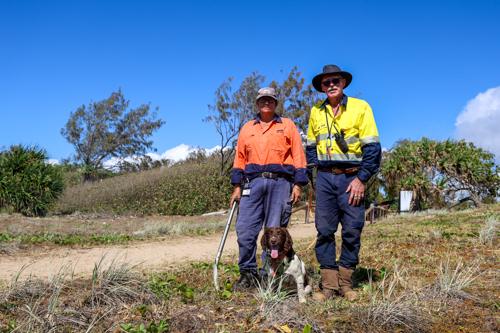
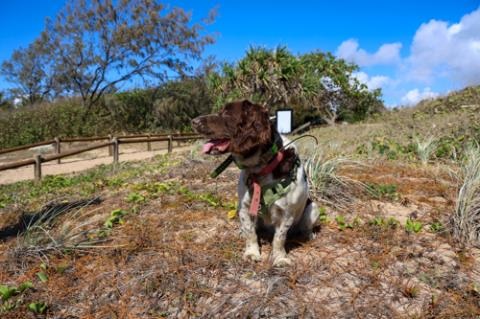
Conservation dogs Cooper and Wally are helping locate European red fox dens across Mackay to protect local wildlife, particularly nesting turtles and hatchlings. Photo supplied by Mackay Regional Council
Two four-legged visitors have been putting their noses to work across Mackay, with conservation dogs Cooper and Wally on the hunt for European red fox dens.
The specially trained English springer spaniels have been working alongside handler Tom Garrett, who has brought the pair to coastal areas across the region each year since 2018 to help locate fox dens.
European red foxes pose a major threat to native Australian wildlife, including ground-nesting birds, small mammals and turtles.
Mackay Mayor Greg Williamson said the conservation dogs had played a critical role in helping protect native species.
“Over the years the dogs have helped our Pest Management Team to locate and identify active and inactive fox dens on public and private land between Calen and Cape Palmerston,” Mayor Williamson said.
“We are particularly concerned about the impact these pest animals have on turtle populations, with foxes not only digging up nests, but also preying on hatchlings as they try to make their way to the water.”
Spokesperson for Mackay and District Turtle Watch, Fay Griffin, said the timing of the detection program is important.
“Turtle nesting season usually commences in October, with hatching starting in mid-December and continuing until March,” Mrs Griffin said.
“By getting in now and identifying where dens may be, we can try and reduce the chance of turtles being attacked, nests disturbed and hatchlings preyed on.”
The Flatback Turtle is the most common turtle species nesting in the Mackay region, with the occasional Green Turtle also recorded.
Several years ago, a confirmed Olive Ridley turtle nest was found on one of Mackay’s southern beaches, marking the only confirmed nesting of the species on Australia’s east coast.
Previous operations have located up to 15 fox dens in a single year, with Calen, Hay Point, Cape Palmerston and Slade Point identified as hotspots.
Foxes found in active dens are humanely euthanised in line with Queensland’s animal welfare laws.
The work is made possible through partnerships with Queensland Parks and Wildlife, North Queensland Bulk Ports, Dalrymple Bay Coal Terminal, Urbex and Reef Catchments.
Residents concerned about foxes in their area are encouraged to contact council on 1300 MACKAY (622 529).
Publishers Indemnity. Any individual or entity that places advertising, supplies copy material, or submits editorial content to Core Life Publishing agrees and undertakes to ensure that all such material:- Does not infringe upon any copyright, trademark, or other intellectual property rights;- Is free from any content that could be considered defamatory, libelous, or slanderous;- Does not infringe upon any rights related to privacy or breach of confidence;- Contains no obscene, indecent, or otherwise unlawful material;- Complies fully with the Trade Practices Act and all other applicable laws, regulations, or statutes.Furthermore, by submitting or placing such material, these individuals or entities agree to indemnify and hold harmless the publisher, Core Publishing and Events Pty Ltd, and/or its agents from and against any and all investigations, claims, demands, liabilities, damages, costs, or judgments arising out of or in connection with the material provided. All material is believed to be accurate at the time of printing and remains the copyright of Core Publishing and Events Pty Ltd.
© 2026 Mackay and Whitsunday Life Pty Ltd.