
Independently Owned, Locally Grown, Community Loved



Photo source: Mackay Regional Council
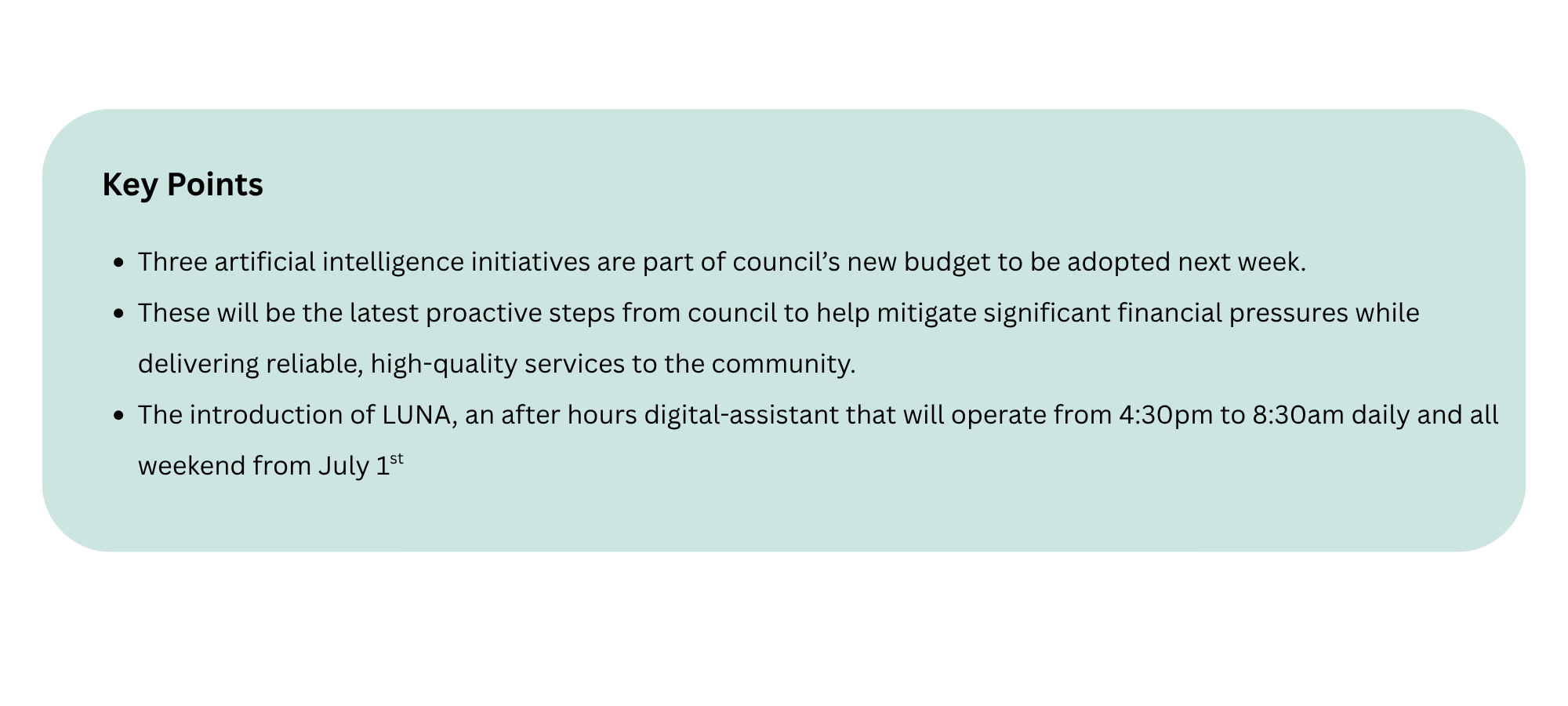
Three artificial intelligence (AI) initiatives are part of council's new budget to be adopted next week.
These initiatives are the latest proactive steps from council to help mitigate significant financial pressures while continuing to deliver reliable, high-quality services to the community.
Mayor Greg Williamson said the 2026/27 Budget reflected both the challenges facing local government and council’s commitment to modern, efficient service delivery.
“Like many councils across the country, we are facing rising costs and reduced external funding,” he said.
“Our focus is on finding smarter, more sustainable ways to deliver services without compromising quality for our community.”
Council has seen a startling increase in a costs over recent years, including:
These pressures highlight the ongoing challenge of balancing affordability for residents with the real cost of delivering essential services.
To help offset these impacts, council is investing in practical, targeted AI solutions that improve efficiency and reduce operating costs.
A key initiative is the introduction of a new after-hours digital assistant, LUNA, which will operate from 4.30pm to 8.30am daily and all weekend from July 1.
Replacing a previous afterhours model which used an outsourced, third-party call centre, LUNA will provide consistent, auditable responses using council-approved information.
It will improve how afterhours calls are triaged, especially urgent and emergency enquiries, and will allow routine requests to be handled without delays or manual intervention.
The transition follows changes in the external provider market and is expected to deliver about $80,000 in annual savings, while maintaining service quality and improving response consistency.
Mayor Williamson said this initiative demonstrated council’s commitment to innovation while managing costs.
“We’re using proven technology to deliver services more efficiently while maintaining the high standard our community expects,” Mayor Williamson said.
Council is also expanding AI use in key service areas to address increasing demand and resource constraints.
In Development Planning, automation of high-volume, low-complexity administrative tasks will reduce processing backlogs and allow skilled staff to focus on more complex work.
A similar outcome will be achieved by using Agentic AI to enhance internal corporate services, allowing council’s staff to tackle more complex issues.
This will help council maintain service levels despite workforce and cost pressures.
Mayor Williamson said council was adopting a scalable approach to AI, building on existing systems to deliver improvements across multiple service areas rather than one-off solutions.
“This approach ensures responsible and sustainable adoption of new technologies,” he said.
“By reducing repetitive manual work and improving consistency, we can better manage costs while maintaining strong governance and oversight.”
While efficiencies from these initiatives will be realised progressively, council’s immediate focus is on improving reliability, reducing inefficiencies and supporting a sustainable workforce model.
These actions form part of council’s broader commitment to ensuring services remain efficient, accountable and future-ready, even as financial pressures continue to grow.
Mayor Williamson said innovation would be key to navigating future challenges.
“Innovation is essential to navigating the challenges ahead. By investing in smarter ways of working now, we are helping protect the services our community relies on into the future while putting downward pressure on rate rises.”

Publishers Indemnity. Any individual or entity that places advertising, supplies copy material, or submits editorial content to Core Life Publishing agrees and undertakes to ensure that all such material:- Does not infringe upon any copyright, trademark, or other intellectual property rights;- Is free from any content that could be considered defamatory, libelous, or slanderous;- Does not infringe upon any rights related to privacy or breach of confidence;- Contains no obscene, indecent, or otherwise unlawful material;- Complies fully with the Trade Practices Act and all other applicable laws, regulations, or statutes.Furthermore, by submitting or placing such material, these individuals or entities agree to indemnify and hold harmless the publisher, Core Publishing and Events Pty Ltd, and/or its agents from and against any and all investigations, claims, demands, liabilities, damages, costs, or judgments arising out of or in connection with the material provided. All material is believed to be accurate at the time of printing and remains the copyright of Core Publishing and Events Pty Ltd.
© 2026 Mackay and Whitsunday Life Pty Ltd.