Independently Owned, Locally Grown, Community Loved

.jpg)
Junior doctors swapped hospital wards for an underground mine during a unique Mackay training exercise, gaining firsthand experience in managing complex emergency situations while exploring the rewards and challenges of a career in regional medicine. Photos supplied
Hard hats replaced lecture halls when junior doctors headed underground as part of an immersive training exercise during the 2026 Junior Doctors Conference in Mackay.
Delivered through a collaboration between the Australian Medical Association Queensland (AMAQ) and James Cook University's Northern Queensland Regional Training Hubs (NQRTH), the workshop gave participants firsthand experience of the challenges and opportunities of regional medicine.
Held at the Resources Centre of Excellence on July 26, the sold-out program included three simulated emergency scenarios: a cardiac arrest, a crush injury and an underground fire.
Working alongside personnel from Anglo American and the Queensland Mines Rescue Service, participants built leadership, communication and rapid decision-making skills while gaining valuable insight into practising medicine in regional communities.
JCU NQRTH Regional Medical Training Manager Cherie Miller said, “Attracting and retaining Australian-trained doctors in regional communities is critical to the future of healthcare in Queensland.”
“This workshop gives junior doctors and medical students an authentic insight into the range of situations and clinical challenges they may encounter while practising in regional areas — not just in hospitals, but in complex, real-world industrial environments.
“What we’re offering here is something junior doctors simply don’t get in a city-based training pathway.
AMAQ President Erica Gannon said the program highlighted Mackay as a place where doctors can build rewarding and diverse careers.
“First-hand experience of high stakes disaster response is the kind of unique training we know will spark excitement and enthusiasm for our members,” the associate professor said.
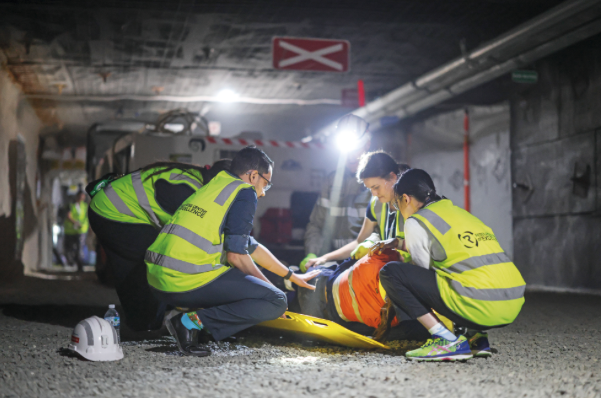
Anglo American Grosvenor Mine rescue captain Boyd Buschmann, who competed in this year's International Mines Rescue Competition in Zambia, drew on more than 20 years of experience to develop the emergency scenarios, saying the workshop was a valuable opportunity to share practical knowledge gained through decades of emergency response and preparation.
“If these junior doctors choose a career in regional medicine, there’s a good chance they’ll one day be called upon to support situations where these skills can make a real difference,” he said.
“The scenarios we created were designed to be as realistic as possible because that’s how people learn. We wanted the junior doctors to experience the kinds of challenges they could face managing complex situations and working effectively with other emergency response teams.
“It’s important we share our learnings with the next generation so they enter the workforce better prepared for complex emergencies whether it’s on an industrial site, at a road crash or in the community.”
Following the mines rescue scenarios, junior doctors worked with Mackay Hospital and Health Service (HHS) senior medical staff to further enhance their judgment in clinical environments.
Mackay HHS Chief Executive Sean Birgan said the doctors involved had first-hand experience in responding to major trauma events involving multiple casualties.
“Our senior medical staff can provide invaluable insight into the realities of responding to situations like these and they are keen to inspire future rural and regional specialists,” he said.
Publishers Indemnity. Any individual or entity that places advertising, supplies copy material, or submits editorial content to Core Life Publishing agrees and undertakes to ensure that all such material:- Does not infringe upon any copyright, trademark, or other intellectual property rights;- Is free from any content that could be considered defamatory, libelous, or slanderous;- Does not infringe upon any rights related to privacy or breach of confidence;- Contains no obscene, indecent, or otherwise unlawful material;- Complies fully with the Trade Practices Act and all other applicable laws, regulations, or statutes.Furthermore, by submitting or placing such material, these individuals or entities agree to indemnify and hold harmless the publisher, Core Publishing and Events Pty Ltd, and/or its agents from and against any and all investigations, claims, demands, liabilities, damages, costs, or judgments arising out of or in connection with the material provided. All material is believed to be accurate at the time of printing and remains the copyright of Core Publishing and Events Pty Ltd.
© 2026 Mackay and Whitsunday Life Pty Ltd.