Independently Owned, Locally Grown, Community Loved


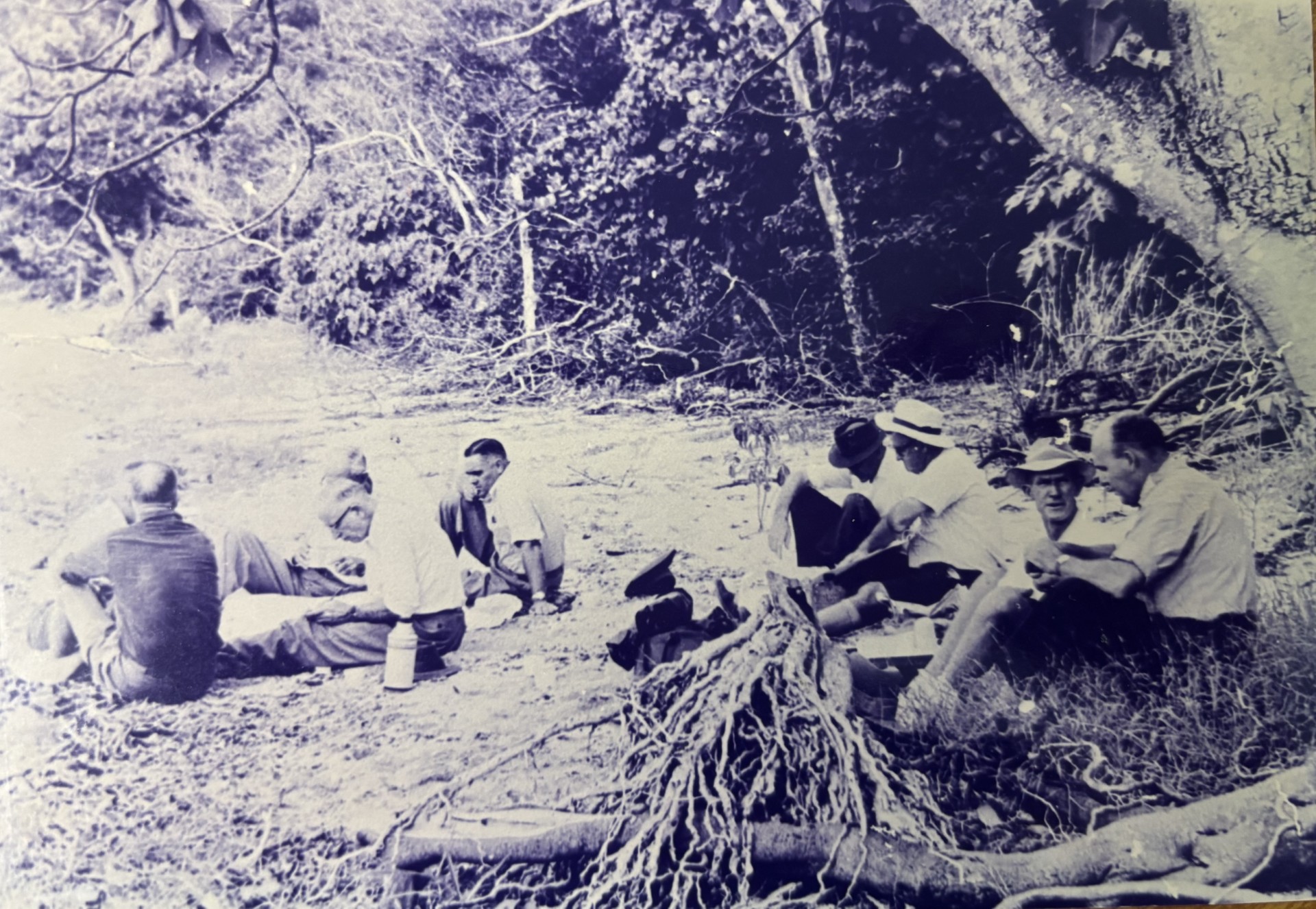
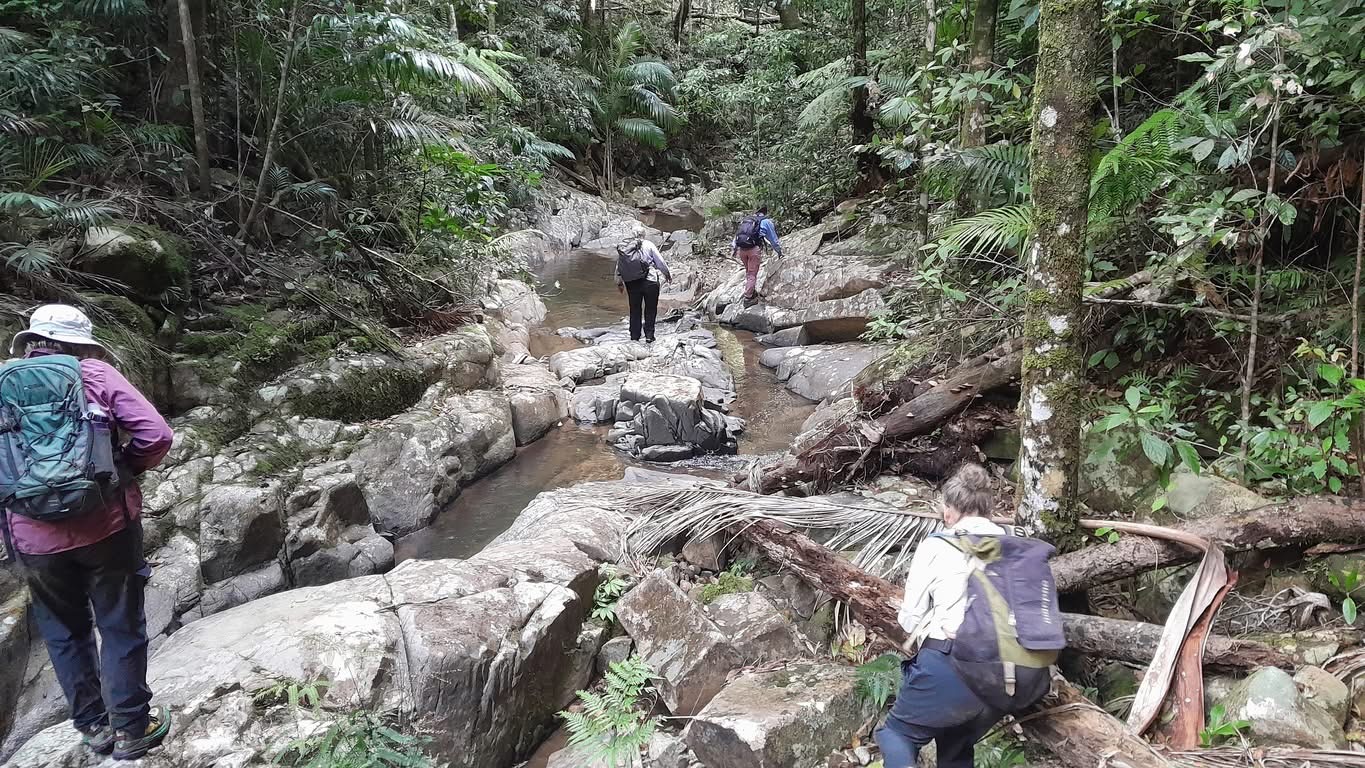
People taking a break from exploring a possible Shute Harbour route from Jubilee Pocket, in 1959. Showcases how underdeveloped the land was at the time. Photo supplied: Larraine Biggs.
Solitary men eking out a living from the land.
In the 1940s and 1950s, our beautiful wild countryside acted like a magnet for several independent souls who sought to construct their own utopian, hermit-like existence within its confines. Some succeeded in eking out an almost completely self-sufficient lifestyle. Usually, they were to be found close to the water as this was their preferred means of transport. They cleared a small area of land on which to construct a cabin.
One such character was George Bailey, a retired Royal Navy engineer, who decided to settle on a small clearing close to Mars Beach, adjacent to neighbours, Athol and Alex Pringle, perhaps very close to where Northerlies is located. Here he constructed a small blue cabin with a shell grit pathway curving down to the beach. Land connection to Cannonvale was not much more than a rough dirt track, but George’s lifestyle rendered this irrelevant.
He purchased a sailing boat which had been raced in the celebrated Brisbane to Gladstone Yacht Race and modified it for rowing. He used it regularly to row across the bay to Cannonvalley Beach store to collect his mail and provisions, often sleeping in his boat on the beach while he waited for the tide to change.
Contemporary locals remembered him as a bright and intelligent man who enjoyed discussing nineteenth century English Literature and had a working knowledge of Esperanto, the planned universal language of the time. George’s relaxed lifestyle included fishing, sailing, looking after his fruit trees and feeding scrub turkeys. There are probably better ways to live but not many!
Bailey was only one of the men living a hermit existence within the fold of the hills. Another George – George Sax – was written about in an earlier article back in September, 2022.
Many died as they had lived, in solitude, as was the case with old Billy Fitzsimmons who lived further on from John Campbell’s place, about as far as one could go. (Stay tuned for John Campbell’s story in a future edition.) Many others made their own unique contribution such as the “Mayor of Muddy Bay” who lived in the mangroves that used to flourish near where the roundabout to Shute Harbour Road is situated, along with his spray painted dog that didn’t seem to mind being purple!
John Harper described them very well – “These men had a natural dignity, a sturdy independence, and a quiet reserve that was engaging. Mostly they lived in some crude shelter which they had built mainly from rough, hewn wood and sapling poles. If they had no iron for a roof, they made a thatch. Their utensils were a saucepan or two, a frying pan and the old black billy. They had an enamel pannikin or two for their tea. Cupboards were old cases and kerosene tins.
They did not encourage visitors, but if you called, they would always put the billy on. If they had not seen a soul for longer than usual, they may be on for a talk. Squatting down poking a stick into the fire, they would recall life as a fettler, or as a shearer. Some had survived Gallipoli or France in the Great War, and most of them had seen very hard times during the Depression.
There is no use speculating on why they chose to live as they did. They would never tell you the real reason. Perhaps because some of them did not know the reason anyway and the others had a reason not to tell.”
Story and photo courtesy Proserpine Historical Museum archives and information also sourced from “Life on the Harper Farm” by John Harper.
Publishers Indemnity. Any individual or entity that places advertising, supplies copy material, or submits editorial content to Core Life Publishing agrees and undertakes to ensure that all such material:- Does not infringe upon any copyright, trademark, or other intellectual property rights;- Is free from any content that could be considered defamatory, libelous, or slanderous;- Does not infringe upon any rights related to privacy or breach of confidence;- Contains no obscene, indecent, or otherwise unlawful material;- Complies fully with the Trade Practices Act and all other applicable laws, regulations, or statutes.Furthermore, by submitting or placing such material, these individuals or entities agree to indemnify and hold harmless the publisher, Core Publishing and Events Pty Ltd, and/or its agents from and against any and all investigations, claims, demands, liabilities, damages, costs, or judgments arising out of or in connection with the material provided. All material is believed to be accurate at the time of printing and remains the copyright of Core Publishing and Events Pty Ltd.
© 2026 Mackay and Whitsunday Life Pty Ltd.

.jpg)