Independently Owned, Locally Grown, Community Loved


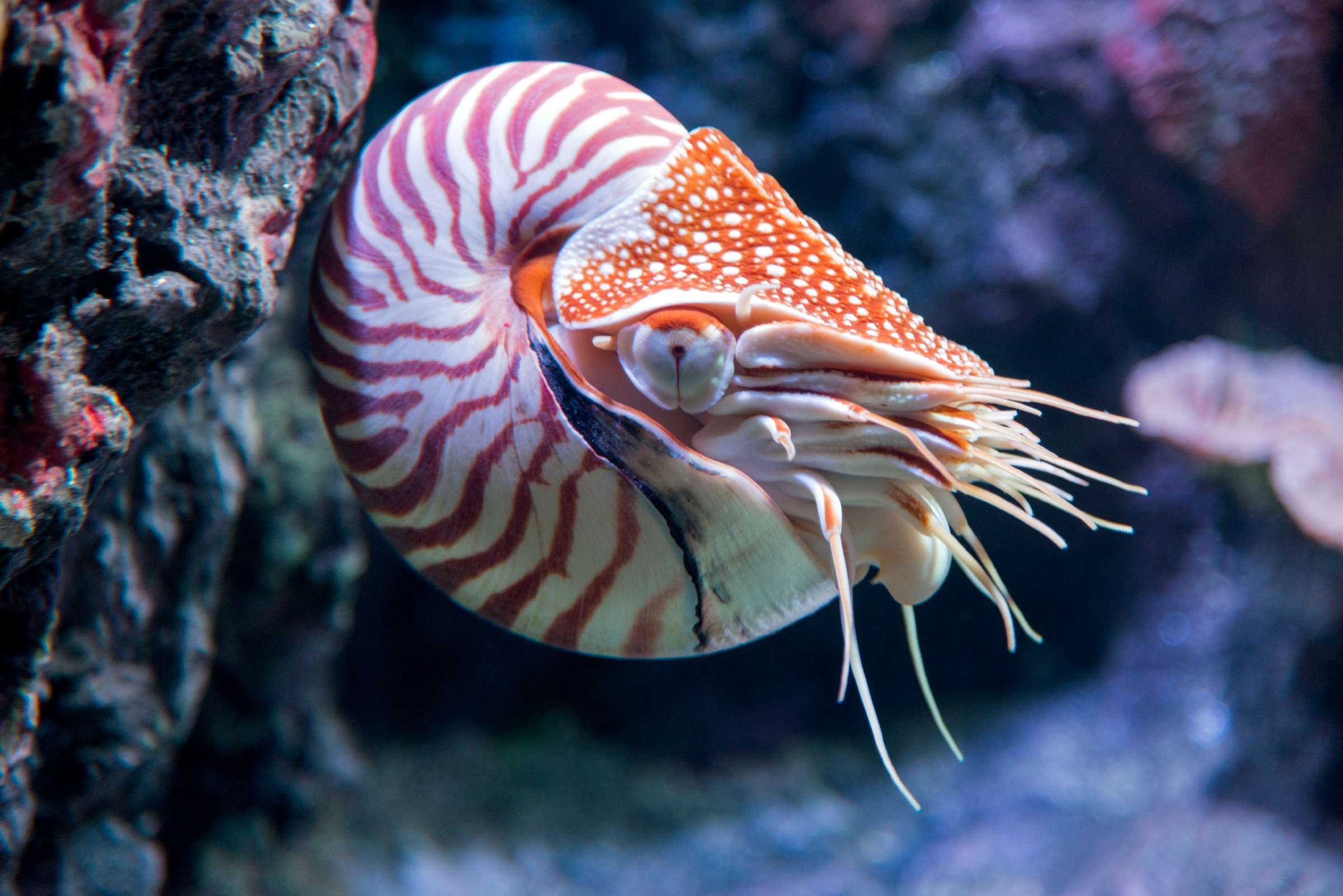
Chambered Nautilus
Our oceans may have changed dramatically since the age of the dinosaurs, yet one remarkable creature has endured the passage of deep time and continues to drift alongside modern marine life today — the chambered nautilus.
Often described as a “living fossil,” the nautilus has remained largely unchanged for around 500 million years. Fossil records reveal that its ancestors swam Earth’s oceans long before the first dinosaurs appeared, making it one of the planet’s most ancient surviving animal lineages.
Native to the tropical Pacific Ocean, including the Great Barrier Reef, the nautilus belongs to the class Cephalopoda, making it a distant cousin of octopuses, squid, and cuttlefish. Unlike its soft-bodied relatives, however, the nautilus lives inside a hard external shell divided into a series of chambers.
This shell is far more than a protective home — it is a buoyancy control device. By adjusting gas and fluid within its chambers, the nautilus can rise or sink in the water column much like a submarine.
During daylight hours, nautiluses avoid predators by remaining along deep reef slopes, sometimes descending to depths of 700 metres. For extra protection, they can seal themselves inside their shells using a specialised hood that functions like a trap door. Under cover of darkness, they migrate upward to shallower waters — around 70 metres — to feed and reproduce.
The nautilus boasts more than 90 tentacles — more than any other cephalopod. Unlike the suckered arms of octopuses and squid, these tentacles have ridges and grooves coated in sticky secretions that help grip prey. Food such as crabs, shrimp, fish, and carrion is passed to a sharp, beak-like mouth, then shredded further by a radula — a ribbon-like structure lined with tiny teeth.
Its eyesight is primitive, limited to detecting light and dark through pinhole-type eyes. However, the nautilus compensates with an acute sense of smell and an ability to detect water depth, current direction, and speed — essential skills for survival in deep environments.
In contrast to most cephalopods, which live short, fast-paced lives, the nautilus is slow-growing and long-lived. It may survive more than 20 years and does not reach maturity until 12 to 15 years of age. Females lay only 10 to 18 eggs annually, each taking about 12 months to hatch — a slow reproductive cycle that makes populations vulnerable to decline.
Movement is achieved through jet propulsion. By expelling water through a siphon near its head, the nautilus can manoeuvre forward, backward, or sideways with surprising agility.
Its most iconic feature remains its shell — a stunning spiral displaying the mathematically precise Fibonacci pattern. This natural geometric beauty has fascinated scientists, artists, and collectors alike.
Contributed with thanks to the Whitsunday Conservation Council

Publishers Indemnity. Any individual or entity that places advertising, supplies copy material, or submits editorial content to Core Life Publishing agrees and undertakes to ensure that all such material:- Does not infringe upon any copyright, trademark, or other intellectual property rights;- Is free from any content that could be considered defamatory, libelous, or slanderous;- Does not infringe upon any rights related to privacy or breach of confidence;- Contains no obscene, indecent, or otherwise unlawful material;- Complies fully with the Trade Practices Act and all other applicable laws, regulations, or statutes.Furthermore, by submitting or placing such material, these individuals or entities agree to indemnify and hold harmless the publisher, Core Publishing and Events Pty Ltd, and/or its agents from and against any and all investigations, claims, demands, liabilities, damages, costs, or judgments arising out of or in connection with the material provided. All material is believed to be accurate at the time of printing and remains the copyright of Core Publishing and Events Pty Ltd.
© 2026 Mackay and Whitsunday Life Pty Ltd.