
Independently Owned, Locally Grown, Community Loved

At just 18 months old and weighing 17kg, Obi is a happy little guy with plenty of love and enthusiasm for life. Getting along well with children, other dogs and visitors, he has plenty of potential to become a much-loved member of his new family. Obi had a rough start to life and can still find the world a little scary at times, so he is looking for a patient and understanding family willing to help build his confidence and show him the ropes. He already knows his basic commands and walks confidently on the lead, making him a great companion for someone happy to continue guiding him as he settles into his new life. Once Obi gets to know and trust you, he will become an unshakeable little shadow, following his favourite person wherever they go. If you have the time, patience and love to give Obi the fresh start he deserves, contact his carer Char on 0402 540 612 to arrange a meeting. Alternatively, email LLTAGSandDogRescue@gmail.com to find out more.
Read the full story
No city or region in Australia has been unaffected by the property market changes that have become obvious ever since the Federal Government introduced its budget in May, removing negative gearing from established housing and changing the capital gains tax rules. But some have been hit harder than others. The latest property market review by valuers Herron Todd White gives an extensive rundown of where particular regions sit as well as the nation as a whole. HTW chief economist Cameron Kusher pointed out in the September review that inflation continues to be a factor, not only in cost of living but also projected interest rate rises in the months ahead. He said: “National dwelling values fell by 3.1 per cent over the three months to August 2026, with capital city values 3.7 per cent lower and regional values falling by 1.2 per cent.” He said property market analyst Cotality estimates that over the three months to August 2026 “there were 14.6 per cent fewer property sales than the same period last year”. “Transaction activity has seen a much greater decline in the capital cities than in the regional markets; however, falls are broad-based,” he said. “Every capital city except for Hobart is seeing a higher volume of properties available for sale relative to a year ago, and only regional Tasmania and regional NT are seeing fewer total listings. “Sydney, Melbourne and Canberra have historically high listing volumes, and although they aren’t at historic highs elsewhere, Brisbane and Perth have seen annual increases of more than 50 per cent, and Adelaide has seen an annual increase of more than 40 per cent. “The heightened volume of stock for sale at a time in which there are fewer active buyers in the market means that those who are buying have less urgency and more choice. In turn, this means that they have greater scope to negotiate on price, and there are many properties that will take a long time to sell in this market or simply won’t transact. “In the regional areas, the longest median days on market are in NT, NSW and Victoria and the lowest are in WA, Queensland and Tasmania.” The HTW monthly review includes their very interesting property clock, in which they categorise where particular markets are in the property cycle. Sitting at 3 o’clock on the property clock in a declining market are Sydney, Melbourne and Canberra. Sitting in the “starting to decline” category includes cities such as Alice Springs, Brisbane and the Gold Coast. Several Queensland cities are included in the “peak of the market” category; Gladstone, Bundaberg and Toowoomba. And cities in the “approaching the top of the market” category include Cairns, Sunshine Coast, Townsville and the Whitsundays. What about the cities still sitting at 9 o’clock, the “rising market” category? Well, there aren’t nearly as many cities in that category as there were a few months ago but it still includes Mackay, Rockhampton and Emerald, among a few others. HTW can only go on the data in front of them, however agents on the ground experience the market as it happens. It is true that the Mackay market is behaving nothing like the free fall being felt in major cities like Sydney. The economy is going well, unemployment is virtually non-existent, rental vacancies are low and properties are selling. However, no agent in Mackay will tell you that right now Mackay is in a rising market. It’s still active and people are still buying but at the moment it’s not going up … it represents a great opportunity for those wanting to get into the market and investors seeking one of Australia’s best rental returns.
Read the full story
Locals gathered in Mackay last Saturday for the annual March For Life, which brought together supporters of the pro-life movement. The march began at Harbour Road before finishing at Caneland Central Park, where attendees heard from guest speakers and community representatives. Among those attending was Cherish Life Queensland CEO Matthew Cliff, who travelled from Brisbane for the event. Operating since 1970, and formerly known as Right to Life Queensland, Cherish Life is one of Queensland's longest-established pro-life organisations, with branches throughout the state, including Mackay. Mr Cliff, who has been CEO for around four and a half years, said the organisation's work centred on two key areas of education and advocacy, aiming to encourage greater understanding of its pro-life position, while engaging with elected representatives and participating in public discussions about abortion. Mr Cliff said the organisation also connected women experiencing unplanned pregnancies with other services that could provide practical and emotional support. Though Cherish Life do not offer direct assistance themselves, they refer women to services like Hope's Dream, a Christian-based, non-profit charitable organization which provides pregnancy counselling and support. “The rallies are really a good way of bringing public awareness,” Mr Cliff said. “It's an opportunity for people who support the pro-life movement to demonstrate why this is important to them.” Mr Cliff said his own Christian beliefs played a role in shaping his position, with his views centred on the belief that human life is valuable from conception. “The Christian method in which I believe as the CEO of Cherish Life Queensland is to walk in grace and truth, and truth in love, and that all human life from conception is valuable,” he said. The Mackay event featured several speakers and representatives, including Mr Cliff, Australian Christian Lobby Assistant Director Daniel Adsett, Family Voice Australia Queensland Director Andrew McColl, Lighthouse Church Mackay Pastor Jai Wright and St Joseph's Catholic Church Associate Pastor Rev. Fr. Raju Mandothparambil. While Cherish Life advocates against abortion, other organisations take a different view of reproductive rights. CEO of Queensland pro choice organisation Children By Choice Anjulee Singh shared: “Children by Choice believe all people have the right to make decisions about their own body and health care. “Abortion is legal healthcare and should be accessible without barriers regardless of where you live.” The organisation advocates for accessible reproductive care in regional communities, claiming that stigma and privacy concerns can make it hard to ask for help, and can prevent women from pursuing the healthcare they are entitled to. “Everyone has the right to make their own decision about their pregnancy, whether that means continuing, ending, or considering adoption,” the organisation states. “Support should be non-judgemental, confidential, and respectful.” The differing perspectives come amid ongoing public and parliamentary debate about reproductive rights in Queensland, including discussions involving Mackay MP Nigel Dalton, who earlier this year crossed the floor in opposition to restrictions on parliamentary debate about abortion. Photo source: Cherish Life QLD - Mackay Branch
Read the full story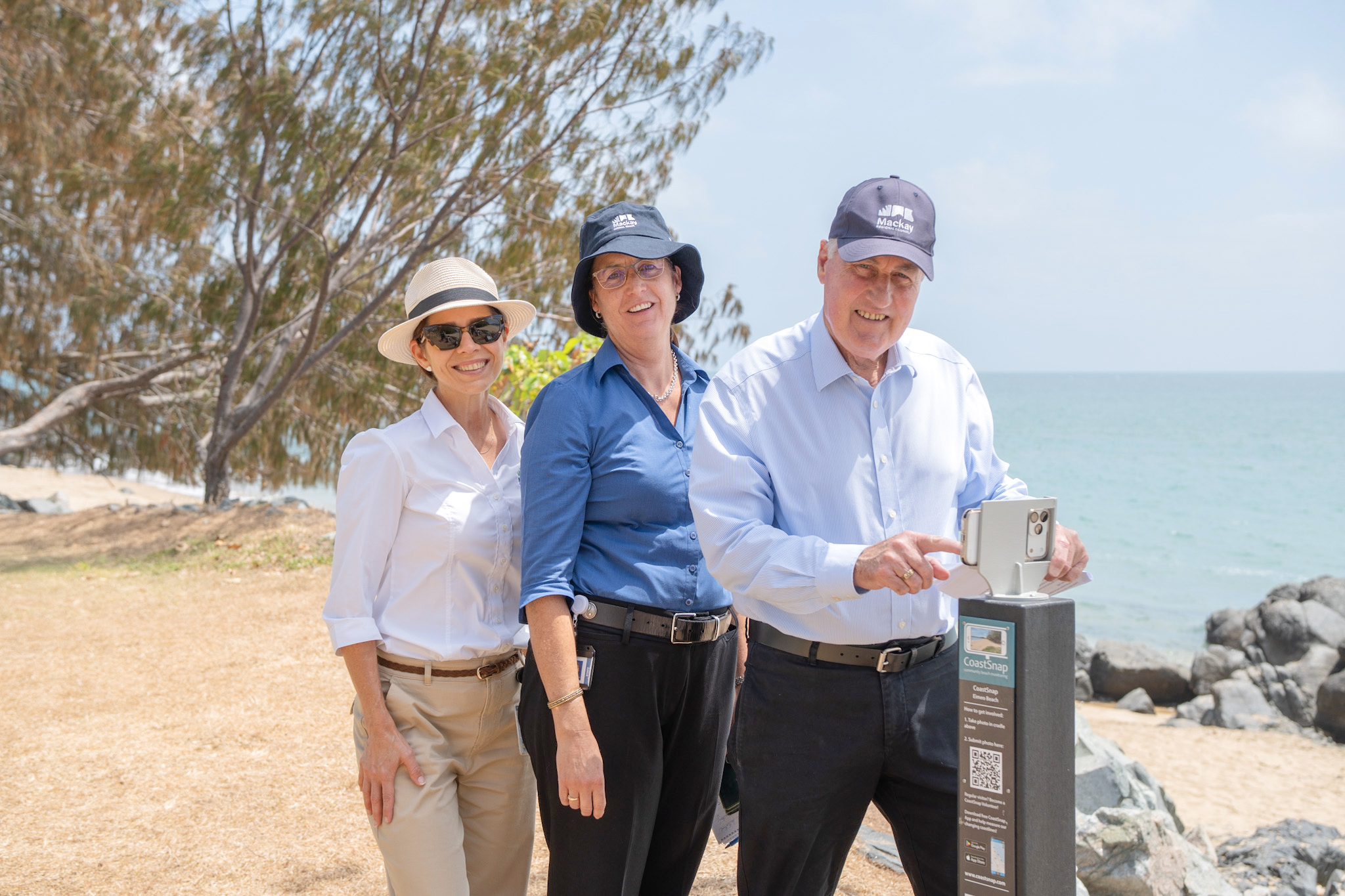
Mackay beachgoers are encouraged to put their photography skills to good use, with the arrival of two new monitoring stations giving community members a hands-on role in tracking changes to the coastline. Eimeo Beach and Lambert’s Beach are the first locations to introduce the newly installed CoastSnap poles, which feature a phone cradle where residents and visitors can position their phones, capture an image of the coastline and upload it through the CoastSnap app. Photos taken from the same position over time will help build a long-term record of sand movement, beach erosion and recovery, providing valuable information to support future coastal management. Mackay Regional Council Mayor Greg Williamson said the project, led by the University of New South Wales, would give council access to valuable monitoring data while allowing the community to get involved. "It's easy to use. You just follow the barcode. And you can do it anonymously, you don't have to put your name on it," he said. Mr Williamson said the photographs and accompanying observations would help build a detailed picture of how the region's beaches change over time. "If everybody does that every day, just imagine the record that we're going to have via the University of New South Wales to manage this in the future," he said. "This is just another tool for us to be able to effectively manage the 31 beaches we've got in our region." Council's Coordinator of Waterways and Coastal Planning Robyn Burkett said the initiative formed part of the Mackay Coast Our Future project, helping council better understand coastal conditions and plan for future changes. "It's about monitoring our beaches, and community education, so that's why we're encouraging people to come along, snap a photo, and learn more about coastal hazards and how our coastal processes work in the Mackay region," she said. Ms Burkett said ongoing monitoring would help determine how much sand was lost during storm events, whether beaches recovered naturally and when intervention might be needed. "Having good information now, when we experience a storm event, looking at what those changes are, and how much sand is lost, whether it will recover over time, or whether it needs intervention is really important." The CoastSnap initiative was founded in 2017 as a pilot project by the University of New South Wales, with more than 100 poles now installed across 16 countries. The two Mackay stations were funded by council, with further locations being considered for the region. To learn more, visit www.coastsnap.com or visit connectingmackay.com.au/mackay-coast-our-future. L-R - Robyn Burkett, Coordinator Waterways and Coastal Planning for Mackay Regional Council, Kylie Cauchi, Waterways Planning Advisor for Mackay Regional Council and Mayor Greg Williamson of Mackay Regional Council, testing out the new CoastSnap pole at Eimeo Beach. Photo credit: Hannah McNamara The impact of tropical cyclone Debbie in 2017. Supplied by Mackay Regional Council
Read the full story

A juvenile joyride traffic incident involving a stolen vehicle has left both the Whitsundays and Burdekin communities on high alert following an almost 24-hour ordeal.
A white Hyundai hatchback was reported stolen from an address close to Home Hill State School the morning of Monday the 20th of January. Locals took to online platforms to demand harsher consequences for offenders with many members of the community saddened to learn the car belonged to a Home Hill grandmother.
Reports have emerged of witnesses sighting the stolen vehicle driving recklessly at around 11pm on Monday night around Soldiers and Horseshoe Bay Road in Bowen, with locals warning their neighbours to take precaution and sharing CCTV footage online.
“Warning Bowen residents – there is a stolen car from Ayr making its way around Bowen, a white hatchback, lock your cars and doors, police have been notified,” shared one concerned Bowen resident.
The five offenders aged 13, 14, 15, 17 and 18, then drove the stolen car back along the Bruce Highway and home to the Burdekin before crashing into an Alva Beach electricity pole at around 5:30am.
“The group of five allegedly left the scene on foot and attempted to evade police but were arrested a short time later at a local caravan park,” a QPS spokeswoman said.
A 13-year-old Home Hill girl, a 14-year-old Home Hill boy, a 15-year-old Home Hill girl, and a 17-year-old Home Hill girl were all charged with one count of unlawful use of a motor vehicle – use in company and appeared in the Ayr Children’s Court on Wednesday the 29th of January.
The fifth offender, an 18-year-old Home Hill man has been charged with one count each of unlawful use of a motor vehicle – use in company, possessing dangerous drugs, possessing utensils or pipes that had been used and breach of bail offences. He is due to appear in the Ayr Magistrates Court on Monday the 10th of February.
The car was left extremely damaged after the ordeal

Burnout used to be the workplace experience we all tried to manage and avoid. In 2025, it’s Change Fatigue.
Change fatigue is feeling exhausted or overwhelmed in response to organisational changes. Covid-19 was when we first started noticing this phenomenon as businesses pivoted left and right to keep up with ever-changing government policies, protocols and requirements.
Today we are being bombarded with constantly shifting workplace flexibility & hybrid work policies, AI technology, keeping ahead of competitors, 4 different generations co-working for first time in history, as well as living in the ‘woke’ generation and trying desperately to stay relevant in an ever-changing landscape.
If you haven’t been paying attention and wondering why your team seems so unmotivated at the moment, here’s some suggestions on how to manage change fatigue:
• Take a beat – acknowledge the change and the angst it may cause
• Celebrate the changes the team has navigated so far
• Discuss why the change is needed – provide purpose
• Understand – uncertainty is anxiety-inducing so be compassionate and patient
• Plan – create a plan on how to implement and manage the change
• Communicate – at the heart of every workplace stress is usually subpar communication
If you’ve recognised that someone in your team is experiencing change fatigue:
1. Schedule a 1:1.
2. Acknowledge the journey they’ve been on.
3. Discuss how they may have benefitted from these changes (growth mindset vs fixed mindset)
4. Celebrate their growth
5. Discuss how to improve the planning & communication on future changes
The only constant is change; how are you helping your team manage constant change?

The good volunteers at the Whitsunday VMR service have had a busy few days. From stingers to sinking boats, they were on the case in the worst of the weather, teaming up with paramedics to ensure the safety of everyone they rescued.
It’s stinger season, and no one should be swimming in the Whitsunday area without a suit. A yachting group paid heed to this and wore them while swimming off the back of their boat but afterwards took them off for a leisurely stroll down the beach. To cool off they romped in the ankle-deep water and the result? One badly stung chest and more than two hours of absolute agony! Fortunately, the VMR team had paramedics on board who were able to administer morphine and the man survived.
Another rescue that happened close to shore was when the VMR team were called to assist a sinking plate boat and its occupants who were stranded on the beach. While the rescue situation appeared simple at first, the boat surprised everyone when it upended and sank to the bottom.
Scratching their heads about that, the team headed off to perform another rescue on the other side of Whitsunday Island. It was tough going as everyone was soaked due a storm creating rough seas and heavy rain. But thunder and lightning did not stop this rescue mission, and after five hours on the water the dedicated crew returned to home base, having rescued all the people and recovered and towed the two boats back to safety.
The skipper that day was Ken Bryce. He is a master 4, with a lot of around the world sailing experience. He brings an enormous depth of skill to our rescues and quite frankly there is no one else you would want to be relying on more in a marine emergency. Of course, he never works alone, and leads a dedicated team, helping people stay out of trouble in the water.
These include those working behind the scenes like radio-operator and fundraisers, without whose efforts VMR could not be put to sea. It’s tough finding volunteers, so if you would like to join the team, please go to the VMR Whitsunday website and sign up. Visit https://vmrwhitsundays.com.au/volunteer/ to learn more and start your marine rescue journey.
The plate boat sinking just off-shore. Photo provided: Shane Newell
Rescuers trying to hitch a tow on the sinking plate boat. Photo provided: Shane Newell

The Whitsundays have long been celebrated for their stunning landscapes, particularly their pristine beaches. It’s no surprise, then, that Whitehaven Beach on Whitsunday Island has recently been named the best beach in the world for 2025 by Lonely Planet, beating out a host of international contenders.
With its iconic white silica sands stretching over 7km, crystal-clear turquoise waters, and breathtaking panoramic views, Whitehaven continues to captivate visitors from around the globe. This recognition marks yet another accolade for the beach, underscoring its unparalleled beauty.
Whitehaven Beach is not just stunning—it's a paradise for all kinds of activities! Whether you want to swim, relax in the sun, hike, camp, snap photos, try out water sports, or spot wildlife, there's something for everyone. It’s a picture-perfect destination for a beach day and offers breathtaking views at every turn.
Local Mayor Ry Collins took to Facebook to express his pride, calling the award a testament to just how extraordinary Whitehaven is.
He further congratulated everyone who contributed to supporting the recognition:
“Well done to those that contribute to supporting this recognition including our tourism operators and body, national parks officers and the broader community.”
Whitehaven Beach, overtook, beaches like squeaky beach in Victoria and Anse Sourse d’Argent, La Digue in the Seychelles.
Mayor Ry Collins and his family at Whitehaven Beach
Whitehaven beach named Worlds Best Beach

The story of Betty Hazel Watts and a life committed to excellence in learning began with her birth in Proserpine on July 21 1928. After attending primary school at Proserpine State School, she completed her secondary education at Blackheath College, Charters Towers. For eight years, commencing in 1946, aged only 17, Betty began teaching in primary schools in Brisbane and in various country centres including Proserpine. During this time, she completed Bachelor Degrees in Arts and Education through external study while teaching fulltime. She also gained letters in LTCL with honours in Art of Speech.
Between 1954 and 1974, Betty held many prominent positions in the field of education. She was appointed Senior Research Assistant at University of Queensland (1954 – 1956); Lecturer in Education (1957 -1965); Senior Lecturer in Education (1966-1971); Reader at Schonell Educational Research Centre (1972 -1974) and from 1974-1981 she was Professor and Director of the Centre.
It is not surprising, then, that in 1976 she was awarded the Order of the British Empire (O.B.E.) for service to education.
Betty Watts was a Foundation Member of the Queensland Board of Teacher Education (now College of Teacher Registration). Serving from 1977-1988, she was one of the longest serving members having held the position for all but two years of its existence; including three terms serving as Chairman.
Further acknowledgement of her ongoing contribution was recognised in 1982, when Betty was awarded the Mackie Medal for distinguished work in the field of education.
Betty Watts was a forerunner in the movement to close the gap in educational outcomes between European and indigenous children and a foundation member of the Australian Institute of Aboriginal Studies, acting as a consultant to State and Federal governments on Aboriginal Education. During her ‘spare’ time as Dean of University of Queensland Department of Education, she published nine separate reports on the education of Aboriginal children, non-English speaking migrants and children with disabilities. These reports were based on primary research which involved interviews and discussions with parents in their own homes where they could relax and voice their true concerns. She would say, “School practices need to take account of what children’s homes and parents are really like.”
From 1976 – 1981, Betty chaired the Ministerial Advisory Council on Special Education and was a member of the National Inquiry into Teacher Education (The Auchmuty Report) from 1979 - 1982.
She was also a member of the National Library Council and such was the esteem in which she was held, that she was invited to open the new library at James Cook University in 1992.
After her retirement, Betty Watts OBE was awarded Life Membership of the Australian Association for Research in Education (AARE) in recognition of her enormous contribution to the field of education and how important her work was viewed by her academic contemporaries.
In 2011, fifteen years after her death, a memorial award - The Professor Betty Watts Award for Outstanding Contributions to Teaching – was made in her name. Betty Watts helped so many people, particularly from vulnerable and disadvantaged groups. For her, education was for everyone. In the tribute to her at this award, Betty Watts was described as a “brilliant teacher” who had high expectations of her students and whose lessons sparked a “sense of excitement”.
Betty Watts died November 25 1997. She was only 69 and had dedicated over fifty years of her life to the people of Queensland as a teacher, lecturer, researcher and leader in education. Betty Watts truly earned the title “Emeritus”. This town can be immensely proud of one of its most celebrated daughters.
Story courtesy Proserpine Historical Museum. Photo courtesy of the Shannon family.
.png)
Lovely Raffi is a 2–3-year-old male cat who is best in a quiet, calm home. Like us all, he loves his peace so he would love a house with no children, loud noises or fast people.
Raffi is a gentle soul, so will need time to adjust to his new home, as he loves treats, some nice snacks will help him to do this.
However, once settled, Raffi is the most loving and affectionate companion, once he feels safe, he will sit and lay with you all day, including having the odd playful spurt.
Are you looking for a relaxed but loving companion who needs a little TLC? If the answer is yes, Raffi is your man.
To find out more about Raffi call or email Bowen Collinsville Pet Rescue:
Phone: 0459 757 455
Facebook: Bowen Collinsville Pet Rescue
Email: bcpri.adoptions@gmail.com

On the night of the 22nd of January, a power outage occurred causing a disruption to the water levels in the Bowen Reservoir. The Whitsunday Regional Council has put out a social media post alerting residents of the issue, along with providing reassurance of the safety of the water coming out of their taps.
Power outages can cause the water supply systems to stop operating and breakdown. The water pumps can shut down and water distribution systems can go offline if they do not a receive constant electrical supply. Also, a dam or reservoir can lose pressure because of an outage because of lowered water levels, hence why one of the procedures being conducted was refilling the reservoir.
The disruption has caused changes to the water supply such as discolouration and fluctuations in water pressure. This was to affect the residents in Bowen and the surrounding areas over the coming hours as the Bowen Reservoir underwent critical maintenance and refilling procedures.
The Council wished everyone to know that the water, though slightly discoloured, was still safe for consumption and general use. They apologised for any inconvenience the power outage and reservoir disruption had caused, while they undertook the critical works to bring the reservoir back to full function.
Two beautiful, giant water tanks that supply water to Bowen below. Photo Credit: Isaac Newman

The Queensland Gives Photo Challenge has begun with entry opening Saturday the 1st of February. The winning entry will receive a $500 prize and a donation of $2000 made to the charity of their choice.
Photographers of all levels anywhere in Queensland are encouraged to enter and show what giving and kindness look like through your lens.
The Photo Challenge is the perfect way for photographers, community groups and non-profit organisations to tell their stories and share their work. Entries can be realistic or conceptual, specific or broad, taken by anyone as long as you are a resident or organisation operating in Queensland.
If you are on social media, promote the challenge and share the love by tagging @QueenslandGives and using the hashtag #2025photochallenge when posting your photos. Multiple entries are accepted and the winning entry will be announced at the Queensland Philanthropy Week Launch at Parliament House in Brisbane on Monday the 2nd of June 2025.
It's time to pick up your camera or smart phone and capture an act of giving, kindness, doing good or to highlight a specific cause or issue affecting Queenslanders. Queensland Gives Chief Executive Officer Tara Castle said the Photo Challenge had produced hundreds of stunning and heartwarming images which captured the good work of Queenslanders over its history.
“Our state is home to thousands of unsung heroes who generously give their time and love to help others, and we are looking for images that capture that spirit of care and compassion.”
To enter, simply submit a photograph to the Queensland Gives website www.queenslandgives.org.au/photochallenge make sure it matches the photo requirements first. The competition closes on the 28th of February at Midnight so get out there and get snapping!
WHAT: Queensland Gives Photo Challenge
WHEN: February 1st – 28th
WHERE: Queensland-Wide

Last year Tourism Whitsundays had the pleasure of working with Virgin Australia and their PR agency, PEPR, to showcase the beauty of the Whitsundays to a wide audience. As part of this initiative, Tourism Whitsundays hosted six talented journalists in our stunning region, giving them a firsthand experience of what makes this place so special.
“We’re thrilled to see their coverage rolling out in prominent publications, inspiring Australians far and wide to discover our slice of paradise,” shared Rosanagh Gallivan, Tourism Whitsundays PR and Social Media Executive.
RUSSH Magazine’s guide highlights the top places to stay, eat, and explore, while Australian Geographic shares an incredible four-day itinerary for visitors of all kinds. The Sydney Morning Herald’s Traveller section offers tips on enjoying Queensland’s dreamiest region on a budget.
These stories, made possible by the collaboration and support of local operators, shine a spotlight on the Whitsundays unique charm and experiences.
“We’d like to extend our heartfelt thanks to everyone who contributed to this successful campaign,” added Rosanagh.
“Your dedication helps ensure that our region remains a must-visit destination and helps share the Whitsundays magic with travellers from all over the world.”
To read the full articles, check out RUSSH, Australian Geographic and the SMH Traveller sections online.
Contributed by Rosanagh Gallivan, PR & Social Media Executive, Tourism Whitsundays
The Journalists enjoying what the Whitsundays has to offer. Photo supplied.

Looking for the perfect spot to escape with friends or family? Let Tourism Whitsundays introduce or perhaps re-introduce you to Whitsunday Terraces Resort - where comfort, space, and stunning views come together to make your trip truly unforgettable.
The Interconnecting Dual Key rooms are a game-changer. Picture this: two kitchenettes, two bathrooms, and 2.5 balconies, all designed to give you and your crew plenty of room to spread out and enjoy. Whether you're whipping up a meal together, lounging on the balcony with a drink in hand, or just relaxing in your spacious retreat, these rooms offer the perfect balance of togetherness and privacy.
Ideal for families or groups, sleeping six people, everyone gets their own space without ever feeling cramped. It's the kind of place where you can have your own little slice of paradise yet still be right there with the people you love most. Plus, the views? Absolutely breathtaking.
So, grab your family, your best friends, or both, and get ready for a Whitsundays escape that’s all about making memories together. Because the only thing better than paradise is sharing it - without stepping on each other’s toes.
Contributed by Jade Yvonne, Business Development Executive, Tourism Whitsundays
Whitsunday Terraces Resort. Photo supplied.

Two lives have been lost on Mackay and Whitsunday roads in just one month, marking a tragic start to 2025. Authorities are pleading with all drivers to slow down, drive defensively, and stay vigilant. The recent fatalities are part of a growing road crisis across Queensland, with road deaths doubling compared to last year. Every decision made on the road can be the difference between life and death.
The Queensland Police Service urges everyone to pay attention to road conditions, act cautiously, and help prevent further heartbreak and loss.
“These tragic numbers are not just statistics, they represent fathers, mothers, sons, daughters, and friends whose lives have been cut short,” said Acting Chief Superintendent Garrath Channells of QPS Road Policing and Regional Support Command.
“We’re pleading with every road user to make the right choices, because every decision you make on the road has the power to save a life or take one.”
Mackay Whitsundays District Acting Inspector Jeremy Novosel emphasised the importance of driving to road conditions.
“We have had two fatalities this year in the Mackay and Whitsunday district, and we really implore that all road users travel safely and get to their destinations,” he said.
A 67-year-old motorcyclist from Roma lost his life after a traffic crash on the Bruce Highway near Mount Ossa earlier this week. He was airlifted to Mackay Base Hospital by BMA CQ Rescue. Photo credit: BMA CQ Rescue
Then use the head / shoulders of the police man in a circle on the front...
Caption: Mackay Whitsundays District Acting Inspector Jeremy Novosel
The first tragedy struck on the 7th of January when Ooralea father, Nick Evangelista, 58, was killed in a crash on Hay Point Road, Alligator Creek. Police allege that a speeding driver of a black Holden ute lost control, veering into the opposite lane and colliding with Mr. Evangelista's silver Kia. The driver of the ute reportedly tested positive to a roadside breath test.
Just two weeks later, on the 20th of January, a 67-year-old motorcyclist from Roma lost his life following a traffic crash on the Bruce Highway near Mount Ossa. According to police investigations, the man attempted to overtake a truck but lost traction, causing the motorcycle to crash into the truck. He sustained critical injuries and was rushed to Mackay Base Hospital, where he later succumbed to his injuries.
Inspector Novosel urged drivers to remain cautious, particularly in adverse conditions.
“We need to drive defensively, particularly where it is a situation that roads are affected by rainfall or other environmental circumstances, and we need to pay attention to road conditions and other road users,” he said.
The tragedies in Mackay and Whitsundays reflect a broader state-wide crisis. QPS data shows that more than 15 people have lost their lives on Queensland roads so far this year, which is more than double the toll for the same period in 2024.
“These tragic numbers are not just statistics, they represent fathers, mothers, sons, daughters, and friends whose lives have been cut short,” said Acting Chief Superintendent Garrath Channells of QPS Road Policing and Regional Support Command.
“Police are out there doing everything they can on the roads to try and bring this figure down and ensure people can return home to loved ones or their families.
“To then observe the deadliest start to the year since 2020 is truly harrowing.
“We’re pleading with every road user to make the right choices, because every decision you make on the road has the power to save a life or take one.”
The BMA CQ Rescue helicopter has already been called to assist with several serious incidents this year, including a multi-vehicle crash on the Peak Downs Highway earlier in January. While no fatalities were reported from that incident, one person was airlifted to Mackay in a critical condition, underscoring the need for extra vigilance on the roads.
To learn more about road safety and QPS’s initiatives to help make Queensland’s roads safer, visit: www.police.qld.gov.au/initiatives/road-safety
Mackay Whitsundays District Acting Inspector Jeremy Novosel. Photo credit: Hannah McNamara
The BMA CQ Rescue helicopter has responded to several serious incidents this year, including a multi-vehicle crash on the Peak Downs Highway in January. While no fatalities occurred, one person was airlifted to Mackay in critical condition. Photo Source: BMA CQ Rescue

Australia Day has long been a paradoxical holiday—both a celebration of national pride and a poignant reminder of history’s complexities. This year, as a wave of national pride resurges, Australians are seeking ways to honour the day with a mindful balance that respects its layered meanings.
For many, January 26 is a day to fire up the barbecue, toss a cricket ball, and celebrate what it means to be Australian: our laid-back nature, a love for community, and a determination to thrive despite the odds. Yet, for Indigenous Australians, the date carries a weight of history that cannot be ignored—a story of dispossession and resilience.
The growing dialogue around Australia Day reflects a more nuanced national identity. The rise in thoughtful gestures, such as holding morning acknowledgments of country or participating in Indigenous-led events, shows that pride and respect can coexist. It’s not about rewriting history but embracing its lessons to unite rather than divide.
After all, isn’t the great Aussie spirit about finding creative compromises?
We’ve mastered the art of vegemite toast (a little goes a long way), so surely, we can manage a national day that celebrates diversity while fostering understanding.
We have a huge Australia Day event guide on pages 18 and 19 in this week’s edition. I’m keen to give Bridge a go, and if the weather’s good, I can see our family participating in some of the fun events planned at our local beaches. The Two Maoris are playing at Harbour Beach, which would be a nice blend of heritage for our little family.
Whether you're lighting up the barbecue or reflecting by the beach, remember that Australia thrives on its contradictions—kangaroos that don’t hop backward, football codes no one else understands, and the ability to hold two truths at once.
It’s what makes us, well, us.
Amanda

A heartwarming story unfolded in a local community when a mother reached out on Facebook, hoping to find someone to take her son fishing offshore.
Her 13-year-old son, Cayden, is a passionate angler who spends “90% of his time out fishing and learning new skills from other like-minded people.”
However, without a boat of their own, Cayden was eager to explore fishing in deeper waters. The mother’s post read, “He has the urge to go fishing offshore in a boat somewhere… happy to pay for your fuel, supply a slab, or chip in any way I can.”
The response was overwhelming, with locals offering their boats and time to support the young fisherman’s dream. One kind-hearted individual commented, “I have a boat, and we head out to islands around Keswick.
“Happy to take him and a mate on an afternoon/day trip.” Another said, “We have a boat, and my partner goes out to Slade Rock, Flat Top, Round Top, and heaps more.”
The mother expressed her gratitude, saying, “There are so many kind and wonderful locals that would like to help my son Cayden to fulfil his wish to fish offshore in deep waters. I cannot thank you all enough.”
With the local community behind this young fisherman, he is sure to cast his line into deeper waters and reel in endless opportunities!
13-year-old Cayden with his prized catches. Photo source: Facebook

While the scorching heat in the region calls for a dip in our beautiful ocean waters, lifeguards and medical professionals are urging locals to stay out of the water as much as possible due to an influx of jellyfish stings.
Mackay Hospital and Health Service (MHHS) reported five recent jellyfish stings in the Mackay region. This includes one box jellyfish sting in December, two Irukandji stings (one in November and one in December), and two other jellyfish stings (one in December and one in January).
Collectively, Proserpine and Bowen Hospitals reported 15 cases of jellyfish stings in the past month. This includes three Irukandji stings recorded in January and seven jellyfish stings (five in December and two in January) at Proserpine Hospital. Bowen Hospital reported two Irukandji stings in January and four jellyfish stings in December.
Among these statistics, on the 10th of January, a young girl was rushed to Mackay Base Hospital after being stung by a jellyfish at Cape Hillsborough, just North of Mackay. This follows a series of stings, including a 14-year-old girl at Airlie Beach who suffered excruciating pain from a box jellyfish encounter only weeks prior.
Just last Thursday, Mackay Regional Council issued a notice of closure from Surf Life Saving Queensland after Eimeo Surf Lifesaving Club advised locals of a two-day closure due to the capture of eight box jellyfish.
Even walking along the beach can potentially be dangerous, as lifeguards have reported incidents of people being stung in shallow waters.
A spokesperson from Eimeo Surf Lifesaving Club said, “The conditions currently being experienced at Mackay beaches (still, hot, recent rain) are making swimming unsafe.
“Around the region, we have had people stung in shallow waters.
“Today (Wednesday, 15th), over eight box jellyfish were caught at Eimeo by the lifeguards.
“We strongly encourage all people to not swim at the moment until we experience a change in conditions.”
Mackay Regional Council was notified on Thursday, 16th January, by Surf Life Saving Queensland that Sarina Beach would also be closed for two days due to the presence of box jellyfish.
A spokesperson from Mackay Regional Council said, “It is stinger season, and we recommend wearing a full-length stinger suit when swimming in tropical waters and packing a bottle of vinegar in the car when heading to the beach.
“In the event of a jellyfish sting, call 000 and prepare for CPR, douse the area with vinegar for 30 seconds, and do not rub the sting.”
Marine biologist Dr. Lisa-ann Gershwin highlights the deadly potential of box jellyfish, known as Chironex fleckeri.
She states that even sick or dying jellyfish washing ashore can be lethal.
“A mature Chironex has 15 tentacles on each corner, totalling up to 180 meters of killing power,” Dr. Gershwin warned.
“It takes as little as three to five minutes to kill a healthy adult.”
While many believe stinger season ends with summer, Dr. Gershwin emphasised that April is also one of the highest-risk periods due to the large, mature jellyfish still present in the waters.
“There is no 'safe' time of year in North Queensland waters - only periods of higher or lower risk,” she cautioned.
Beachgoers are reminded to wear protective stinger suits, avoid swimming outside patrolled areas, and exercise caution even on the sand, as jellyfish tentacles can remain active.
Staying informed and prepared can make all the difference in safely enjoying North Queensland's stunning coastline.
Read up on the latest information regarding patrols by visiting Surf Life Saving’s website https://beachsafe.org.au/or by downloading the BeachSafe app.
HOW TO TREAT MARINE STINGS
The rule of thumb for marine stings is to apply hot water as most venom is made inactive by heat.
The exception to this rule is box jellyfish stings which are best treated with vinegar.
In a 2020 article, Mackay Base Hospital Emergency Department specialist, Dr Andrew Brier, said the pain of other jellyfish, stingrays and stonefish stings could be relieved by plunging the affected area into water as hot as the person could stand, but not so hot it damaged the skin.
“The only time you wouldn’t do this is for a box jellyfish sting and that is quite obvious from the ladder tentacle pattern,” he said.
Statistics from MHHS:
Proserpine Hospital
3 Irukandji stings in January
7 jellyfish stings (5 in December and 2 in January)
Mackay Base Hospital
1 box jellyfish sting in December
2 Irukandji stings (1 in November and 1 in December)
2 jellyfish stings (1 in December and 1 in January)
Bowen Hospital
2 Irukandji stings in January
4 jellyfish stings in December
Box jellyfish numbers are surging across North Queensland, prompting beach closures and warnings from lifeguards and medical professionals to avoid swimming due to a rise in stings, with incidents reported even in shallow waters. Photo source: Eimeo Surf Lifesaving Club
This young lad was stung at a Mackay Beach several years ago and was admitted to the Children’s Ward. Photo source: Mackay Hospital and Health Service

That’s how 14-year-old Zoe Hoffman describes her journey and surviving life-threatening injuries including a broken neck and nearly losing her leg in a horrific accident more than 12 months ago.
The teenager was hit by a four-wheel-drive while riding her bike on a Sunday afternoon in November 2023. She was racing her brother and neighbour down a hill in North Mackay when she rode out in front of a car – the driver didn’t have time to brake.
Dad Luke remembers a frantic phone call from her younger brother to say Zoe had been seriously injured.
“I drove straight to the accident site – it was horrific. There were people standing around her, and there was lots of blood, and the extent of her injuries was quite evident,” he said.
“My heart sunk as I just knew she was in a very bad way.”
Zoe’s injuries were extensive and included serious spinal, head and abdominal issues, a broken femur and nose as well as a compound fracture of her right ring finger.
“She was taken to surgery straight away at Mackay Base Hospital for the internal bleeding and to stitch up her abdomen which took about eight hours,” Luke said.
“They told me the good news was she had pulled through, but the bad news was she had an extremely high chance of losing her leg due her broken femur and restricted blood flow.
“It shattered me; we went from one extreme to the other.”
Zoe was flown to Townsville University Hospital by the Royal Flying Doctor Service for surgery to save her leg and spent 15 days in the Paediatric Intensive Care Unit (PICU). She also had a halo (head brace) fitted for seven weeks to stabilise her spine, neck and head.
“The doctors referred to it as an internal decapitation – no vertebrae were broken and there was no damage to Zoe’s spinal cord, but all the ligaments and tendons were damaged,” Luke said.
“Wearing a helmet saved her life, but she did suffer a traumatic brain injury which meant she lost some function of her tongue. That palsy got in the way of her speech and affected her swallowing for a while.”
Luke never left Zoe’s side and is keenly aware of how important it was for him to be allowed to travel with her on the flight north that day.
“I was struggling to cope as it was – if I had to travel by road with that burden on my mind, it would have destroyed me. I couldn’t imagine it.”
Zoe spent 12 weeks in hospital, two months in a wheelchair and was on a liquid diet for three months. She has endured more than 10 surgeries, the most recent to insert a plate to straighten her leg.
“I had to learn how to walk again,” Zoe said.
“Dad embarrassed me in front of the whole children’s ward in Townsville when he shouted, ‘My baby is taking her first steps’; everyone started cheering for me.”
Despite her incredible resilience, life has changed a lot for Zoe since her accident. She has ongoing learning difficulties and issues with her vision, but she’s optimistic about life returning to normal. She’s even back on her bike.
“The only thing I remember about the day of the accident was talking to Dad about me signing up to play football – I can never play now, which really sucks,” she said.
Luke said it had been a very challenging journey; but describes Zoe’s treatment as “absolutely awesome”.
“She had more gifts for Christmas than she’s ever had before despite the situation. We couldn’t have asked for better care – she was completely loved and looked after both in Townsville and in Mackay,” he said.
A year on, Zoe’s recovery is ongoing and still includes regular visits to Mackay Base Hospital for physiotherapy.
“We’ve been to hell and back but the way Zoe has coped with it all makes me proud,” Luke said.
“I get upset when I see all the scars and I can’t help but wonder how she will cope when she’s a bit older and more mature.
“She nearly lost her life, nearly lost her leg, she had a broken neck and brain damage; but she beat them all. That is testament to just how tough she is.”
Luke expressed his heartfelt gratitude, saying, “I’d like to thank everyone for their kind and beautiful words. A massive thanks to the Mackay and Townsville Hospitals for their outstanding work – you guys truly are amazing.”
He also gave a big shout-out to Ronald McDonald House for their incredible efforts and extended his thanks to those who stepped in to help before the emergency crew arrived. “It makes me happy to know she was in good hands,” he shared.
Luke added, “I never got to see or meet the driver that day, but I’m sorry for any inconvenience or pain you went through. I hope you’re doing well, mate.”
The best news of all?
“You’ll all be happy to know she’s doing great and is back to her cheeky self. She has full function of her body and is in good health,” Luke confirmed.
“The doctors referred to it as an internal decapitation”
Luke and Zoe Hoffman during a recent trip to Mackay Base Hospital for physiotherapy. Photo credit: Mackay Hospital and Health Service
Publishers Indemnity. Any individual or entity that places advertising, supplies copy material, or submits editorial content to Core Life Publishing agrees and undertakes to ensure that all such material:- Does not infringe upon any copyright, trademark, or other intellectual property rights;- Is free from any content that could be considered defamatory, libelous, or slanderous;- Does not infringe upon any rights related to privacy or breach of confidence;- Contains no obscene, indecent, or otherwise unlawful material;- Complies fully with the Trade Practices Act and all other applicable laws, regulations, or statutes.Furthermore, by submitting or placing such material, these individuals or entities agree to indemnify and hold harmless the publisher, Core Publishing and Events Pty Ltd, and/or its agents from and against any and all investigations, claims, demands, liabilities, damages, costs, or judgments arising out of or in connection with the material provided. All material is believed to be accurate at the time of printing and remains the copyright of Core Publishing and Events Pty Ltd.
© 2026 Mackay and Whitsunday Life Pty Ltd.
