Independently Owned, Locally Grown, Community Loved

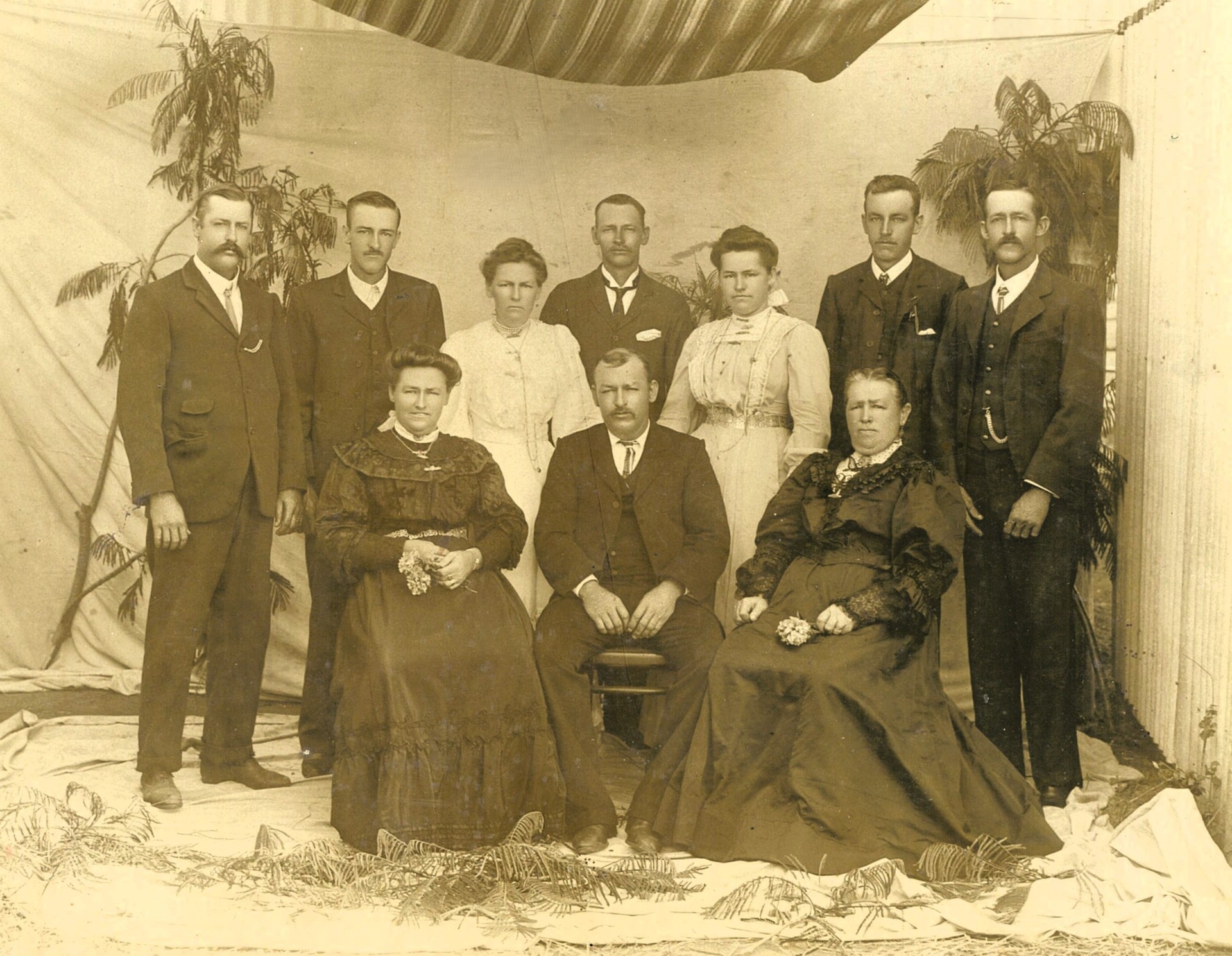
Mina Deicke (seated front row, on the left) and her nine children. Photo supplied
Grazing, the shire’s first major industry, began with mid-nineteenth-century settlement. Pioneer families endured bushfires, floods, drought, isolation, rough tracks and long hours. Among them were the Deickes, whose Collingvale Station, 16 kilometres north of Proserpine on the Bruce Highway, has supported five generations of graziers.
Before Mine (Mena) Margaret Deicke acquired Collingvale in 1904, the land changed hands several times. Charles Bradley occupied part in 1871; Walter Gordon took up the property in 1888, selling it three months later to James Collings, who renamed it Collingvale. Financial difficulties brought it under the South Australian Land Mortgage Agency Company in 1890. Alfred Cotton held the lease from 1902 until transferring it to Mena.
Mena apparently expanded Collingvale to about 60 square miles by acquiring adjoining land, including Henry Sheriden’s 1,250 acres. While raising nine children with husband, Edward, she managed the station and the family’s Bowen businesses, including Mookarra’s Homestead Hotel. Second son, George, managed Collingvale from 1904 to 1918, after which Artie took over and received the property in 1925. Mena lived there from about 1913 until illness returned her to Bowen in 1918; she died the next year.
Arthur bought Portion 285 in 1917 but remained at Collingvale after George bought Proserpine Station in 1918. Artie married Sophia Augusta Hyden on 12 August 1925, and they had four children.
Collingvale apparently had the district’s only stockyards, recording at least sixteen brands for dipping and branding. Cattle came long distances from other properties. The station also had a cane assignment, with its first recorded crop in 1921; tobacco was tried around the same time, apparently with limited success.
Early cattle were driven from Dingo Beach to the homestead by moonlight. As volunteer musterers dwindled, in 1935 a dip, yards and “humpy” were built nine miles away. A hand-dug well and windmill supplied water; later fencing created a bullock holding paddock shortening drives, though musterers still camped at the humpy with provisions carried by packhorse.
Gangs ringbarked country to kill trees and encourage pasture, arduous work then considered essential. The devastating 1946 drought is still remembered. Riverbank foliage was cut for cattle, which ran to the sound of axes. This saved many cattle, but eleven days and nights of rain the following February killed half the herd.
In 1948, Artie introduced Brahman blood by buying a brindle Zebu bull from Burnside Stud, Ingham. During another drought three years later, this hardier strain reduced losses.
After Artie died in 1952, his son, William (Bill), took over the 95-square-mile holding, enlarged with the addition of part of the Pluto holding. In the late 1960s, Bill introduced improved pastures, mainly Townsville Stylo and some Pangola, suited to varied rainfall and soils and baled for dry periods.
Fifth-generation, Marvin Deicke and wife, Pauline, now own Collingvale. About 10,000 hectares (25,000 acres) carry Brahman–Brangus cattle, mustered by horse and increasingly by motorbike. The property runs from Dryander Range and Gloucester’s coast to the Gregory River and Bruce Highway.
A laneway links two yard-and-dip complexes 16 kilometres apart, supporting three or four full musters annually. Thirteen dams, three bores, four windmills, tanks and troughs connected by poly pipe provide water. Collingvale includes 12,000 acres of cleared native pasture and 2,300 acres sown with Callide Rhodes, Kassengula, Pangola and Legum Seca.
Collingvale’s survival reflects both family continuity and adaptation. Moonlight cattle drives gave way to fenced laneways, better water systems, improved pasture, hardier breeds and motorbikes. Through drought, flood and changing methods, five generations have kept the station productive. If only Mena could see it now!
Story sourced from “The Deicke Family History” by Veronica Deicke and PHMS archives.
Publishers Indemnity. Any individual or entity that places advertising, supplies copy material, or submits editorial content to Core Life Publishing agrees and undertakes to ensure that all such material:- Does not infringe upon any copyright, trademark, or other intellectual property rights;- Is free from any content that could be considered defamatory, libelous, or slanderous;- Does not infringe upon any rights related to privacy or breach of confidence;- Contains no obscene, indecent, or otherwise unlawful material;- Complies fully with the Trade Practices Act and all other applicable laws, regulations, or statutes.Furthermore, by submitting or placing such material, these individuals or entities agree to indemnify and hold harmless the publisher, Core Publishing and Events Pty Ltd, and/or its agents from and against any and all investigations, claims, demands, liabilities, damages, costs, or judgments arising out of or in connection with the material provided. All material is believed to be accurate at the time of printing and remains the copyright of Core Publishing and Events Pty Ltd.
© 2026 Mackay and Whitsunday Life Pty Ltd.