Independently Owned, Locally Grown, Community Loved

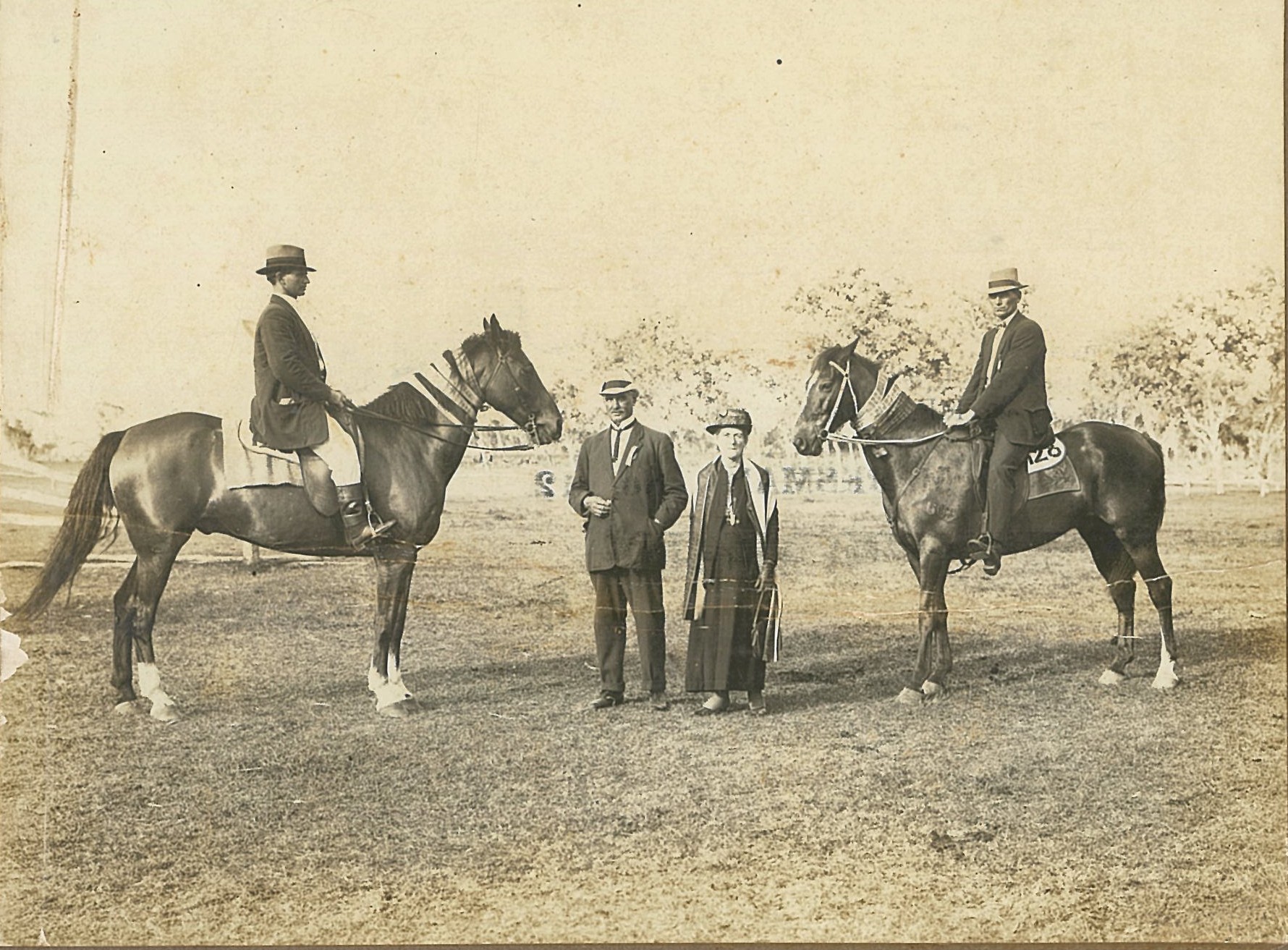
The Lascelles presenting ribbons at the Proserpine Show.
Edward George and Emma Minna Faithful Lascelles (nee Boyle) pioneered the Goorganga, Lethebroo and Gunyarra district in the first half of the twentieth century.
Edward Lascelles, born in 1859, was the third son of the Honourable George and Lady Louise Lascelles, both from notable British families. He began in the pastoral industry with his cousin, the Honourable Harold Finch Hatton, at Mount Spencer Station, Mackay. After exploring the country between Mackay and the Barkly Tablelands, he partnered with C Crofton to buy Mount Pleasant on the Bogie River. He was among the few pastoralists to survive drought, tick invasion and low cattle prices.
Lascelles was renowned for his keen eye for horses, likely the reason he judged horses at the annual Proserpine Show. At Mt Pleasant, he bought all forty horses from a deceased pastoralist’s estate for £4 each. At one time, about 500 horses, mainly draught horses and hacks, ran on the property. He bred mostly for the Indian Army, though he said the work was barely worthwhile because keeping the horses quiet was difficult.
In 1891, he married Emma Minna Faithful Boyle, daughter of Rev. John Boyle of Leicestershire. They had three sons – Evelyn (Eve) Herbert; George Murray who died in infancy and Geoff Edward who died of blood poisoning aged fourteen.
In 1893, along with other pastoralists, E G Lascelles became a foundation member and director of the Bowen Meat Works. For fifteen years, he was a member of the Wangaratta Shire Council and a member of the Bowen-Proserpine Tramway Board which built the line between Bowen and Proserpine in 1910.
In 1910, he purchased Goorganga from Mr H Macartney (who had bought it from the Cotton family). In 1916, he sold Mt Pleasant to concentrate on developing Goorganga, a property with rich grassy plains and surroundings of lagoons teaming with wildlife. Goorganga was fairly well off for water, and the stock had access to tidal flats. He purchased some stud stock from Mr A. Cook of Greenmount, Mackay.
George and Minna Lascelles were always kind and sympathetic to those less fortunate and ardently supported charitable organisations. Minna was an accomplished pianist and was actively involved in the social life of the district. She helped furnish a rest room in the Digger’s Hut – forerunner of the later CWA room – for women and their children coming to town in those days by horse and buggy. She was also an active member of St Paul’s Church of England.
Son, Evelyn’s World War I service shaped the family’s support for service personnel. Minna served with the Red Cross, and George was a foundation member of the Scartwater Trust, founded by A H Cunningham in 1917 to support soldiers and their families from Proserpine to Innisfail and west to the Queensland border. The Trust provided scholarships and continues today in an evolved form. George also supported Soldier Settlement by buying 2,000 acres known as The Pocket, adjoining Goorganga between Thompson Creek and the O’Connell River.
After the war, Evelyn took over management of Goorganga and remained active in the RSSLA, visiting schools each year to explain Anzac. In 1939, the Proserpine Returned Soldiers' League founded the Edward George Lascelles Memorial Bursary in honour of their patron who died in 1938; it continued until at least 1947. Evelyn’s son, Geoff, later received Queen’s Birthday honours for service to returned soldiers and the community.
The Lascelles family were successful pioneers whose contributions left a lasting mark on the local community.
POSTSCRIPT: In 1957, Evelyn Lascelles sold Goorganga to the Cox family.
Story and photo courtesy Proserpine Historical Society.
Publishers Indemnity. Any individual or entity that places advertising, supplies copy material, or submits editorial content to Core Life Publishing agrees and undertakes to ensure that all such material:- Does not infringe upon any copyright, trademark, or other intellectual property rights;- Is free from any content that could be considered defamatory, libelous, or slanderous;- Does not infringe upon any rights related to privacy or breach of confidence;- Contains no obscene, indecent, or otherwise unlawful material;- Complies fully with the Trade Practices Act and all other applicable laws, regulations, or statutes.Furthermore, by submitting or placing such material, these individuals or entities agree to indemnify and hold harmless the publisher, Core Publishing and Events Pty Ltd, and/or its agents from and against any and all investigations, claims, demands, liabilities, damages, costs, or judgments arising out of or in connection with the material provided. All material is believed to be accurate at the time of printing and remains the copyright of Core Publishing and Events Pty Ltd.
© 2026 Mackay and Whitsunday Life Pty Ltd.