Independently Owned, Locally Grown, Community Loved



Dry paddocks and rising costs weigh heavily on Mackay’s cane growers, as El Niño and soaring fuel prices push irrigation decisions to the brink. Photo source: ABC News
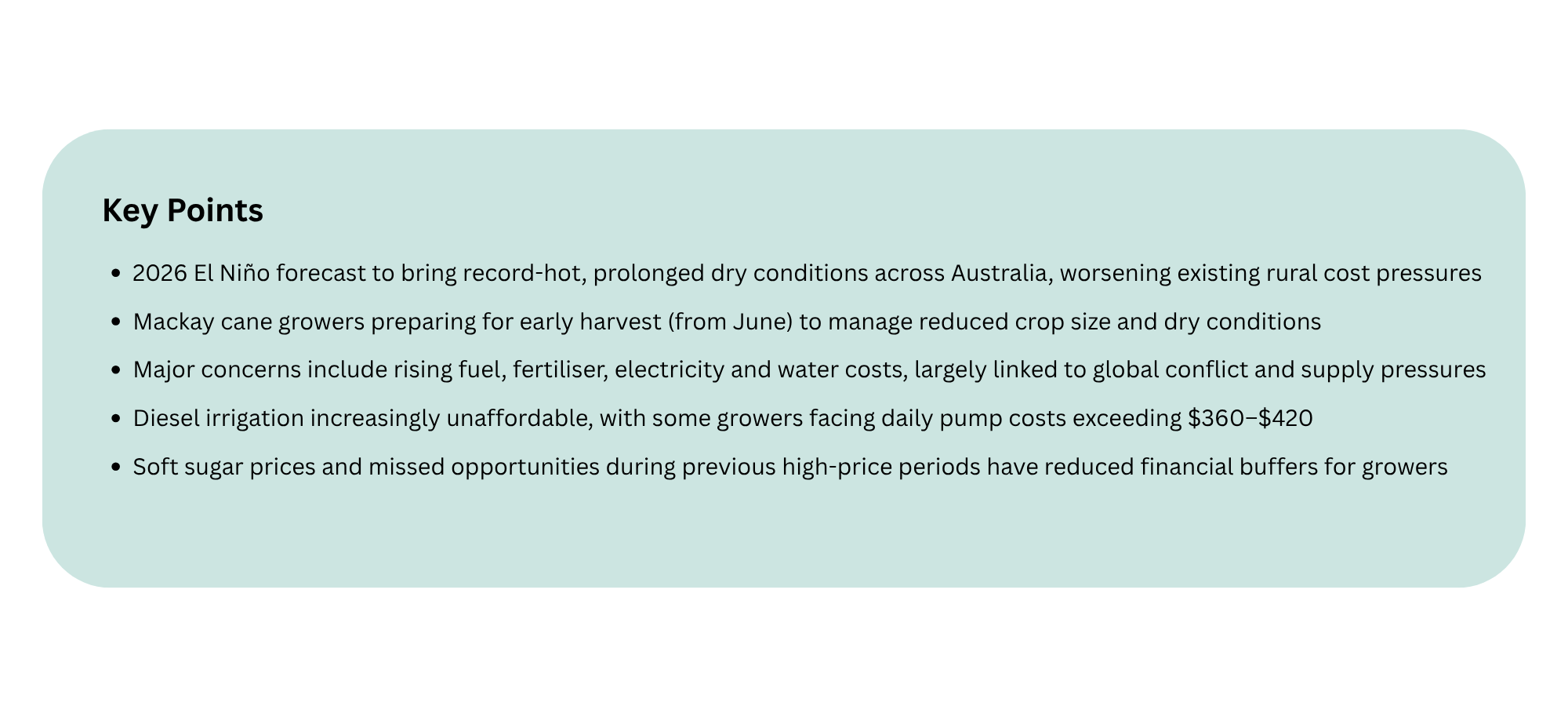
In the coming weeks, the 2026 El Niño is forecast to be one of the hottest on record, bringing prolonged dry conditions across the country. Conditions both nation and state-wide are compounding existing pressures, with rising fuel and fertiliser costs, linked to ongoing conflict in the Middle East, placing further strain on already stretched rural communities and amplifying financial stress in drought-affected regions.
Deputy Chairman of Mackay Canegrowers, Brett Leach said that while an extended period of heat and dry conditions may be on the horizon, farmers across the region are already taking proactive steps to prepare, with harvesting expected to begin as early as June.
“Ideally, when it’s a smaller crop like this year, we want to get in and get out as quick as we can,” he said.
“A little bit of rain would be nice, and you want that for the ratooning cane, but you don’t want much winter rain – the last thing you want is wages dragged out, time dragged out. If the mills run fairly well, and it’s dry, we can get the crop harvested.”
However, beyond the impact of El Niño, Mr Leach said growers are increasingly focused on the ongoing fuel crisis and the rising cost of fertiliser, warning the combined pressures are making basic farming decisions far more difficult.
“The biggest concern if fuel costs remain the way they are, is that if you are running diesel irrigation pumps, combined with the cost of water, you won’t be able to afford to turn the pumps on,” said Mr Leach.
“The current world sugar price, the current price of fertiliser, the current price of diesel, on top of high electricity prices, on top of rising water prices: it’s going to make an irrigation decision be ‘only when I have to do it’, to be frank.”
Mr Leach said while he has been able to offset some costs through solar, many growers are not in the same position. With diesel prices sitting between $3 and $3.50 per litre, and irrigation pumps consuming around 120 litres per day, he said daily costs could quickly climb beyond $360 to $420.
“You do that for a week, it’s over $2500. Who can afford that? Then you have water charges. No one is going to turn a pump on for those sorts of costs.”
Mr Leach said there would be a need for practical, on-the-ground solutions to support growers through the current conditions, and while the region has avoided drought on the scale seen eight years ago, he noted that past dry periods had prompted effective responses that delivered real benefits to the industry.
However, Mr Leach warned that a softening sugar price, combined with sharply rising production costs, was placing increasing pressure on growers and threatening the long-term stability of the industry.
“If you’ve got big debt, the last thing you need is more debt. The cruel thing for us in the sugar industry is two or three years ago, we had a chance, where sugar prices were $700 to $900 a tonne, to bank some real money, and we missed it due to poor mill performance. We were not able to take full advantage of that,” he said.
“Last year we cut 500,000 tonnes of standover in Mackay area. If you take a cane price of $50 per tonne, that is $25million out of the pockets of growers in Mackay Sugar area alone. That’s the money you count on to get you over these times.”
Mr Leach said fluctuations are a normal part of the agricultural cycle but warned the current conflict in Iran and the broader Middle East has added a new layer of pressure, driving up the cost of key inputs such as fuel and fertiliser.
“There’s certainly a great deal of angst and uncertainty out there amongst our growers. You can see it in them at meetings. You can hear it in their voices, the worry,” said Mr Leach.
“The government needs to take that into account: though no fault of their own, some people are really in trouble.
We need to make sure that firstly the mental health and physical health support is there and freely available for families. They need it, and they need to be encouraged to seek out that help.”
In previous periods of severe drought, Mr Leach pointed to government support measures that provided a vital lifeline for growers, including access to Centrelink payments and assistance with managing debt. Canegrowers Mackay are now calling for similar support to be introduced urgently, to help farmers navigate the current challenges and maintain the viability of their operations during this severe cost of production crisis.
“It is up to the Federal Government to come to the party and say, “we will make up for the poor decisions made before this” just to help people get over this hump that is no fault of their own,” Mr Leach said.
“Any financial assistance is appreciated. This is not just a situation for the sugar industry, but right across agriculture. If a drought is also factored into this equation for farming regions, it spells disaster.”
Mackay Canegrowers remains committed to supporting the local community through regular branch meetings and by amplifying the concerns of growers. The district office also provides access to vital resources, assisting members in navigating government support programs and connecting them with services such as the Rural Financial Counselling Service.
“The Queensland Cane Growers Organisation is there to speak up for growers. We’ve done this for 100 years, and we will not stop making sure we have their back,” added Mr Leach.
“When times are tough, you need your community around you. Please don’t let problems be your downfall: we will help you find solutions. We are there for growers.”

Publishers Indemnity. Any individual or entity that places advertising, supplies copy material, or submits editorial content to Core Life Publishing agrees and undertakes to ensure that all such material:- Does not infringe upon any copyright, trademark, or other intellectual property rights;- Is free from any content that could be considered defamatory, libelous, or slanderous;- Does not infringe upon any rights related to privacy or breach of confidence;- Contains no obscene, indecent, or otherwise unlawful material;- Complies fully with the Trade Practices Act and all other applicable laws, regulations, or statutes.Furthermore, by submitting or placing such material, these individuals or entities agree to indemnify and hold harmless the publisher, Core Publishing and Events Pty Ltd, and/or its agents from and against any and all investigations, claims, demands, liabilities, damages, costs, or judgments arising out of or in connection with the material provided. All material is believed to be accurate at the time of printing and remains the copyright of Core Publishing and Events Pty Ltd.
© 2026 Mackay and Whitsunday Life Pty Ltd.