

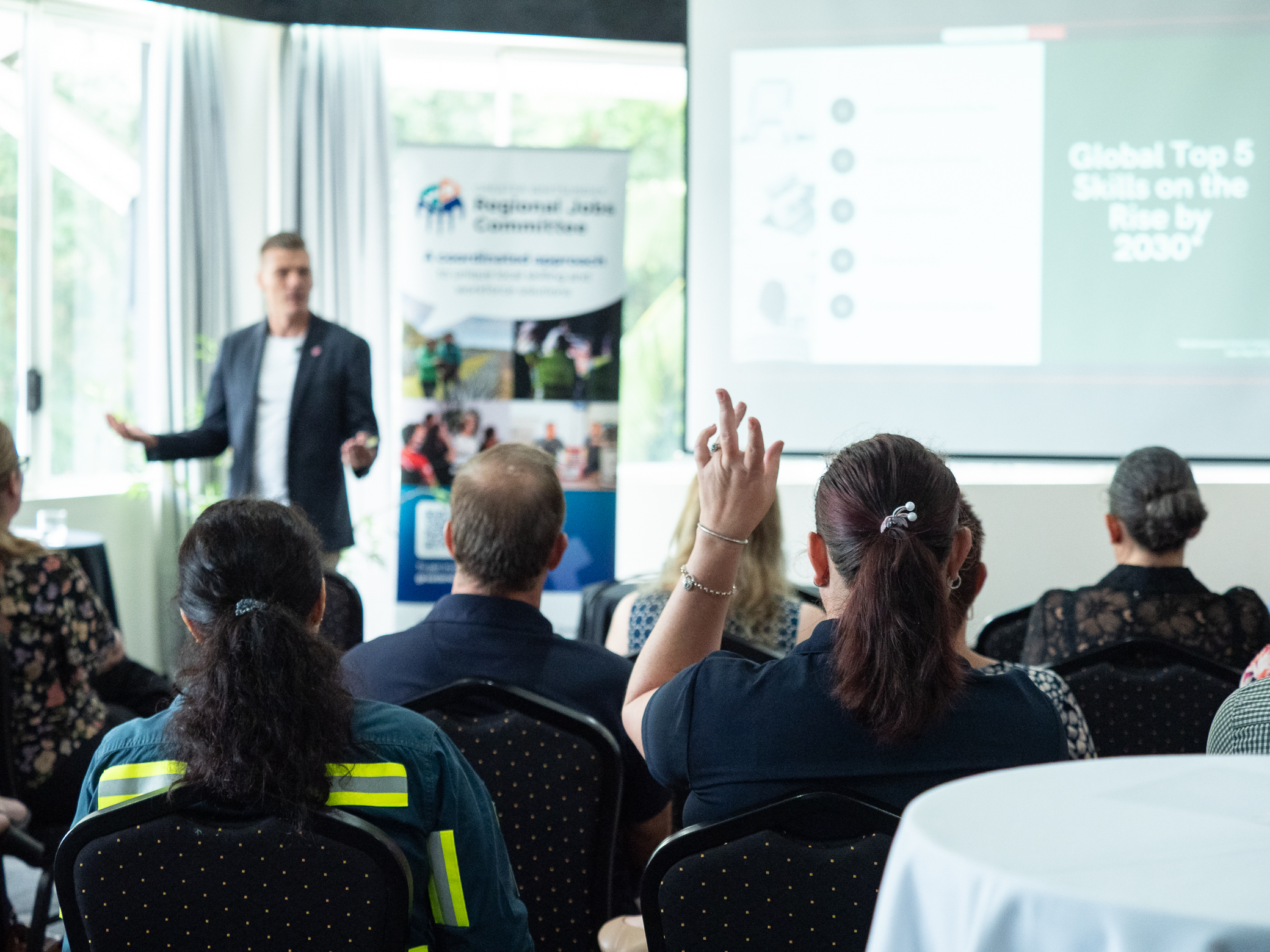
Queensland Government Extends Support for Greater Whitsunday Regional workforce collaboration Greater Whitsunday Alliance (GW3) has welcomed the Queensland Government’s announcement of continued funding for the Greater Whitsunday Regional Jobs Committee (RJC), securing the program through to 2027. This extension confirms GW3 as the host organisation for the Regional Jobs Committee program until 2027 and reinforces the vital role the committee plays in aligning local industry needs, training pathways, and regional workforce development. The program is designed by locals, for locals, providing a coordinated approach to identifying unique skilling challenges and strengthening connections between industry, government, training providers and community organisations. The Greater Whitsunday RJC forms part of a statewide network of 12 Regional Jobs Committees operating from Cairns to the Gold Coast. Together, these committees deliver region-specific skilling and workforce solutions that respond directly to local needs and support long-term economic growth. Greater Whitsunday Alliance (GW3) Chief Executive Officer, Ms Kylie Porter, said the commitment demonstrates the importance of proactive workforce planning as local industries continue to evolve. “We are delighted the Queensland Government is continuing to invest in regional workforce development through the RJC program. “This extension ensures we can keep driving a coordinated, industry-led approach to skills, training, and workforce attraction across Mackay, Isaac, and Whitsunday. Greater Whitsunday Regional Jobs Committee Chair, Ms Carissa Mansfield, said sustained funding provides important certainty for industry and partners. “Workforce remains one of the biggest challenges facing our region. The continuation of the RJC program means we can keep bringing local voices together to address barriers to training, participation, and business growth.” Member for Mackay, Mr Nigel Dalton, said the Queensland Government is committed to supporting strong regional jobs and skills development. “The Greater Whitsunday RJC is delivering real impact by strengthening local training pathways and helping businesses connect with the support they need. Extending this program through to 2027 ensures continued investment in regional jobs, industry alignment, and sustainable economic growth.” “This funding reflects our commitment to ensuring local people have access to local opportunities, and that regional communities are supported to thrive.” The Greater Whitsunday Regional Jobs Committee is proudly supported and funded by the Queensland Government.
Read the full story
Mackay residents are being encouraged to put their hand up to help shape the future of the Bruce Highway, with Expressions of Interest now open for regional representatives to join the Bruce Highway Advisory Council. The State Government has opened applications for the next round of regional representatives, including one position for the Mackay Whitsunday region, as part of its commitment to improving safety, reliability and long-term planning along Queensland’s major north–south transport corridor. The Bruce Highway Advisory Council brings together regional representatives and industry experts to help inform priorities for investment and upgrades, including the $9 billion Bruce Highway Targeted Safety Program and the development of a statewide Fatigue Management Strategy. Chaired by the Minister for Transport and Main Roads, the Council includes stakeholders from Pine River to Far North Queensland and plays a key role in identifying local issues and directing where funding should be prioritised. The six regional representatives will join five peak industry bodies on the Council, including the Royal Automobile Club of Queensland, Queensland Trucking Association, Queensland Farmers' Federation, Queensland Tourism Industry Council and the Local Government Association of Queensland. Regional representatives are appointed on a voluntary basis for a 12-month term and may reapply if they wish to continue. The government said the process ensured a diverse mix of local experience and industry expertise was brought to the table. Expressions of Interest are open for representatives from six regions, including Far North Queensland, North Queensland, Mackay Whitsunday, Fitzroy, Wide Bay Burnett and North Coast. Applications for the Bruce Highway Advisory Council close on the 23rd of January.
Read the full story
Mackay To Become Specialist Cancer Service Hub The Queensland Government has confirmed major progress on its fully funded Hospital Rescue Plan, unveiling clear timelines for hospital upgrades and new facilities across the state — with Mackay set to benefit as part of a strengthened regional health network. The plan has reached a significant milestone, with masterplans finalised for key hospital projects including Townsville University Hospital, Toowoomba Hospital, Coomera Hospital, Redcliffe Hospital and Bundaberg Hospital, alongside confirmed planning details for major upgrades at hospitals across Queensland. The Government said the plan was introduced after inheriting what it described as a failed and under-funded health infrastructure program, which resulted in major delays, missing services and $7 billion in cost blowouts. Under the Hospital Rescue Plan, the government is delivering a coordinated and fully costed approach to hospital construction and upgrades, aimed at restoring health services and delivering urgently needed hospital beds across Queensland. While Mackay is not listed for a major hospital expansion under the current tranche of projects, the region is expected to benefit directly through the Queensland Cancer Plan, which will establish Mackay as one of several specialist cancer service hubs across the state. The network will support regional hospitals and improve access to cancer care for communities outside Brisbane. As part of the statewide plan, specialist cancer hubs will be established in Cairns, Townsville, Mackay, Wide Bay, Darling Downs, Brisbane and the Gold Coast, helping reduce the need for patients to travel long distances for treatment. Across Queensland, the Hospital Rescue Plan will deliver at least 2,600 additional hospital beds through new hospitals, expansions and upgrades, representing the largest hospital infrastructure investment in the state’s history. Major hospital projects are already moving forward, including expansions at Townsville University Hospital, which will deliver at least 165 new beds by 2028, and Bundaberg Hospital, which is set to receive more than 200 new beds along with an expanded emergency department and improved maternity services by 2031. Minister for Health and Ambulance Services Tim Nicholls said the government was focused on delivering hospital beds and services when Queenslanders need them most. "Our fully-funded Hospital Rescue Plan is delivering new and expanded hospitals, 2,600 new hospital beds and health services when Queenslanders need them most," Minister Nicholls said. "After Labor’s decade of decline that left the system in crisis and without a credible path to building the hospital beds needed, Queenslanders are starting to see the results of getting our hospital build back on track with masterplans, designs and construction moving forward. "We’ve put to bed the poor planning, delays and cost blowouts we inherited and we’re now delivering the hospital beds Queensland needs now and into the future." Queensland Health Implementation Lead Sam Sangster said extensive planning was underway to ensure hospital projects met the needs of local communities across the state. “These masterplans mark an exciting first step in the process where Queenslanders will begin to see work intensifying on sites across the state,” Mr Sangster said. “It’s important to take the time to properly plan these major projects to ensure we leave a lasting legacy through sustainable infrastructure that caters for staff, clinicians, patients and their families.” The Queensland Government said the Hospital Rescue Plan marked a turning point for health infrastructure delivery, providing certainty for communities like Mackay through improved access to specialist services and a stronger statewide hospital network.
Read the full story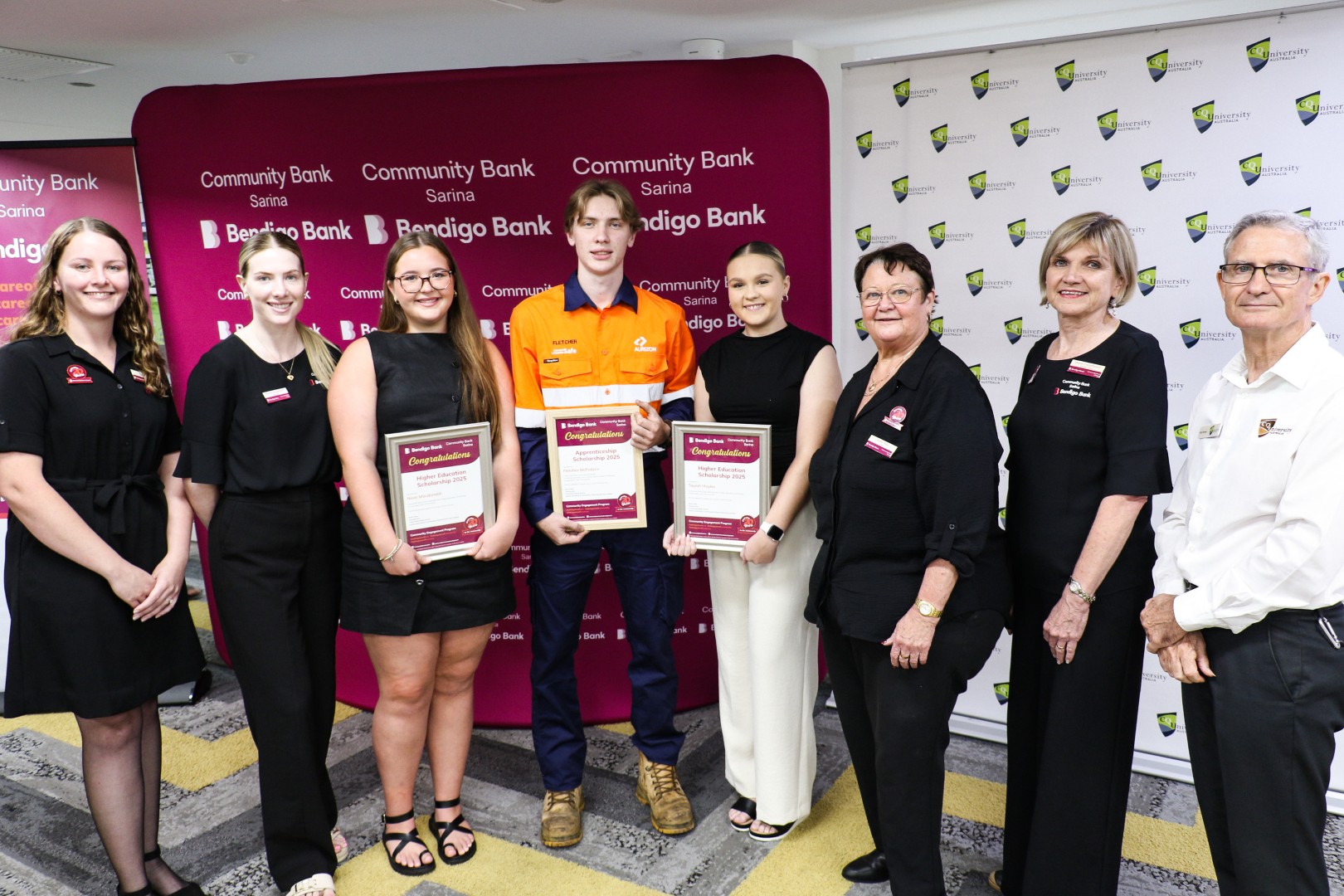
In celebration of 20 years, Community Bank Sarina Bendigo Bank has introduced an additional higher education scholarship as part of its Community Engagement Program, allowing more students to receive a share of $39,000. For eligible degrees and apprenticeships at CQUniversity in 2026, the program includes three $9000 scholarships for undergraduate degrees and two $6000 scholarships for apprenticeships, providing not only financial assistance but also opportunities for professional development and growth. Community Bank Sarina Board Deputy Chair Maree Franettovich highlighted Community Bank Sarina’s commitment to supporting local talent, describing the scholarships as “an ongoing investment in the personal growth and skills development of young people in our region, marking two decades of community impact." “Scholarships show students that their community is behind them, allowing them to stay close to family, friends and support networks while pursuing their studies and careers,” Ms Franettovich said. “This initiative creates opportunities for networking, mentoring and connection with local businesses - key elements in building a strong foundation for their future.” Higher education scholarships are available for a range of fields for those commencing their studies in 2026, including accounting, agriculture/agribusiness, business, digital media, environmental science, health, information technology, law, nursing, science and teaching. In addition, scholarships are offered for first-year apprentices in automotive engineering and technology, building and construction, electrical, manufacturing engineering and technology, hairdressing, horticulture, hospitality and mechanical trades. 2026 Community Bank Sarina CQUniversity Scholarship applications close 28 February. To find out more information and request an application pack, email executive@sarinacommunity.com.au.
Read the full story

Much is discussed about how employers need to focus on the employee value proposition (EVP) to attract staff, however on a personal level, it’s just as important for your career to know what you have to offer the market.
It’s widely acknowledged there’s a general skills shortage and that it’s more acute in some industries, therefore it’s mostly an employee’s market. It’s also reported that businesses are experiencing economic challenges and there’s an air of uncertainty. How are you as an employee positioned to respond to changes in the economic and employment landscape to make the most of opportunities for the career (and lifestyle) you want?
With the end of the financial year, it’s timely to undertake a personal career audit and these are some key questions to consider:
• What are your longer-term career ambitions? This helps with deciding on career moves. It’s tempting to take advantage of an offer with higher remuneration (totally understandable in the current economic climate), however, it’s worth considering if the move will help you in the longer term and not potentially put you in the career wilderness. Before making major decisions, take the time to reflect on how such a move will help or hinder your career ambitions, and where to next.
• What are you offering to the market? What is your level of capability? Is it where it should be for the type and level of roles you want? What are your current skills and expertise that you can offer to ensure you remain competitive in the employment market? Have you invested in yourself with further learning to keep pace with the way work is changing? Are you open to learning new skills to add to your professional toolkit? Are you able to adapt to new ways of working?
• What personal attributes complement your skills and expertise? Employers are hiring not only for skills but for the ‘right fit’ – values and culture. These are some of the core attributes that are highlighted by employers - reliability; adaptability; team player; willing to learn, consistency – and more, depending on the nature of the role. Also reflect on whether you bring a positive attitude to the workplace.
In simple terms, a personal career audit is a check in on where you are, where you want to be (by when) and what are you doing to get there. To assist with your personal career audit, and power up your purpose, engage with a trusted personal career guide. CareerForce Australia can provide that individualised support - contact me at powerup@careerforceaustralia.com.au or 0409 894 131 to learn more.

A pioneering Moranbah program designed to equip local talent with cutting-edge
electrotechnology skills is creating career pathways into the mining industry while fostering thriving communities.
Anglo American – which operates five steelmaking coal mines in the Bowen Basin – partnered with Moranbah State High School (MSHS) and Major Training to deliver the electrotechnology course in the region.
The course provides an entry-level understanding of electrical systems, circuitry and safety while allowing graduates to carve six months off an electrical apprenticeship.
With a 100 per cent success rate, the 19 graduating students from Moranbah, Dysart and Clermont will get four credits towards the 20 credits needed to complete their Queensland Certificate of Education.
MSHS student Alexandra Ibbertson, who is about to finish the electrotech course, was also selected as a school-based trainee at Anglo American’s Moranbah North Mine in January.
She said the course and the traineeship had been invaluable for steering her to a career in the mining industry.
“It has shown me a full, in-depth scope of what will come if I end up as an electrician in the field,” she said.
“It’s taught me about safety, teamwork and how important it is to co-operate in a group.
“With Moranbah being such a small town and mining being the central focus of it, having courses such as these allow students to transition smoothly into the mining industry and help them secure apprenticeships for the future.”
Moranbah North Mine offers three school-based traineeships, four mechanical and four electrical apprenticeships, and six new-to-industry positions each year.
Moranbah North Mine general manager Paul Stephan said they had received more than 1,500 applications for the 14 apprentice and new-to-industry roles advertised last month and would advertise in August for the next intake of school-based apprentices.
“By hiring locally, we ensure we retain talent within our region, driving economic growth and
sustainability for years to come.
“It keeps kids connected to family and community while providing a talent pipeline to ensure we have sustainable operations going forward, and helps to keep our local businesses thriving.”
The Moranbah electrotech graduates were treated to a visit to the Resources Centre of Excellence (RCoE) in Mackay to celebrate the end of their course.
Moranbah student Bradley Oram said it was an eye-opening, hands-on experience that cemented his desire to work in the mining industry.
“I was leaning towards auto electrical but after this electrotechnology program, I’m definitely open to becoming a high voltage electrician.
“If you help get the kids into the industry, that’s obviously making the town more sustainable.”
Fellow graduate Brooke Foley said her electrician father had inspired her to pursue this career.
“I grew up helping him around the house which made me interested in it,” she said.
“Having courses like this in school, it builds the future generations to have the incentive to go into mining careers and follow the paths of their elders.”
Moranbah State High School electrotechnology students Hayden Bell and Lincoln
Nicholas preparing for an underground simulation tour at Resources Centre of Excellence in
Mackay. Image supplied

Queensland is intensifying its battle against Varroa destructor by employing six Varroa Development Officers (VDOs), an Extension and Engagement Coordinator, and establishing new surveillance hives for early pest detection.
While varroa mite Varroa destructor has not yet been detected in Queensland, it is currently in New South Wales and the State Government has identified that Queensland needs to be prepared for this pest.
The varroa mite is an insidious pest that poses a significant biosecurity threat to the common European honeybees whose pollination services add an estimated $14.2 billion to the Australian agricultural and horticultural industries each year.
Following the endorsement of the National Varroa Mite Response Plan earlier this year, Queensland along with other states and territories has shifted from attempting to eradicate varroa mite to managing it.
The newly advertised VDO positions will educate and support beekeepers on integrated pest management (IPM) techniques and offer practical support during the transition. Working closely with individual beekeepers and beekeeping clubs, the VDOs will provide hands-on assistance to build skills, understanding and resilience.
This approach aims to mitigate the impact of Varroa destructor on Queensland's beekeeping and pollination-reliant industries when it inevitably arrives.
Minister for Agricultural Industry Development and Fisheries and Minister for Rural Communities Mark Furner said that Queensland is intensifying its efforts against varroa mite by appointing six Varroa Development Officers (VDOs) and delivering 19 workshops across the state over the next 12 months.
"We have joined with other states and territories in shifting our focus from eradication to management of varroa mite and will continue to safeguard Queensland's valuable honeybee industry and recreational beekeeping sector from this pest,” Minister Furner said.
Additionally, 19 workshops will be conducted for both commercial and recreational beekeepers. These workshops will focus on enhancing skills in detecting, monitoring, reporting and managing varroa mite for the long term.
"Biosecurity zone provisions under the Biosecurity Act 2014 restricts the movement of bees and bee related equipment into Queensland from a state or territory where varroa mite has been detected,” Minister Furner added.
"Through comprehensive training and practical support, we are fostering a more resilient and well-informed beekeeping community.”
Customised resources for Queensland’s beekeeping industry will be made available online free of charge.
Biosecurity Queensland is also enhancing surveillance along the Queensland-New South Wales border, focusing on the Gold Coast region and high-risk areas of Stanthorpe and Warwick, where pollination events are anticipated in early spring.
To provide early warning for Varro destructor in Queensland, 18 sentinel hives have been established in these key locations.
"This initiative is crucial for protecting our beekeeping and pollination sectors, which play a vital role in the agricultural success of Queensland,” the Minister said.
"It is crucial to continue protecting Queensland's bees, which in turn supports the sustainability of pollination-dependent industries.”

$2 million in funding has just been announced by the Queensland Government in hopes of managing the State’s feral pig problem.
Feral pigs are widespread across Queensland and cause significant harm as pests. They degrade soil and water quality, threaten native species, spread invasive plants, harm agricultural crops and livestock and can even transmit diseases.
More than $2 million in funding has been awarded with four new feral pig management coordinators appointed with a focus on investing in a biosecure future for all Queenslanders.
Rachel Chay Deputy Director General & Chief Biosecurity Officer said “Feral pigs wreak havoc on agriculture and the environment.
“These grants not only mitigate the impact of feral pests but also create more jobs in regional areas, contributing to the overall economic health of our communities.
The two successful applicants - Desert Channels Queensland and South West Queensland Regional Organisation of Councils were selected to receive funding through Round 8(a) which will see the employment of four feral pig management coordinators.
These coordinators will support the initiation and delivery of effective feral pig management bolstering local biosecurity efforts.
“This funding of more than $2 million has been dedicated to employing up to four feral pig management coordinators to support the initiation and delivery of effective feral pig management across the state,” Dr Chay added.
"This is a crucial investment in biosecurity and feral pest management in Queenslanders.”
The application period for Round 8(a) - Feral Pig Coordination - Biosecurity Preparedness closed on February 29, 2024.
Applications were received from various Regional Natural Resource Management groups, Regional Organisations of Councils and incorporated industry organisations.
This latest funding round under QFPI brings the Queensland Government’s total investment in controlling invasive plants and animals to more than $29.2 million over eight years. This initiative is further bolstered by a $14 million investment from the Federal Government.
For more information, visit https://www.daf.qld.gov.au/business-priorities/biosecurity/invasive-plants-animals/qld-feral-pest-initiative
$2 million has been awarded to combat the issue of troublesome trotters with a focus on investing in a biosecure future for all Queenslanders

CANEGROWERS Mackay urged Mackay Regional Council (MRC) to reconsider its position on the agricultural land ratings categories, as council headed in to vote on the budget earlier this week.
CANEGROWERS Mackay Chairman Kevin Borg said that having spoken with MRC councillors both before - and since - the 2023-24 budget it seems that council have again ignored the inequitable rating system on rural and cane categories.
Sugarcane is on the brink of a revolution that will assist this region’s economy as it diversifies to renewables making it a stable source of renewable sources of fuels, fibres and foods.
There has been strong support from the State Government to develop the sector, but to realise any sugarcane based biocommodities, there is a real and urgent need to preserve land under cane.
Further, mills are an integral asset to our industry and need throughput to remain viable.
“Cane farming land is being challenged by the pressures of our city’s growth,” said CANEGROWERS Mackay Chairman Kevin Borg.
“The city has expanded, taking up a large portion of cane land in and around the alluvial delta of the Pioneer River. Some of the best, most productive growing land has now been taken up by housing, manufacturing facilities and concrete pathways.”
As a result of urban expansion, growers in these areas have been challenged by a double-whammy of high State Land Valuations, primarily based on the rising prices of nearby residential and industrial land.
To add insult to injury, a cents-in-the-dollar rating of cane land has been maintained by council that is more in line with what is charged for big Paget workshop enterprises rather than comparing it with other rural land uses in this region.
In farming, high valuations do not reflect the returns made from the land but is only an indicator of an unrealised value attached to it.
“The reality is, cane farms are quite different to many businesses. The price we receive for our sugar is such that growers simply cannot pass on their ever-increasing costs to absorb over-inflated rates bills. We are heavily exposed to the fluctuations of world market prices, making us price takers and not price makers. Most businesses can increase their prices to absorb cost increases. Cane growers absolutely do not have that liberty,” he said.
According to Mackay Sugar milling area data recorded by CANEGROWERS, since 2007 there has been almost 12,000 hectares of land taken out of cane production: a drop of 13.63%.
Mr Borg said he appreciated that Mackay Regional Council had reduced the cents in the dollar rate from 2.77 to 2.25 on the cane land category last year, which brought savings to some growers, but not to some 40% of growers who experienced steep rates increases- some to dizzying numbers well in excess of $10,000.
This went no way to apprehending the problem for those 40 percent that are unfairly impacted.
“We have heard from growers who have faced rates bill increases since the last round of land valuations, of over $18,000. This is unacceptable,” said Mr Borg.
According to research conducted by Queensland Economic Advocacy Solutions on behalf of CANEGROWERS, Mackay Regional Council has the highest rates on cane land of comparable Category 4/5 Councils.
“We recognise that council has to address meeting its own rising costs, but it does not solve that problem by beating a select section of growers over the head with almost unmanageable rates costs, just as the industry stands ready to offer a bio-commodity boon to the regional economy, with attendant manufacturing, educational and technical opportunities,” said Mr Borg.
“The ratings structure separated cane out from other rural land in 2007, privileging other agricultural pursuits over cane. That is unreasonable.
“Further, we urge Council to consider that the majority of cane farms are family-run enterprises that contain family homes.”
The State Government has issued the Guideline on Equity and Fairness in rating for Queensland Local Governments, which Queensland CANEGROWERS has encouraged all Local Governments to formally adopt.
It says that land used for similar purposes should be similarly rated.
“We aren’t asking for special treatment. We are asking for equitable treatment. We are asking for rating policies and practices that support farming – whether of livestock, cane, or any other produce,” said Mr Borg.
“This region has long known that it needs to be more economically diverse. We need Council policies that support the growth of cane farming alongside a growing regional population.
“Council has the power to determine its rating categories.
“We urge it to reconsider its approach on rural rating and bring the rates of those growers grappling with steep increases back to an acceptable level.”
* this article was submitted prior to the council budget meeting which took place the same time this publication was sent for print, meaning actions from the budget meeting were unable to be added to this story.
Deputy Chairman and Mackay Area Committee Chairman Joseph Borg with CANEGROWERS Mackay Chairman, Kevin Borg and District Manager Michelle Martin
CANEGROWERS Mackay advocates for fair treatment in the land ratings debate, urging Mackay Regional Council to reconsider its policies affecting local cane farmers. Photo credit: Hannah McNamara

Wilmar Sugar and Renewables has urged unions to seriously consider a suggestion made by the company earlier this week in a Fair Work Commission hearing that the parties meet and explore the possibility of independent voluntary arbitration as a means of concluding a new enterprise agreement on fair and reasonable terms.
However, Wilmar claims that the two unions did not immediately take up the offer while the third rejected the option.
The offer to meet and explore the potential of the option of voluntary arbitration will now be put in writing by the company.
A Wilmar Sugar and Renewables spokesman said the company welcomed the assistance of the Fair Work Commission over recent weeks in trying to bring negotiations to a conclusion.
“It is since the Commission’s involvement that we have been able to close the gap between company and union positions, this week managing to specify the ranges within which each party believes agreement might be reached,” the spokesman said.
“At bargaining talks on Thursday, Sugar and Renewables indicated it was looking to an outcome between 14.25% and 15% over 3.5 years, while unions said they were looking to a range between 18% and 22% for a 3-year agreement.
“Unfortunately in the Commission conference today, the unions withdrew their 18% to 22% range, and instead reverted to a claim of 22%.
“Despite the gap having been expanded by unions, we remain committed to exploring all options to bring negotiations to an outcome, including voluntary arbitration,” he said.
“If the parties can agree on the parameters for voluntary arbitration, this is a certain way to test the arguments and the data. We have complete confidence in the information on which we have based our offer and we would expect unions would welcome the same opportunity.”
The Australian Worker’s Union (AWU) claimed that Wilmar “Is now not making an offer to their employees, instead offering a “window” which involves removing employees' right to take accrued RDO hours when they choose.”
A union representative said that despite unions providing indisputable data that the cost of living over the last four years has dramatically outpaced the wage increases Wilmar has paid to mill workers, and the published pay rates of surrounding mills, Wilmar has instead stuck to their “discredited, questionable figures” which include aggregate quarterly inflation figures to artificially lower the rate.
“I suppose we shouldn’t be surprised that Wilmar has got the figures wrong again, this is a company that claims four days of industrial action have delayed the start of the crush by several weeks,” AWU Northern District Secretary Jim Wilson said.
The AWU also claimed that at least one mill may have to stop for up to six hours a day due to Wilmar being unable to attract staff at the wages they offer.
“No doubt Wilmar will try to blame this on their workforce as well, and not the below industry standard rates they pay,” Mr Wilson said.
At time of print, a date for further bargaining has not been agreed by the parties.
Gibson Creek Farm in April. Photo credit: Wilmar Agricultural Productivity Manager Peter Larsen

Having worked in the radio industry for the better part of a decade I have given away my fair share of holidays, but at 28 years old, I’m ashamed to say I haven’t travelled since I became an adult. Any memories of foreign lands date back to when I was living on ‘the bank of Mum and Dad’. I always thought I’d love to explore the world with ‘the one I love’ but alas, I’m in my late 20s, single as hell, and still haven’t left the country since I was 11!
That’s all about to change for me personally because next year is the BIG one. The dreaded three-o. I’m not particularly good with change so I decided to disassociate and do three things I’ve never done before to mark my three decades of life. Travel internationally as a grown-up, go on a girl’s trip, and explore Thailand!
I’ve already got my money tin starting to save, despite not even having had my 29th birthday yet! But if reading this does anything for you, let it be the inspiration to start the group chat. Look at the travel hack videos and start planning an international trip with people you care about. It could be the bestie, the friendship group or the family. It could be for this year, next year or the one after that!
It really doesn’t matter, if you put $20 in a tin every week for a year, you’ve already got yourself over $1,000 so think how early it would be to pay off a trip to a paradise like Bali or Thailand within a year or two. We’re so lucky to have so many incredible places to see and visit in our own backyard which many of us partake in regularly, but sometimes I think we get so comfortable in our own home; at some point, we need to put ourselves out there and become the tourists. Explore something different and unknown. Push ourselves out of our comfort zones because that’s where our wisdom and experience grows.
Anyways, clearly, you can tell I’m excited for August 2025 and it makes thirty look a whole lot more appealing. Frankly, I take regular naps, focus on my fitness and use expensive night cream already so 30 is just shaping up to be my 20s with more money at this rate so I’ll take it!
At Star FM we’ve been giving one person in Mackay and The Whitsundays the chance to get in the draw to win a trip for two to London with Star’s Take Me To London. That one is being drawn on Saturday 29th of July on the Airlie Beach foreshore at the markets. If you’re in Airlie, pop down and see us for the big draw!
Kaley

One of the best put-downs of Australians came from the late former New Zealand Prime Minister Sir Robert “Piggy” Muldoon, who said that “New Zealanders who leave for Australia raise the IQ of both countries”.
Meaning only stupid people would want to leave the Land of the Long White Cloud for Australia, so their departure would lift the average intelligence in New Zealand, but they would still be smarter than the average Aussie, so their arrival would lift the average intelligence here.
You’ve got to pay an insult that’s delivered with humour.
The New Zealand contribution to this nation’s intelligence can be debated but in these, more modern times, the discussion is more about artificial intelligence than clever Kiwis.
Artificial intelligence seems to have gone from science fiction and an obscure phenomenon that nerds discussed between themselves to suddenly taking centre stage in all sorts of aspects of our lives.
The future has arrived and it’s artificial. I’m not sure whether that’s a good thing but it is definitely a thing.
AI is already influencing most areas of life and this will grow, creating massive uncertainty in terms of jobs and people’s careers. It will create new jobs and destroy, or drastically alter, many others.
What will the impact be on real estate? Is there a ticking time-bomb under the seats of today’s real estate agents? Will AI do the job that agents currently do? Ultimately that is up to you, the consumer; the buyer and the seller will spell out what works for them and that will determine how things evolve.
The AI change is already being felt in some areas of real estate; agents who can’t write, now have the assistance of AI.
But what about other areas of real estate? Does it mean the end of open homes and private inspections? Will people just interact with some form of AI that answers their questions and gives them information? Will AI be the middle-man (or woman or cyber entity) between a buyer and a seller negotiating a deal.
At Gardian we are already working with AI and researching how it can help us improve our performance. Where this all leads, I don’t know but I do know that we are not planning on humans being obsolete.
A big factor in selling real estate is the person-to-person interaction, the relationship that is central when someone is buying or selling a property.
At one of our recent regular Gardian real estate training sessions, we discussed the importance of emotional intelligence.
Having emotional intelligence means picking up on someone’s feelings, the nuance of a conversation, having a human connection, and empathy for how someone feels and what they are going through.
This can apply to someone who is selling their late parent’s property that had been in the family for 40 years, people who are selling their property as part of their divorce, a buyer who is looking to downsize after their husband or wife passed away, first-home buyers who are emersed in the excitement of embarking on a life-long journey, a young family looking to upgrade to a property that can accommodate teenagers needing their own space.
The common element in all these scenarios is emotion; it’s not just a business decision. When you sell your BHP shares it’s not an emotional journey. That’s a business decision.
A seller needs to know that the agent not only understands them but also has the emotional intelligence to understand buyers and, through that, help get the best price for their property.
AI won’t replace good service or human connection and hopefully, Artificial Emotional Intelligence (AEI) is still a fair way off. Or is it?
%20(1).jpg)
June is a month of merriment for St Catherine’s Catholic School Year 12 students who celebrated their School Formal on Thursday evening last week.
Friends gathered, parents with tears in their eyes looked on and school pride infused this special celebration to mark the nearing of the end of their school years and the beginning of adult life.
See the photo gallery at https://www.mackayandwhitsundaylife.com/social-pics/shimmering-dresses-and-stunning-sunsets-at-st-catherines-catholic-college
St Cath’s Year 12 students enjoyed their School Formal at the VMR last week. Photo credit: R Jean Photography

Hi Everyone
While Rach is away on holiday this week, I’m filling in this part of the paper and thought I would introduce myself and let you know what I’ve been up to.
I’m Daniel and I’ve been in the Whitsundays for almost four months now and the time has flown by! I’m originally from England but my family and I moved to Adelaide when I was seven and I had been living there until I accepted the position here.
I’m absolutely loving my job at Whitsunday Life Newspaper and what a beautiful place to start my journalism career. Since moving here, I’ve attended multiple events and have got a feel for the region, I think I’ve settled in quite well and I enjoy it here. But my absolute favourite is getting out and interviewing people. I find producing stories and putting it into print extremely satisfying. I’m sure some of you have seen me out and about already but if not, do say hi, I’m always up for a chat.
When I’m not working, I’m trying to stay active, I get down to parkrun every Saturday and that’s always a great way to start the weekend. I also want to take advantage of the amazing tourism opportunities we have here in the Whitsundays, I went to Whitehaven with my mum and dad but there’s many more things to do.
Lastly, I’d like to introduce Ruth, Ruth is the new cadet journalist with us at Whitsunday Life. She’s got a load of experience and I’m looking forward to knowing her as well as working alongside her. Say hi to her if you see her out and you can read her story on page 10 of this week’s paper.
Daniel

The annual Proserpine show went ahead last Friday, and 13 helpful students from Proserpine State High School volunteered to help the Proserpine Lions Club in serving food at the show.
The Lions Club are a group of individuals who get involved with humanitarian efforts locally, nationally, and internationally.
The Proserpine Lions Club had members away due to illness and an annual conference, and the 13 fantastic students jumped in to help the 45 volunteers on the day. The students were offered the opportunity through their school, where it was displayed on the school’s noticeboard. The students were ages 14-18 and anyone at the school could apply.
Mia Vloedmans, one of the kind students who offered her time up on the Show Day, said unlike the other students she was contacted directly to participate in the volunteering. She also expressed her enjoyment of the day.
“It was a great experience working and giving back to the community”.
“I would definitely do it again”.
Mia also explained how she really enjoyed being around the big group of volunteers that day and that the Lions Club volunteers gave lots of helpful mentoring to them and were very supportive.
Mia continued, saying that the volunteer work was mainly done in three-hour shifts, saying that her shift ran from “12:30pm- 3:30pm”.
Mia encourages everyone to “get involved with the Lions Club” as they “do a lot for the community”.
Well done to all the 13 tremendous students who spent their Show Day volunteering and helping out the community.

Did you know that the Whitsundays was officially designated as a Whale Heritage Area on 25 March 2024? On Wednesday 19th June, an excited group of individuals met up at the Whitsunday’s Sailing Club for a whale information night, hosted by Whales of the Whitsundays (WoW) a community group concerned about the health and future of cetaceans in our region.
WoW organised for special guest speakers from the Great Barrier Reef Marine Park Authority to come and share their knowledge. The speakers updated guests about how to record sightings and identify trends in the citizen science program Eye on the Reef, alongside providing knowledge on the unique rules and regulations within the Whitsundays Whale Protection Area. The night also included fun facts and tips for education and interpretation during the whale season.
Crystal Lacey, manager of the Master Reef Guide Program, commented on how the event was “mainly targeted at the tourism industry”, including, “masters, frontline crew, local bodies” and anyone else who is “always out on the water”.
Crystal explained how the event was designed to inform attendees of what “the unique rules and regulations are within the Whitsundays”.
The regulations are “slightly different to everywhere else in the Great Barrier Reef,” she said.
Crystal also added how the information night would provide more of an understanding of Whales' characteristics as “humpbacks are quite aerobatic animals”.
Chair of the Whales of Whitsunday Steering Committee, Olivia Brodhurst, expressed her excitement towards “circling back with everybody since last year's event”.
“We don’t have a university or conferences, so we get experts to come down once a year and do this for us”.
“People get to hear straight from the horse’s mouth about all their eye on the reef data, and the science everyone contributes to all year round”, Olivia added.
Chris Jones, Eye on the Reef Program manager, expressed similar excitement towards the evening.
“Unlike 90% of citizen science projects that go to a person, a PHD project or a university, this is going to managing the reef, making decisions, the data goes to the decision makers”.
“The fact that all of it's been designed to be done by the community creates that beautiful connection, you are part of management, you're not standing aloof from it.” Chris continued.
The Whitsundays is recognised as a critically important mating and birthing ground for the Eastern Australian Humpback Whales, so information nights on these animals are vital to ensure everyone working around them are up to date with the rules and regulations for these fin-tastic animals.
The speakers at the Whales of the Whitsunday Information Night enthused over their newly launched website, which includes resources for anyone interested in furthering their knowledge: https://www.whalesofthewhitsundays.com

There were plenty of thrills and a couple of spills as Collinsville residents celebrated the official opening of the town’s eagerly anticipated $300,000 ‘pump’ bike track.
Located in Darcy Munro Park, the Collinsville pump track is designed for bike, scooter riders and skateboarders to make their way over a thrilling series of rollers, jumps, and berms by generating momentum through up and down body movements, instead of pedalling or pushing.
Whitsunday Regional Council Mayor Ry Collins said the pump track was an exemplar of Council working with local businesses to provide investments that add to community vibrancy and a sense of belonging.
“As a Council we spend a lot of our time upgrading existing assets and legacy assets,” Mr Collins said.
“So, when we’ve got the opportunity to put something new into the community it’s really valued, and that’s shown by the turnout we’ve had for the official opening of stage one of Collinsville’s pump track.
Bowen Rail Company funded the pump track and General Manager Brendan Lane said it was terrific to see Collinsville’s young and young at heart embrace their new community asset with fearless enthusiasm.
“We’re deeply grateful for the incredible support we’ve received from Collinsville and the greater Whitsunday region as we’ve built our railway and grown from a startup to a thriving rail operator,” Mr Lane said.
“Better playground equipment and new and more diverse activities for older kids were two things that resonated loudly in the 2021 Collinsville Masterplan, and the Pump Track is a perfect fit.”
Whitsunday Regional Council Mayor Ry Collins, Bowen Rail Company General Manager Brendan Lane and children at the Collinsville Pump Track, Photo supplied

Every year, in the winter months of June to October, whales – in particular, Humpback whales –migrate 10,000km from Antarctica to Tropical North Queensland and back. The Whitsundays is a birthing ground for the whales due to the warm and protected waters at the hub of the Great Barrier Reef.
Following the tremendous success of the inaugural event in 2023, and to stamp the beginning of whale season, The Whitsunday Regional Council and Yooribaya Cultural Experiences are hosting another NAIDOC whale welcome evening.
The event is sacred to Indigenous people, who hold a deep and cultural connection to the whales and are the Traditional Owners of The Whitsundays. The Traditional Owners kindly allow The Whitsundays community to participate in their formal welcoming of the whales and traditional practices.
The jam-packed evening will be full of cultural celebrations and community spirit. The evening will begin with a heartfelt welcome to Country, followed by a powerful Smoking Ceremony and mesmerising traditional dance and songs.
The event includes Ochre painting, the opportunity to taste authentic damper and also the chance to engage in a variety of free workshops and community artwork projects. There will also be a vibrant array of market stalls and food and drink vans to browse.
Later in the evening, there will be a movie screening of “Whale Nation”, followed by the beloved musical comedy-drama film “The Sapphires”.
Event organisers encourage all to join them in the traditional celebration. Head on down and welcome the whales with the community. The event has no entry fee’s.
What: Whales Welcome Night
When: 5th July 2024, 17:00pm
Where: Airlie Beach Foreshore

In light of the current challenging economic climate, on the 26th June, the Whitsunday Regional Council unveiled a cost-of-living budget focused on the community’s most critical needs.
Mayor Ry Collins said that the 2024-25 Council budget ensured the essential services that our community relied upon were maintained, while, also positioning the Whitsunday region for future growth and prosperity.
“The Council’s priority for this budget has been to maintain essential services, address legacy issues in our waste business and adequately plan for the future, while keeping rates as low as possible.” Mayor Collins added that they were presenting a 0% yield increase in general residential owner-occupied rates across the region.
“This measure is intended to dampen the impact of the huge variation in the new State Government valuations handed down this year”.
“Land valuations help determine your rates, so Council are appealing to the State Government for more clarity and certainty around the timings of these valuations to protect our ratepayers from significant spikes like we are experiencing in this budget.”
Mayor Collins continued, stating that some ratepayers will pay “less”, while others will pay “more”. He emphasises the importance for the council to not just think of short-term challenges but also remain financially sustainable long-term, however, councillors have worked hard to deliver a financially sustainable budget.
“The cost-of-living crisis has had a huge impact on the cost of running Council, and I’m very aware that it has also had a huge impact on residents and business owners.”
The mayor added that with the federal and more recent state budgets being handed down, it is apparent that cost shifting by higher tiers of government is seriously impacting the future sustainability of regional councils and their ability to deliver growth and services.
Since 2002, the financial impact of services, which have been shifted onto local councils over a 12-month period has risen from $47 million to $360 million.
The mayor met up with state opposition leader David Crisafulli last week, where he raised the impact of cost-shifting on their ability to deliver vital council services like roads, parks, gardens, swimming pools and libraries. He also stated that he is advocating to the premier and major parties to support local communities by undertaking a Parliamentary Inquiry into local government cost shifting.
Mayor Collins added that “Waste management has been a challenge with increasing compliance costs, so Council has had to increase waste service charges by six per cent to cover the costs of operations”.
Additional discussions included Water and Sewage utilities, which will also increase 8 per cent and 3 per cent respectively, to meet increasing service costs, support strategic network planning and deliver network upgrades.
Highlights of Council’s 2024/25 capital works program include Whitsunday Coast Airport treatment plant upgrade, resealing program to maintain rural roads, new solar at Bowen and Proserpine pools, sealing and lighting of Collinsville airstrip, Jubilee Pocket Road trunk water main and a major investment in waste infrastructure.
Mayor Collins said that himself and Councillors are committed to ensuring that Council’s financial decisions reflect the needs of the Whitsunday community. He continued that they must seek a reduction in costs and work smarter and grow their rate base and number of rateable properties, he added that new housing is “critical” to this.
“We will collaborate with and call on our state and federal governments, as well as private developers, to increase the availability and quantity of affordable housing in our region.”
Mayor Collins adds that they will use allocated funds for strategic projects to drive service, growth, innovation and create new community opportunities.
After the council meeting Mayor Collins added that, whilst the budget is something they can look at improving going forward, they also “need to have a broader view towards the future”, and how they can deliver their “services and infrastructure”.
“We've tried to really look at ways we can reduce expenditure in the organisation, yet, we still have to be able to deliver our services in their entirety”.
Visit the Whitsunday Regional Council website and Facebook page for a range of information and videos relating to the 2024-25 WRC budget.
Mayor Ry Collins holding the 2024-25 Council budget. Photo credit: Ruth Puddefoot

Publishers Indemnity. Any individual or entity that places advertising, supplies copy material, or submits editorial content to Core Life Publishing agrees and undertakes to ensure that all such material:- Does not infringe upon any copyright, trademark, or other intellectual property rights;- Is free from any content that could be considered defamatory, libelous, or slanderous;- Does not infringe upon any rights related to privacy or breach of confidence;- Contains no obscene, indecent, or otherwise unlawful material;- Complies fully with the Trade Practices Act and all other applicable laws, regulations, or statutes.Furthermore, by submitting or placing such material, these individuals or entities agree to indemnify and hold harmless the publisher, Core Publishing and Events Pty Ltd, and/or its agents from and against any and all investigations, claims, demands, liabilities, damages, costs, or judgments arising out of or in connection with the material provided. All material is believed to be accurate at the time of printing and remains the copyright of Core Publishing and Events Pty Ltd.
© 2026 Mackay and Whitsunday Life Pty Ltd.
