
Independently Owned, Locally Grown, Community Loved

Member for Whitsunday Amanda Camm has stepped down from her role as Minister for Child Safety and the Prevention of Domestic and Family Violence, in an effort to prioritise her health and wellbeing. The announcement comes a fortnight after Ms Camm returned from six weeks of medical leave following major surgery, with the Whitsunday MP recognising she needed more time to recover. “This has been a considered and deeply personal decision,” Ms Camm said. “Having returned from six weeks of medical leave following major surgery I have come to recognise that my recovery still has some way to go and I need to prioritise my health and wellbeing.” “I sincerely thank the Premier for the opportunity to serve in his Government and for his support of my decision.” Ms Camm added in a presser outside of Parliament house in Brisbane, that the pressures of ministerial work had contributed to her decision to step down. This follows months of intense scrutiny over conditions for children in care and domestic violence prevention funding cuts had reinforced the importance of personal safety, especially in light of the recent attack on Victorian MP Helen Haines. “Public scrutiny and accountability are essential to democracy and to our institutions,” she said. “Harassment, threats, bullying and personal vilification are not and for the past year this has been my experience.” But during her time in the role, Ms Camm oversaw reforms to strengthen child protection, support foster and kinship carers and improve responses to domestic and family violence. Central to her child safety work was the Government’s response to the Child Safety Commission of Inquiry, which delivered 52 recommendations for improving the system. “The landmark Child Safety Commission of Inquiry was the turning point for the Child Safety system,” Ms Camm said. “There is much more work to be done, while early positive signs show we have stabilised numbers in the Residential Care system for the first time.” Her work in domestic and family violence included introducing laws for electronic monitoring of perpetrators to strengthen accountability, alongside her reporting a doubling of calls answered by DVConnect to help more people access support when they needed it. “After sitting with victims of domestic and family violence over many years through opposition and then in the ministry, I’m proud to have been part of delivering change that can help save lives,” Ms Camm said. In a statement following her decision, Premier David Crisafulli praised her work across both portfolios, describing the child safety inquiry’s reform roadmap as her greatest legacy and highlighting improved access to the domestic violence helpline. “I thank Amanda for her service to Queensland firstly as a Shadow Minister and then as a Minister,” Mr Crisafulli said. “Amanda took on an enormous task with a Child Safety system in crisis and a state in need of domestic violence reform. “With her dedication, passion and commitment, she has put Queensland on the road to repair both. “I speak on behalf of the Government, the LNP and all Queenslanders in wishing her the best in her recovery.” Ms Camm will continue serving as the Member for Whitsunday, reaffirming her commitment to the local community. “I remain committed to the people of Whitsunday as their Member of Parliament, and to supporting the Premier and the Government in delivering a fresh start for Queensland,” she said.
Read the full story
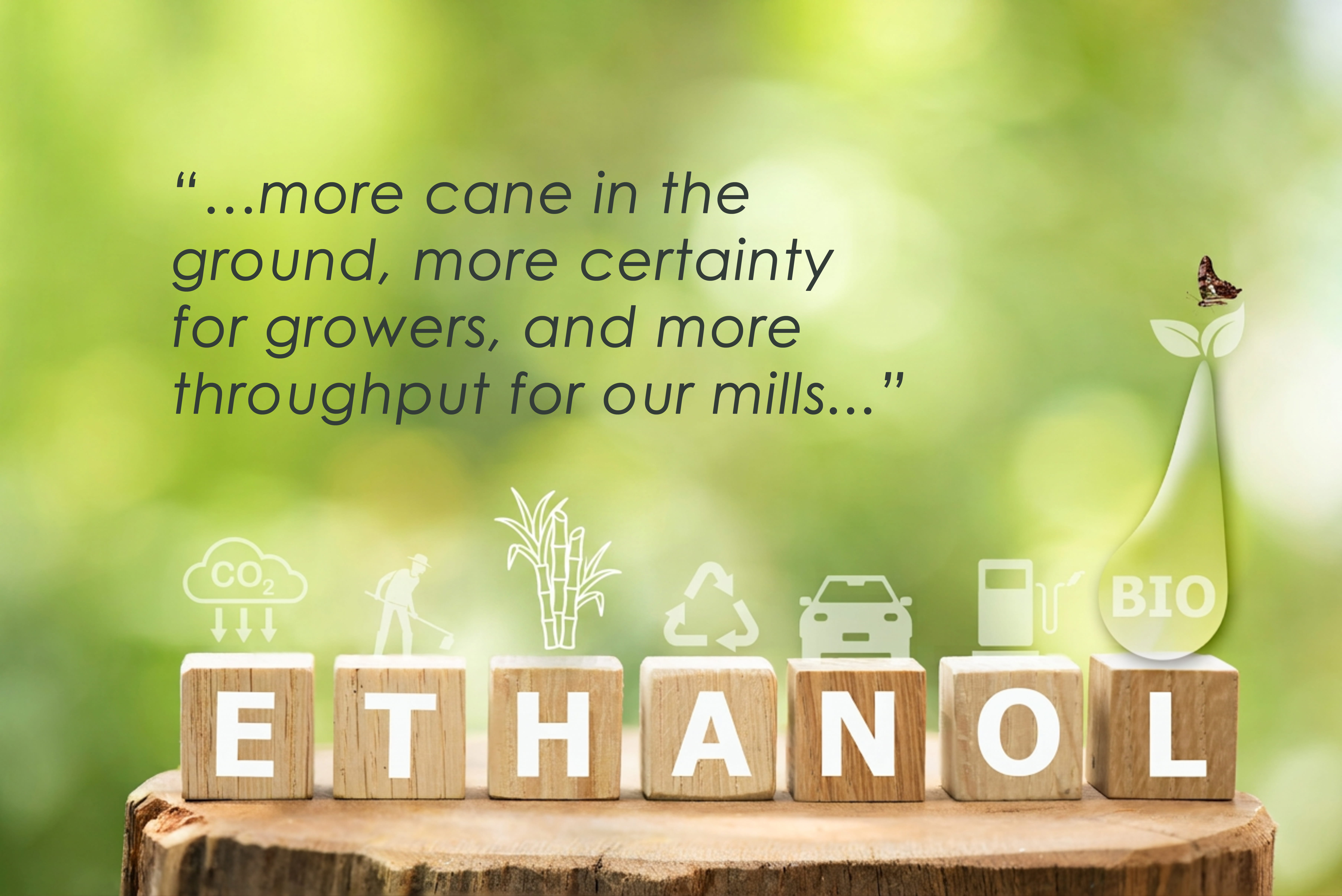
By Joseph Borg, Chairman, CANEGROWERS Mackay A firmly enforced bioethanol mandate, backed by increased local sugarcane production, is essential to strengthening Queensland’s industry resilience, regional jobs, and Australia’s long‑term fuel security. Our region holds enormous potential: not only for producing sugar, but for renewable fuel, energy diversification, and national economic security. Queensland’s sugarcane industry has always been a cornerstone of regional prosperity, but today it stands at a crossroads. Global markets are volatile and input costs are rising, and at the same time, Australia faces increasing pressure to reduce emissions, strengthen domestic fuel supplies, and build more resilient regional economies. A properly enforced bioethanol mandate is one of the most effective tools we have to meet these challenges head on. Queensland already has a mandate in place, but compliance remains inconsistent. When fuel retailers fail to meet their obligations, growers, mills, and regional communities lose out on opportunities that should rightfully be flowing into our local economy. Bioethanol is not a theoretical solution: it is a proven, practical, and immediate pathway to cleaner fuel and stronger regional industries and economies. Countries like Brazil and the United States have shown that bioethanol can reduce emissions, stabilise fuel markets, and create thousands of rural jobs. In these countries, and across the world, bioethanol forms a substantially higher portion of retail fuel sales than this country has embraced. Queensland has the same potential, but only if the mandate is taken seriously and enforced with the consistency it deserves. For Mackay, the benefits are clear. Our region is one of Australia’s most productive sugarcane hubs, with the land, infrastructure, climate, and expertise to support a thriving biofuels sector. Increased demand for bioethanol directly translates into increased demand for sugarcane. That means more cane in the ground, more certainty for growers, and more throughput for our mills, and we all know that milling is a volume game. This in turn supports jobs from the paddock to the processing line. But the opportunity extends far beyond economics. A stronger bioethanol industry enhances national fuel security, reducing Australia’s reliance on imported fuels. At a time when global supply chains are increasingly unstable, producing more of our own fuel is not just smart policy, it is essential. Every litre of bioethanol produced in Queensland is a litre of fuel Australia does not have to import. To seize this opportunity, we must also focus on increasing local sugarcane production. The industry cannot diversify, innovate, or expand into new markets without a reliable and growing supply of cane. More cane means more flexibility for mills, more investment in advanced manufacturing, and greater capacity to produce not only sugar and ethanol, but also bioplastics, green electricity, and other high value products. Growers are ready to meet this challenge. With the right policy settings from all levels of government, including a robust and enforced bioethanol mandate, we can plant more cane, improve productivity, and strengthen the long‑term viability of our region. But growers cannot do it alone. We need government to ensure the mandate is upheld, fuel retailers to meet their obligations, and industry partners to continue investing in innovation and infrastructure. Mackay has the land, the people, and the expertise to lead Queensland’s next era of renewable energy and agricultural diversification. What we need now is the policy certainty that comes from a mandate that is not only written into law but actively enforced. A stronger bioethanol mandate is not just good for growers it is good for Queensland, good for regional jobs, and good for Australia’s fuel future. The time to act is now. Bioethanol can use sugarcane by-products including molasses, bagasse, mill mud as well as plant material. Image: AdobeStock
Read the full story
Marketing strategy boils down to answering four questions: What does your business want? > The goal. Who can help you achieve your goal? > The audience. What do you need to tell your audience so that they can help you achieve your goal? > The message. Where do you need to put your message so that your audience sees it? > The delivery. But how do you actually go about answering those Q’s? Like anything, the broad strokes are more complicated in practice but it’s a good framework to come back to when you’re planning your next marketing activity. Start by drilling down + identifying a measurable goal that you can work towards. Vague + lofty goals are okay, but without a clear way to track your progress, achieving them will be pretty tough. For example, tracking how many enquiries you get + the quote conversion rate can be useful info to have as a baseline. That way, if you do a targeted campaign to attract more work, you can see if it meaningfully pushed the needle in the right direction! Next, really empathise with who can help you achieve those goals. Try to build up a target customer in your head. How old are they? What do they want from your business? What are they interested in? The more specific you are, the easier it’ll be to craft messaging that will actually appeal to that person. Once you’ve defined your goal + who can help you achieve it, you’ve got to tell them how to help you do it. Your messaging should be the key information that your audience needs to know about your business. This is where you focus on not only what your customers want to know about you, but how your business is different to all the others out there. Your messaging should change based on the people you’re targeting. Lastly, the delivery. Where does your target market frequent? Do they use socials? Are they constantly listening to the radio? Do they frequent the pub on a Friday arvo? Once you know where they go, you can start figuring out how to get your message there. While socials are a great option, they’re not the only one. Billboards, coasters, or a flyer that sits on a wall somewhere are all effective options. But if that all sounds like too much effort, you can always reach out + talk to us. We’ll help you figure it out 😉 Taren McAuley
Read the full story

Over 150,000 Australians are diagnosed with skin cancer each year and, on average 1,700 people pass away from the disease.
In Queensland we can be more susceptible to skin cancer due to high levels of sun exposure, so it is vital to get regular skin cancer check-ups.
Next week the Skin Cancer Doctor will be back in town and is available for checks and treatments.
Dr Amid Gayed will be hosting a pop-up clinic at the Whitsunday PCYC on Tuesday 13 and Wednesday 14 of June.
You can book an appointment directly and do not need a referral.
The cost is $140 and you’ll receive a $39.75 Medicare rebate.
Simply follow this link to make an appointment: bit.ly/3qkHvMu

As the 2023 crushing season gets underway, locomotives will become a prevalent sight in the district. But the technologically sophisticated machines of today are a far cry from the locos that chugged along the tracks in days gone by.
Before big expansions in the sugar industry necessitated inevitable changes, steam locomotives hauled the cane from farm to mill. The Proserpine Sugar Mill owned nine steam locomotives. Until the early 50s, the locos had coal (mostly from Collinsville) and wood fired steam engines and pulled a tender loaded with the fuel and water supplies essential for operations. These engines weighed up to 18 tons and could pull 152 full trucks of cane.
Most of the locos were affectionately given names apart from Numbers 1 and 8.
Number 1, built in South Australia in 1939, was the largest engine and it handled the big hauls from Up River, Lethebrook and Kelsey Creek.
One of the most famous was Number 2 – Digger. Built in Leeds, England in 1916, this locomotive was one of 155 ordered by the war department to serve in France in World War 1. After the war, it was taken back to Leeds, slightly modified, and in 1924 was one of several sold to Australia for use in the Queensland Sugar Industry. Despite some modifications throughout its life, it remained essentially a Hunslet War Department design – hence adding to its historic significance.
Number 3 – Fritz also served in France during the war. Numbers 2 and 3 had smaller engines and handled runs to Cannon Valley, Strathdickie and Waterson.
Number 4 – German Annie was built in Germany in 1908 and was used on Conway and Preston runs. It had a distinctive shrill whistle making it easily identifiable from a distance or at night.
Number 5 - Bonnie Jean, an 1899 Krauss, was named after a local lady, Jeannie Voss. It was the first one to service the Conway line, however, having a very small engine, it was seldom fired up and was used for emergency work around the mill yard.
Number 6 – Tilly, the mill’s original locomotive, was named after another Proserpine lady, Mrs Matilda Stoneham. Despite its small engine, it did mighty work and was mainly used on the Lethebrook line. On a clear night with a big load, most of the town would hear her coming, puffing like billyho from Goorganga Plains through Glen Isla to the mill. She whistled at every crossing and must have been cursed by many as she hit town areas and passed by the hospital - but locals did consider her whistle cheerful.
Number 7 – There were 2 Number 7s. The first, Mae West, built in England in 1915, was distinctive in that it had water tanks positioned on each side of the boiler, like 2 big floaties. The second, was a new Perry built in 1948.
Number 8 completed the steam fleet. Bought in 1953, it was a Bundaberg Fowler steam loco fitted with a distinct spark arrestor on its smoke stack. Used until the early 1970s, it had historical significance, being the last of its type in the world.
Gone now are the days of the steam locomotive. In 1954, the first diesel engines graced the tramlines. All engines were eventually changed to diesel burners in the early 50s and by 1965, the mill had 8 diesels.
Gone too are the days when communications were especially difficult - when, in order to establish the position of a loco that was running late, it involved ringing telephones along the route to establish where it had passed and where it was yet to reach. The exchange and farm ladies were always helpful and generally had a rough idea of where the loco would be. When a derailment occurred, a common occurrence, drivers blew the whistle 3 times. If a navvy gang was within earshot, they would come to assist, otherwise, the fireman could have a long walk to the nearest telephone for help.
And gone too are the days of all male crews steaming along the line …
Story and photos courtesy of the Proserpine Historical Museum and Proserpine Sugar Mill.
Number 5 – The Bonnie Jean L-R Martin Braby, Joey James, Roy Hansen, Tom Treacy
Lady Drivers I McCormack - Mrs Frazer at the last lady driving contest c1930
Vicki Burnett - first lady crew person on the locos -1989

By Bronte Hodge
When Helen Maynard-Turner, Coordinator for Meals on Wheels Proserpine, set out to plan the Meals on Wheels Day celebrations, she didn’t think that all three local members of government would raise up their hand on the same day to take part in the cause.
Meals on Wheels Day is always held on the last Wednesday of August however, a special honorary day was planned to align with the schedules of the three special guests.
Federal Member for Dawson, Andrew Willcox MP, Member for Whitsunday Amanda Camm MP and Mayor for the Whitsundays, Julie Hall, all came along to lend a hand and celebrate Meals on Wheels.
Mayor Hall arrived first and was tasked with the Beach Run, encompassing the clients who live in Airlie Beach, Cannonvale, and Jubilee Pocket.
Mr Willcox and Ms Camm were on the local run, accompanied by an existing volunteer couple who showed them the ropes.
“It was incredible to join the team for a meal run and get a look behind the scenes of this operation,” said Mr Willcox.
“Seeing first-hand the dedication these volunteers have to our region; supporting residents in need right around the Whitsundays.”
Mrs Camm said the Meals on Wheels service is invaluable to our community as it supports so many.
“It doesn’t take a lot of time and has great positive impacts for the people you are delivering to and as a volunteer,” she said.
“I came away with a gratitude for the wonderful individuals I met. Get involved!”
Mayor Hall said Meals on Wheels has provided a vital lifeline for many individuals in our community, particularly our elderly and vulnerable residents.
“Their service extends far beyond the physical act of delivering meals; it brings comfort and a much-needed human connection to those who may otherwise feel isolated or alone,” she said.
“The Proserpine Meals on Wheels service embodies the true spirit of community, and the volunteers and staff are an inspiration to us all.”
Meals on Wheels Proserpine has been servicing locals for over 65 years, and can assist anyone needing meals, including elderly, disable, and impaired.
Mayor Julie Hall joins Meals on Wheels Proserpine and delivers meals. Photo supplied.
Andrew Willcox MP, and Amanda Camm MP, with Helen Maynard-Turner and volunteers with Meals on Wheels Proserpine. Photo credit: Bronte Hodge

Born and bred local, Proserpine State High School student Reid Ogden did not expect to be welcomed back to the school year with an invitation to be a part of the Ministerial Student Advisory Council.
Reid is one of 16 students from across Queensland to represent youth opinions on matters that directly influence and impact on them with their school environment.
Established in 2018 by Minister for Education, the Honourable Grace Grace MP, the council gives Queensland students the opportunity and space to voice concerns, feedback, and advice on a range of educational matters.
With two meetings every year, the council discuss important matters, which Grace MP takes on board when creating changes in the education sector.
While not being able to discuss the agenda of his first meeting, Reid mentioned that previously the council discussed the e-cigarette and vape crisis occurring in schools, which helped inform the ban that was later put in place.
“I feel pretty privileged to be picked from this school and that I get to go down there and voice my opinion to someone of power,” Reid said.
“Voice my opinion formally and properly so they take it in and take it on board, yeah I feel very grateful that I get the opportunity to do that.”
Reid was put forward to the council by his school Proserpine State High School, based on his history of school commitment and outstanding effort.
Reid had been elected as a Junior School Executive leader in Year 9 and is currently in the Senior Leadership Team.
In 2022, when Reid was in Year 10, he was awarded the St Vincent de Paul Scholarship, for dedication to upholding school values, work ethic and leadership in the school community.
Don McDermid, Principal of Proserpine State High School, said “we have great confidence in Reid’s ability to be a valuable member of the Ministerial Student Advisory Council.”
Students come from all across Queensland, from Cairns, Longreach, and Tully, as well as Brisbane and Redcliff, as well as a range of year groups, with one student only being in Year 7.
Reid will remain in the council until he graduates at the end of 2024.
Until then, he continues to influence within his school, eyeing to become School Captain next year, as well as play Volleyball and AFL, as well as be a part of his House Committee.
Reid Ogden standing outside the William Street Queensland Government Building
Year 11 student Reid Ogden (back row, third from left) joins 15 other students to inform Queensland Government on youth and student opinion. Photo supplied


The advertisement which launched a regional newspaper into the international spotlight has once again been acknowledged as an industry game-changer for its ability to spark conversation towards the enduring power of print media.
The ‘Jenny and Steve’ advertisement for Best Marketing Campaign was one of four awards scooped up by this very publication, Mackay and Whitsunday Life, at the 2023 Queensland Country Press Association (QCPA) awards and conference in Brisbane last week.
Showcasing its talent across all forms of print media, Mackay and Whitsunday Life was recognised for unique marketing capabilities, an excellence in delivering newspaper features, talent in advertisement design and its ability to keep the region informed and engaged with quality editorial content.
Owner and Publisher, Rebecca Douthwaite, said it was humbling to be recognised as a leading regional newspaper in what is only the second year of being in print for Mackay and Whitsunday Life.
“Delivering news without barriers so everyone in the community can stay informed has been at the heart of our publication since its inception,” Mrs Douthwaite said.
“We said we’d be ‘free and always will be’ and we’ve honoured that promise.
“It was an incredible feeling to be recognised for what we have achieved this past year, which is a testament to our team who strive daily to deliver news that people genuinely want to read.”
Mackay and Whitsunday Life took home four state awards last week, recognised at the annual Queensland Country Press Association (QCPA) awards and conference held in Brisbane.
A star-studded affair, the conference was opened by Queensland Premier Annastacia Palaszczuk who emphasised the importance of regional newspapers in keeping a wider audience informed. Olympic swimmer Julie McDonald OAM delivered an inspirational speech on what it takes to reach the top, and attendees were left in stitches with the hilarious comedian, Dave O’Neil, as the MC of the awards dinner.
Thinking outside of the box and taking risks is the key to success of any advertising campaign. Mackay and Whitsunday Life was awarded gold in the Best Marketing Campaign for printing the infamous ‘Jenny and Steve’ advertisement. Award judges said it set a new benchmark for the way regional and community newspapers should market themselves.
“Mackay Life was a great example of how this risk taking can have huge rewards and help a campaign exceed even the highest expectations,” the judges’ comments read.
“A standout campaign that combines great, innovative creative with simple execution. A real game changer.”
Whitsunday Life scooped silver for the ‘Best Newspaper Feature’ with its Great Barrier Reef Festival advertising extravaganza, with judges saying it was “eye catching and fun”.
“The front cover of this feature really caught my eye,” the judge said.
“Stories were very informative. Highlighting each event gave me a great insight into the festival. A lovely feature supported by nicely designed advertising.”
Mackay Life was recognised for editorial excellence with a bronze award for its Homelessness feature, saying the campaign had a clear aim, to connect homeless people to services that can support them.
“It comprised a good mix of stories, including those that presented personal insights that humanised the issue,” the judging comments read.
Lastly, the design team was recognised with a bronze for the Best Locally Produced Advertisement, for a Mother’s Day ad designed for Karen Hill Floral Design.
The QCPA conference and awards night broke several records including receiving the most nominations for awards ever. Delegates travelled from across regional Queensland and from all eastern states to attend, including Mareeba in far north Queensland, Dubbo and Narrabri in central NSW, Gippsland in Victoria and the Barossa and Clare Valleys of South Australia.
Mackay and Whitsunday Life won four awards at the Queensland Country Press Association (QCPA) awards and conference, including a gold award for best marketing campaign. L-R: Journalist, Sam Gillespie, Mackay Editor, Amanda Wright, Owner and Publisher, Rebecca Douthwaite, Advertising Sales Manager, Mike McCann, Whitsunday Editor, Rachael Smith, Owner, Paul Douthwaite. Photo credit: Demie Wigham
Comedian Dave O’Neil was the MC for the Queensland Country Press Association (QCPA) awards and conference

As National Reconciliation Week wraps up on Saturday, June 3, local organisations Murri Watch, Murri Court and Binga Birri invited residents of Mackay to gather and learn about shared histories and cultures as society works towards achieving reconciliation in Australia, with a Reconciliation Bridge Walk taking place on Monday.
The National Reconciliation Week 2023 theme is “Be a voice for generations”, encouraging all Australians to be a voice for reconciliation in tangible ways in our everyday lives.
Murri Watch Senior Officer Jenny Timor, who has a Torres Strait Island and South Sea Island background, said the National Reconciliation Week creates further awareness of local Aboriginal, Torres Strait Islander and South Sea Islander culture.
“It’s an opportunity for all of us of all backgrounds to focus on who the Indigenous people are, to ask questions, to begin conversations, to have events in local schools and community,” she said.
“It’s all about showcasing Aboriginal and Islander culture and all the positives.”
A large group walked across the Forgan Bridge with signs, flags and banners, including schools, local organisations, members of parliament and police.
“We have a lot of community groups and people from the community in general who, by showing up today, are in support and appreciation of reconciliation and what it means to reconcile with each other, to demonstrate that we are equal in our differences, which is probably the crux of reconciliation,” Ms Timor said.
“People are continually moving forward in their own small ways and every year more people are beginning to become confident to approach and ask questions.”
A Reconciliation Bridge Walk was held in Mackay on Monday to mark National Reconciliation Week. Photo credit: Sam Gillespie

A Mackay resident has put the call out to the community after her dad misplaced his wedding ring on Cockermouth Island.
Emmy Lou was on the Wildcat Mackay tour with her parents last Friday, saying “it was an amazing tour”, but shared on the Mackay Noticeboard Facebook group that her dad lost his gold wedding band while on the tour.
“My parents have been married for 48 years and my dad has never taken his wedding ring off once,” she wrote.
“They are the most sincere, committed and loving couple ever.
“I’ve never seen my dad so upset.
“When you marry your best friend it symbolises love, commitment and affection, so when you lose your wedding ring the feelings of sadness and guilt are apparent.”
After combing through videos and photos taken on the day, Ms Lou concluded that the wedding ring was lost while stand-up paddleboarding on the island.
She’s put the call out to the community to keep an eye out when visiting the island.
“I know this is a long shot, but I have read stories where people have found their wedding rings after losing them in the ocean,” she wrote.
“If anyone happens to go to Cockermouth Island on a tour/privately and is fortunate enough to find this I’ll be ever so grateful.
“If anyone out there does this stuff as a professional job with a metal detector, I would love to chat to you.”
Cockermouth Island

It was a delightful coincidence to jump right back into the swing of things at work just as we were gearing up for the Queensland Country Press Association (QCPA) awards and conference in the vibrant city of Brisbane.
Sure, it came with its fair share of challenges, like finding discreet spots every few hours to pump breast milk (shout-out to all the multitasking supermums out there!).
The highlight of it all? Reconnecting with my amazing colleagues and sharing countless laughs that brought back the feeling of camaraderie. And let's not forget the icing on the cake – our publication scooping up not one, not two, but four prestigious awards! Talk about feeling proud as punch!
But that's not all we gained from the conference. We had the privilege of listening to Queensland Premier, Annastasia Palaszczuk, who reminded us just how important regional newspapers are to our beloved communities. She assured us that the government is committed to keeping those ink-stained pages alive and kicking, ensuring that even the most vulnerable among us have access to vital news. Read more about this on page 7.
Industry expert speakers reignited our passion for doing what we do. They preached the gospel of positive press, urging us to steer clear of clickbait and exaggerated headlines aimed at nothing more than grabbing eyeballs. It was heartwarming to witness a shift in the industry, with more publications focusing on giving readers what they truly desire, instead of playing tricks on them.
It feels fantastic to be a part of an industry that values authenticity and understands the pulse of its audience.
As we embark on this new chapter, we promise to keep the creative juices flowing, delivering news that engages, entertains, and enlightens. We're stoked to have you all by our side as we navigate the ever-evolving world of media, one thrilling story at a time. Stay tuned, folks!
Amanda

Dawson Councils are set to lose government support, after the Federal Government slashed funding for local councils in the May Budget, says Federal Member for Dawson, Andrew Willcox.
Mr Willcox is concerned local councils will be unable to provide the facilities and programs their communities need, and ratepayers will be forced to foot the bill on large-scale community projects, as he says support from the Federal Government wanes.
“There are 537 Local Councils across Australia who are set to lose out from Labor axing support in the May Budget.” Mr. Willcox said.
“A budget is all about priorities, and it’s concerning that local councils aren’t near the top of Labor’s list.
“I understand there’s a long-term goal for local councils to achieve 1 per cent of tax revenue through Financial Assistance Grants, and this is something I am fully supportive of. Yet in the May Budget, the funding was reduced to 0.5 per cent, which is half of what’s needed.”
“Cost of living is biting at the heels of Australian families, and this move is set to force ratepayers to foot the bill of more community projects. This could also mean councils may have to increase rates to help pay for those projects.”
Mr Willcox is also disappointed to see future phases of the Local Roads and Community Infrastructure Program (LCRIP) be scrapped.
“The LCRIP was the previous Coalition Government’s way of assisting Councils to work directly for their constituencies,” Mr. Willcox said.
“When I was Mayor, the Coalition provided us with $6,437,903 over the previous four phases of the program. This gave us the support council needed to develop plans and deliver projects for the Whitsunday community, when and where it was needed most.
“This was the same right around Dawson, with the Townsville City Council receiving $16,824,146, the Mackay Regional Council receiving $13,328,688, and the Burdekin Shire Council receiving $3,698,445 over the previous four phases.
“This funding was vital for Dawson residents. Bureaucracy always slows down progress, and the LCRI program made sure that project delivery was streamlined and efficient.
“I’m urging Labor to get out of the road and let our local councils work for their people.”

Whitsunday Anglican School celebrated its thirty-sixth-year anniversary with a whole-school celebration recently.
The school joined in a celebration service and, like all good birthday parties, enjoyed music performances, balloons and cake.
Principal Andrew Wheaton said the ‘Celebrate Whitsunday’ birthday event incorporated many school traditions – including the Run for Cover relay where students join for a running relay that covers the entire school grounds.
This initiative was inspired by a famous run that occurs around the Great Court of Cambridge University each year and was initiated by previous School Principal Mr Bassingthwaighte.
“It is our Whitsunday Way to come together to honour the legacy of staff and students over the past thirty-six years and to look towards our future,” Mr Wheaton said.
“Our exceptional teachers who support our students on their learning journey, set strong foundations over many years to ensure our students continue to grow and be the best version of themselves.”
The service, led by The Venerable Christopher Wright OAM Archdeacon, included a special presentation of staff members who have achieved considerable years of service with Whitsunday.
“We were proud to acknowledge some of our staff members who have been with the school for 30, 20 and 10 years. An amazing achievement of commitment to our students,” Mr Wheaton said.
“The wider Whitsunday School community are also to be congratulated for the important role they play in the lives of our students.”
Whitsunday Anglican School is a vibrant co-educational day and boarding school with a philosophy of personalised learning that drives an education of excellence.
From Kindergarten to Year 12, the school provides high quality teaching, and the time and support needed to promote each student’s individual success.
Whitsunday Anglican School is proud of its reputation as a leading Queensland School and our ability to support students to follow their pathway of choice.
36-year celebrations at Whitsunday Anglican School. Photos supplied

Mackay’s Maggie Fenner has retired twice from nursing – but her love for her work at Mater Private Hospital Mackay keeps her coming back.
Maggie has been part of Mater’s palliative care team for three decades and says the area is a ‘blessing’ to work in.
This week (May 21-27) is Palliative Care Week – a time to increase awareness of palliative care and celebrate the staff who work in the sector.
“Palliative comes from palliare, the Latin word for a cloak, because you really are embracing people, making them as comfortable as possible, as they approach the end of their life,” Maggie said.
Maggie was 40 when she completed her first shift in a palliative care unit and she soon decided to specialise in the field.
“I did a few evening shifts in the palliative care unit and I gradually got more and more interested in it,” she said.
“I was lucky to go to England to learn about Dame Cicely Saunders, who pioneered the idea of palliative care worldwide – and I was also fortunate to meet her.”
Dame Saunders founded the concept of ‘total pain’, which encompasses a person’s physical, psychological, social, spiritual and practical needs.
“Cicely worked closely with soldiers from the war and wanted to better understand their pain,” Maggie said.
“She became a doctor, before also starting a hospice to ensure these people didn’t die with physical or mental pain.”
While Maggie continues to be passionate about palliative care, her other love has required her to take a step back from full-time work.
“I look after my disabled husband, who is an ex-doctor, which is really my top priority. However I really enjoy sharing any knowledge I can with the team here and am still learning off them too,” she said.
“I’m down to about four or five hours a week of work, when I am able to get a carer for my husband, but it’s so lovely to come in because it is like a big family here.”
Maggie’s colleague, palliative care unit Registered Nurse Amanda Barnes, agreed.
“You form real connections with not only patients but their families too, because providing palliative care to a patient is not generally a fast process, it can be months,” Ms Barnes said.
“We are so privileged to be with these people and their families at this time in their life – in many cases, there are no cures for the conditions these patients do have, so both the patients and their families do become like a second family who you want to make as comfortable as possible, giving them the comfort they need before the end.
“Maggie has taught us a lot – she’s been hands on for so long and has so much knowledge that even now when she can only come in for a few hours at a time we value them so.”
Mater Private Hospital Mackay General Manager Elizabeth Thomas said Palliative Care Week offered a timely opportunity to recognise Mater’s full-circle compassionate care.
“Mater Private Hospital Mackay has proudly offered palliative care services to the Mackay and Central Queensland community for decades now, and it is a service we are proud to continue providing into the future,” Ms Thomas said.
“We are fortunate to have an incredibly passionate palliative care team, with more people just as dedicated as Maggie and Amanda, who provide the exceptional compassionate care Mater is known for.”
Members of Mater Mackay's palliative care unit - Sarah Smith, Maggie Fenner and Amanda Barnes

RACQ CQ Rescue completed 638 lifesaving missions in 2022.
Whether it be a horror highway crash, a sinking boat, a lost bushwalker or a workplace accident, RACQ CQ Rescue is the best chance of survival for residents, workers and visitors in our region when injury or illness strikes.
June 1 marked the start of the 2023 RACQ CQ Rescue Annual Appeal, aiming to raise $250,000 for the community-funded rescue helicopter service.
RACQ CQ Rescue CEO Tim Healee said community support was critical to saving lives and was imperative given the service’s undertaking to upgrade the rescue helicopters to improve their speed, range and performance across Central Queensland.
The service’s annual running costs are around $11 million with a large proportion coming from community donations, payroll deductions and sponsorship.
“The revolutionary new platform of two Leonardo AW139s, scheduled to arrive in mid-2024, will ensure our fleet here in Mackay are among the most advanced and best-equipped emergency aircraft in Australia,” Mr Healee said.
“This will allow our service to fly twice as far and about 30% faster, reaching patients in remote and rural locations more quickly and safely.”
The RACQ CQ Rescue flight crew know first-hand the value of the service and how every minute counts in a life and death situation.
“Anyone who donates during Annual Appeal becomes a hero to this organisation - anything we do or any time we fly has the potential to be lifesaving,” RACQ CQ Rescue pilot Leigh Wilkinson said.
Donate to the 2023 Annual Appeal today at www.cqrescue.org.au/donate or phone 4998 5232.
RACQ CQ Rescue anticipate the arrival of two new helicopters in 2024. Photo supplied

Queensland Premier Annastacia Palaszczuk has described regional newspapers as ‘absolutely vital’ and as the ‘lifeblood of their communities’ before offering to help ensure that a larger share of the Queensland state government advertising budget be directed at communicating with regional Queenslanders through independent regional newspapers.
The Premier made the comments at the Queensland Country Press Association (QCPA) conference in Brisbane last week, referring to the ‘resurgence’ of independent newspaper publishers in Queensland as a contributing factor.
The announcement from Premier Palaszczuk follows the recent Victorian government commitment to ensuring one full page of government advertising is placed in every regional newspaper every week.
The Premier’s pledge also aligns with key findings from a recently released Deakin University report on media innovation which found that, “Securing the future of quality and reliable news and information platforms in non-metropolitan areas is in the national interest.”
The Deakin report refers to numerous senate inquiries examining aspects of rural and regional news since 2016, as well as the Digital Platforms Inquiry, conducted by the Australian Competition and Consumer Commission (ACCC) and a parliamentary inquiry into the future of local newspapers, and concluded that, “Simply put, it is now widely understood that local news matters to our democracy, but it has struggled and requires support. Our research suggests government policies and advertising spending is the single most influential factor in providing baseline surety to the long-term sustainability of small, independently owned news outlets in rural, regional and suburban Australia.”
Premier Annastacia Palaszczuk opened the 2023 Queensland Country Press Association (QCPA) conference where she spoke about the importance of regional newspapers to communities

A casual fun run back in 2012 to get back into fitness was the springboard for charity work and half marathon success for St Patrick’s College Mackay school counsellor Dee Trannore.
Just two months after giving birth to her eldest daughter Evie, an adventurous Dee lined up for the 8km Marina Run in Mackay with a group of friends – eager to get back into top shape. “I enjoyed the experience and completed the course in just under 45 minutes,” Dee recalled.
Buoyed by an encouraging time in her maiden run, a rejuvenated Dee backed up again the following year by entering in the Half Marathon category. It has become a regular custom for the dedicated mother of two who has participated in ten of the past eleven Marina Runs – sparking an interest in long distance events.
Having moved on to ultra marathons in recent years, the talented Trannore has participated in some gruelling events such as the Gold Coast 50km in 2020; the 55km Mountain Ultra Marathon at Eungella in both 2021 and 2022 where she finished second in the Female category; second and third placings at the Whitehaven Beach Half Marathon; the spectacular Surf Coast Century 100km ultra-marathon race in the Great Ocean Road region of Angelsea in Victoria and the Hamilton Island Hilly Half earlier this year.
Dee has worked as a counsellor in Catholic Education – Diocese of Rockhampton for the past seven years and has competed in ultra-marathons with close friend Kathy Parrish, Finance Officer at St Mary’s Catholic Primary School and Mackay locals Emily Dalglish, Natasha Weekes and Jenny Harmer.
“I use running and planning the training for these marathon events as part of my self-care and looking after my mental health,” revealed Dee.
“The adrenaline rush and runners high you receive when crossing that finish line has such a positive impact,” she said.
“Here in Mackay the running community is so supportive and inclusive particularly On The Run Mackay and Running Mums Australia and being involved has enabled me to build so many friendships” Dee added.
Her next major assignment is to complete the Kokoda Challenge with teammates Natasha Weekes, Sarah Jensen and Jenny Harmer on July 15.
“My teammates and I will be hiking some of the harshest terrain on the Gold Coast Hinterland to raise funds for the Kokoda Youth Foundation’s life changing Youth Programs,” quipped Dee.
“It is a demanding 96km hike from Nerang to Springbrook National Park – Conservation Park with teams expected to complete the course in 39 hours,” she said.
“We will be embodying the spirit of Kokoda by walking in memory of our Australian diggers and aim to finish in 30 hours” Dee added.
The Kokoda Youth Foundation is a Gold Coast charity that runs experiential Youth Programs, inspiring young Aussies to reach their full potential. The foundation takes kids from all walks of life and provides them with free programs that have life changing capabilities. These kids are fondly known as the Kokoda Kids.
For further details log on to: https://www.kokodachallenge.com/fundraisers/deetrannore/kokodachallenge-gold-coast-96km-women-2023
A super fit Dee climbs the stairs at Bells Beach during her 100km Surf Coast Century ultra marathon race on the Great Ocean Road in Victoria
Mackay ultra marathon warriors Kathy Parrish and Dee Trannore
Publishers Indemnity. Any individual or entity that places advertising, supplies copy material, or submits editorial content to Core Life Publishing agrees and undertakes to ensure that all such material:- Does not infringe upon any copyright, trademark, or other intellectual property rights;- Is free from any content that could be considered defamatory, libelous, or slanderous;- Does not infringe upon any rights related to privacy or breach of confidence;- Contains no obscene, indecent, or otherwise unlawful material;- Complies fully with the Trade Practices Act and all other applicable laws, regulations, or statutes.Furthermore, by submitting or placing such material, these individuals or entities agree to indemnify and hold harmless the publisher, Core Publishing and Events Pty Ltd, and/or its agents from and against any and all investigations, claims, demands, liabilities, damages, costs, or judgments arising out of or in connection with the material provided. All material is believed to be accurate at the time of printing and remains the copyright of Core Publishing and Events Pty Ltd.
© 2026 Mackay and Whitsunday Life Pty Ltd.
