Independently Owned, Locally Grown, Community Loved


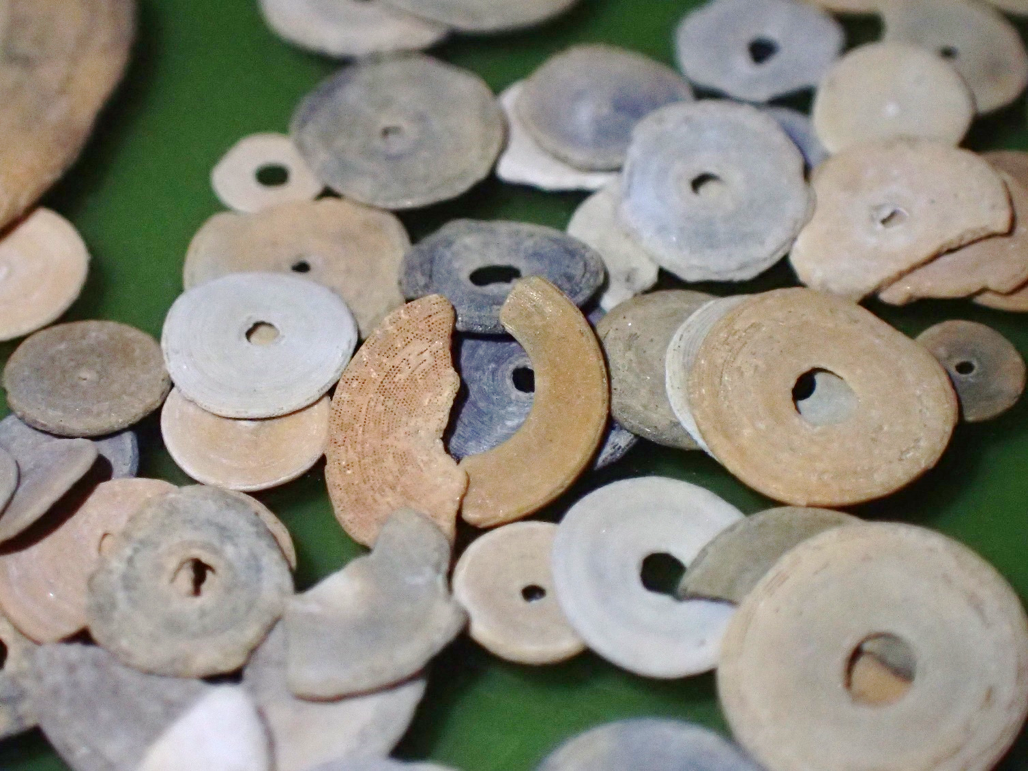
Are you one of those people who loves strolling along the beach, eyes down, scanning the sand for the little natural treasures left behind by the last high tide?
If you’ve wandered along almost any beach in the Whitsundays, you may have noticed a curious find: numerous small, thin discs—only one or two centimetres across—with a neat hole right in the centre.
What are these mysterious beach gems?
Meet the Forams
These tiny discs are the shells of foraminifera—forams, for short. Although they behave much like animals, forams are actually single-celled protozoans: incredibly complex organisms made up of just one cell. To protect themselves, they build an intricate shell, called a test, made from calcium carbonate—the same material that forms corals and familiar sea shells.
Today, there are somewhere between 4,000 and 10,000 species of forams living throughout the world’s oceans. They vary dramatically in size, from microscopic specks to species that reach an astonishing 20 centimetres in length. Some species host symbiotic algae, effectively “farming” them inside their shells. Others feed on dissolved organic matter, bacteria, diatoms, other single-celled algae, and even tiny animals such as copepods.
To catch their meals, forams extend a delicate network of thin, thread-like pseudopodia—think spaghetti strands—through openings in their shell. Bottom-dwelling (benthic) species also use these pseudopodia to move slowly across the seafloor.
Although most forams live in the ocean, a few hardy species inhabit freshwater or even moist soils. Many live on or in the sea floor, while others drift freely in the plankton.
**A Familiar Foram: Marginopora **
One of the most common species found around the Whitsundays is Marginopora. These forams build a thin, perfectly circular disc, thickest at the rim and delicate in the centre. Once the organism dies, its empty shell is tossed about by waves and currents; the thin centre often wears through, creating the distinctive “doughnut” shape beachcombers frequently find.
Living Marginopora are yellowish-green to brownish in colour, thanks to the symbiotic algae living inside their shells. Once washed ashore, their tests fade to white, cream, orange, or even black, depending on staining from iron and manganese oxides in the sand.
Ancient Creatures With a Story to Tell
Forams have existed for at least 500 million years, first appearing in the Cambrian period. Because they are so widespread and abundant, and because their shells preserve well, they have left behind one of the most detailed fossil records of any marine organism. For more than a century, scientists have used fossil forams to study past climates, ocean chemistry, and evolutionary history.
Tiny Creatures, Big Challenges
Like corals, forams—especially species with calcium carbonate shells such as Marginopora—are vulnerable to the modern pressures facing our oceans. Rising sea temperatures, ocean acidification, and changes in water quality can all affect their survival. These tiny architects of the seafloor are sensitive indicators of ocean health, making them important not just as beach treasures but as early warning signals for the wider marine ecosystem.
Contributed with thanks to Whitsunday Conservation Council
Publishers Indemnity. Any individual or entity that places advertising, supplies copy material, or submits editorial content to Core Life Publishing agrees and undertakes to ensure that all such material:- Does not infringe upon any copyright, trademark, or other intellectual property rights;- Is free from any content that could be considered defamatory, libelous, or slanderous;- Does not infringe upon any rights related to privacy or breach of confidence;- Contains no obscene, indecent, or otherwise unlawful material;- Complies fully with the Trade Practices Act and all other applicable laws, regulations, or statutes.Furthermore, by submitting or placing such material, these individuals or entities agree to indemnify and hold harmless the publisher, Core Publishing and Events Pty Ltd, and/or its agents from and against any and all investigations, claims, demands, liabilities, damages, costs, or judgments arising out of or in connection with the material provided. All material is believed to be accurate at the time of printing and remains the copyright of Core Publishing and Events Pty Ltd.
© 2026 Mackay and Whitsunday Life Pty Ltd.