Independently Owned, Locally Grown, Community Loved

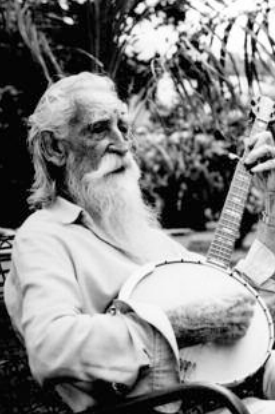
Banjo Jack, back in the 80s. Photo supplied
Now in its 14th year, the Airlie Beach Festival of Music has helped establish the town as a premier live-music destination. Described as “a tropical escape with a killer soundtrack” (“Core Magazine”, Issue 5, 2026), it has become a permanent fixture on the Australian festival calendar.
Long before this festival began, however, Airlie Beach’s reputation for live entertainment was taking shape at the Airlie Beach Hotel.
Local identity, Harry Muller, was among the first to recognise the area’s potential. In 1968, he took a significant step towards developing local tourism by opening the Airlie Beach Hotel. Believing the hotel needed live entertainment, he hired a local band featuring Noel Durnsford, Ross Howard, Richie Leo, Hec Phillipson and Lui Raiteri. The idea was an immediate success and helped launch the live-music tradition that would become an Airlie Beach trademark.
The first established musician employed at Muller’s hotel was Peter Zeigenhahn, a German-born pianist with an eclectic repertoire spanning classical pieces, Glenn Miller tunes, jazz and contemporary pop songs.
Peter performed both solo and with musicians who helped shape the area’s vibrant music culture during the 1960s and 1970s. They included local schoolteacher Keith Hickox, Merv Jones, Ken Locke, Tex Simmons, Tommy Smith and Jack Gilbert Crane, better known as Banjo Jack. They performed at Wanderers, Bob Porter’s Whitsunday Village, the Wildlife Park, island venues and on boats. Skipper Derek “Billy” Williams, known as Captain Seaweed, ferried travelling musicians to mainland jam sessions.
As Airlie Beach grew, so did the music scene – and so too the reputation of one of its earliest musicians, Jack Gilbert Crane. After travelling the world with his drums, guitar and banjo, he settled in the Whitsundays in 1961 and worked as a labourer and musician, and taught music behind Fuller’s music shop in Proserpine. Among his many aspiring students was a young Sharon Waddington who later became the popular Australian country singer, Sharon (Shaza) Leigh. Sharon recalled that, at just ten years old, she regularly performed with Banjo at Whitsunday Village, earning $20 plus free food and drinks each Sunday evening.
A carpenter and all-round tradesman, Banjo helped build the Daydream Island resort and other tourist developments. He often served as “entertainment officer”, using his trusty banjo, Silver Bells, to keep workers amused. In later years, he continued performing at weddings and functions around Airlie Beach and Shute Harbour. His music was an eclectic mix of popular songs from the early 60s together with older jazz compositions as well as country and western.
Banjo led an unusual life. Although he had a modest home, he spent many nights in a tin-lined cave dug into the black volcanic soil of his hillside block at Airlie. For years, he was an easily recognisable figure around town. With his distinctive long white hair and beard, his beloved banjo seemingly always at hand, and an encyclopaedic knowledge of history, archaeology, politics, astrology and life, he was a charismatic presence.
In the final years of his life, he lived quietly at 69 Faust Street, Proserpine, under the name Jack George Gilbert, for reasons unknown. There he was far removed from the pines, ornamental trees, bananas, tomatoes, avocados and oranges he had planted on his terraced hillside overlooking the Whitsunday Islands.
More than a memorable local character, Banjo Jack was among the musicians who helped shape Airlie Beach’s emerging music scene. Together, they left a lasting musical legacy.
Sources: “Core Magazine”; “Tide Lines” by Philip Hayward; “Pioneers of Airlie Beach Volume 2” by Dale Hell; and the “Whitsunday Times”. Photo sourced from “Tide Lines”.
Publishers Indemnity. Any individual or entity that places advertising, supplies copy material, or submits editorial content to Core Life Publishing agrees and undertakes to ensure that all such material:- Does not infringe upon any copyright, trademark, or other intellectual property rights;- Is free from any content that could be considered defamatory, libelous, or slanderous;- Does not infringe upon any rights related to privacy or breach of confidence;- Contains no obscene, indecent, or otherwise unlawful material;- Complies fully with the Trade Practices Act and all other applicable laws, regulations, or statutes.Furthermore, by submitting or placing such material, these individuals or entities agree to indemnify and hold harmless the publisher, Core Publishing and Events Pty Ltd, and/or its agents from and against any and all investigations, claims, demands, liabilities, damages, costs, or judgments arising out of or in connection with the material provided. All material is believed to be accurate at the time of printing and remains the copyright of Core Publishing and Events Pty Ltd.
© 2026 Mackay and Whitsunday Life Pty Ltd.