Independently Owned, Locally Grown, Community Loved

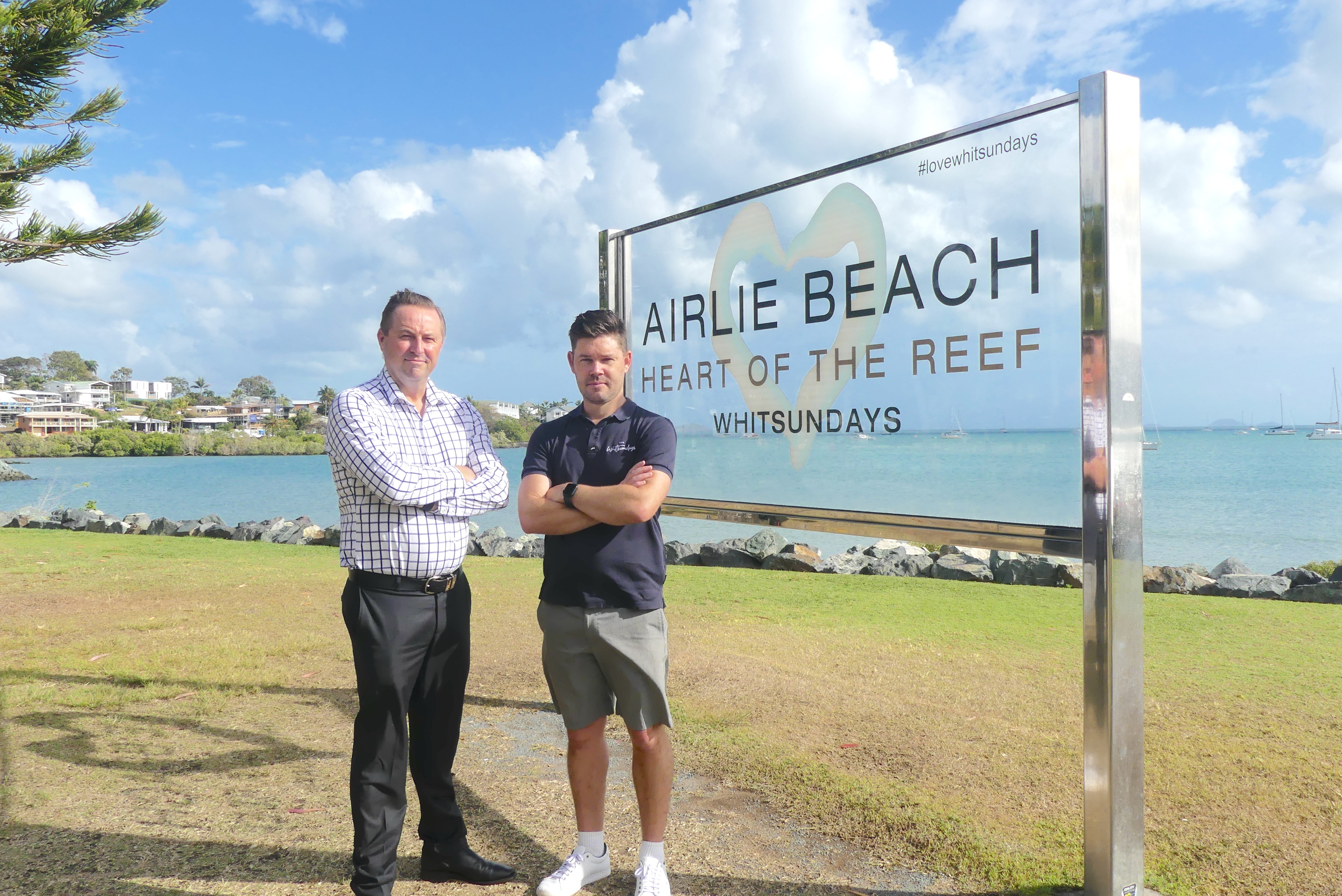
Whitsunday Mayor Ry Collins and CEO of Tourism Whitsundays, Tim Booth. Photo credit: Zach Houtenville
Local tourism operators are expressing concern toward troubling times ahead, with the federal government’s new visa restrictions set to shrink the backpacker workforce that drives seasonal operations.
The Federal Government’s proposed cuts to Working Holiday Visas have raised concerns across two of the Whitsundays’ biggest industries. Bowen farmers warned that fewer backpackers could leave crops unpicked, and now tourism leaders in Airlie Beach have added that the same cuts could leave local businesses scrambling to find workers that aren’t there.
At Airlie Beach’s Heart of the Great Barrier Reef sign, Tourism Whitsundays CEO Tim Booth and Whitsunday Mayor Ry Collins spoke about what the proposed changes could mean for a region that relies heavily on tourism.
“We can't have Airlie Beach named Australia's top tourism town in the small category and then have the knees cut out from us by federal policy,” Tim said.
The proposed changes form part of the Federal Government’s effort to reduce migration, a topic that has been of hot debate by all three parties that Mayor Ry Collins believes the working holiday visas should be separated from.
“Obviously the federal government is really coming in with broad brushstrokes to try and address the publicly perceived issue around net overseas migration (NOM),” said Mayor Collins.
“Some of the dialogue I heard last week in Canberra was actually taking that working holiday maker class completely out of the NOM calculation.
“I think that's a fair and reasonable way that they can make the numbers look as good as they want but it won't affect the actual number of workers that are here to support our industries.”
The new restrictions look to cut the second-year extension on Working Holiday Visas from 57,000 to 45,000 slots, and 3rd year extension from 31,000 to just 5,000. According to Tourism Whitsundays, the Whitsundays hosts about 3,500 backpacker workers at any given time of the year.
“I think for regions like the Whitsunday’s unemployment rate is lower than the national average by 0.9%, so at a 3.5% unemployment rate, we just don't have the workforce there that can pick up these roles that the working holidaymaker delivers for our communities,” Tim said.
According to figures released by Tourism Whitsundays, in the year ending March 2026, domestic visitors spent $959.1 million in the region and international visitors spent a further $271.8 million. This spending was made possible by the abundance ofworkers delivering those experiences.
“[Working holidaymakers] do a terrific job already in delivering world-class experiences, particularly here in the Whitsundays,” said Mayor Collins.
“We do see working holidaymakers really take up that mantle, particularly in areas like customer service roles, hospitality roles, housekeeping roles...
“What we're asking for is that we can stay strong as an entire tourism industry.”
Having just returned from Canberra, the pair said raising regional and statewide voices is crucial to persuading the Federal Government to reconsider how the proposed restrictions would apply.
“And then at a federal level, obviously through our federal member Andrew Wilcox, but we've also engaged with the members of the Labor Party around that as well.
“But unfortunately it's starting to feel like a number of issues that we're campaigning on…along with things like disaster recovery funding arrangements which was one we linked into last week.”
Publishers Indemnity. Any individual or entity that places advertising, supplies copy material, or submits editorial content to Core Life Publishing agrees and undertakes to ensure that all such material:- Does not infringe upon any copyright, trademark, or other intellectual property rights;- Is free from any content that could be considered defamatory, libelous, or slanderous;- Does not infringe upon any rights related to privacy or breach of confidence;- Contains no obscene, indecent, or otherwise unlawful material;- Complies fully with the Trade Practices Act and all other applicable laws, regulations, or statutes.Furthermore, by submitting or placing such material, these individuals or entities agree to indemnify and hold harmless the publisher, Core Publishing and Events Pty Ltd, and/or its agents from and against any and all investigations, claims, demands, liabilities, damages, costs, or judgments arising out of or in connection with the material provided. All material is believed to be accurate at the time of printing and remains the copyright of Core Publishing and Events Pty Ltd.
© 2026 Mackay and Whitsunday Life Pty Ltd.